Thank you for visiting SNEWPapers!
Sign up free
Story
January 27, 1881
The Bossier Banner
Benton, Bellevue, Bossier County, Louisiana
What is this article about?
Dr. C.W. Siemens advocates economical fuel use in homes and offices, describing a patent-free grate design that heats rooms cleanly using gas jets, copper conduction, and coke or anthracite, criticizing raw coal as barbarous.
Clipping
OCR Quality
98%
Excellent
Full Text
Economy in Fuel.
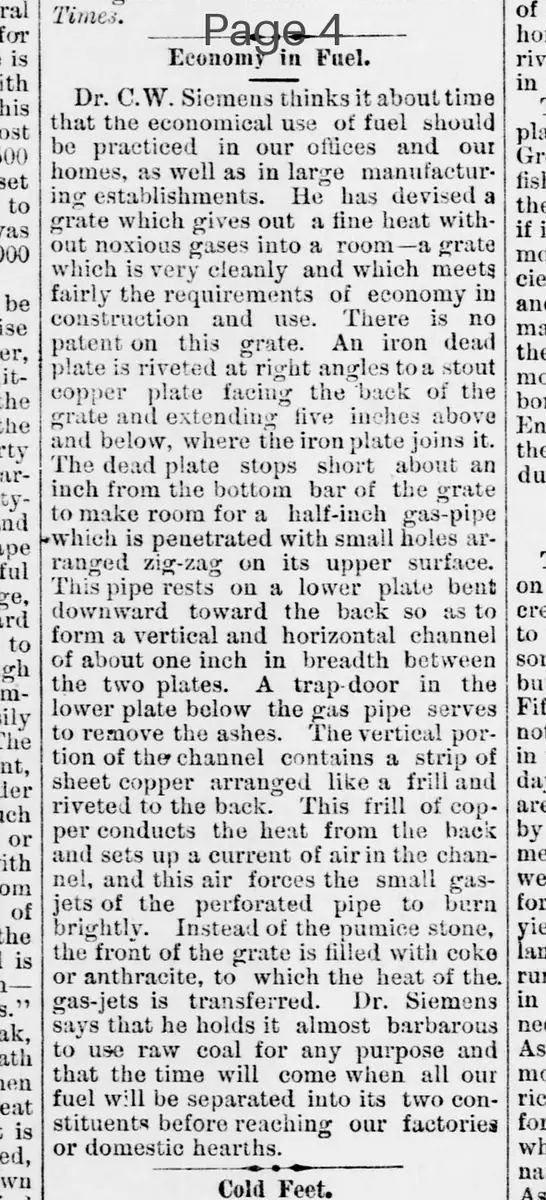
Dr. C.W. Siemens thinks it about time that the economical use of fuel should be practiced in our offices and our homes, as well as in large manufacturing establishments. He has devised a grate which gives out a fine heat without noxious gases into a room—a grate which is very cleanly and which meets fairly the requirements of economy in construction and use. There is no patent on this grate. An iron dead plate is riveted at right angles to a stout copper plate facing the back of the grate and extending five inches above and below, where the iron plate joins it. The dead plate stops short about an inch from the bottom bar of the grate to make room for a half-inch gas-pipe which is penetrated with small holes arranged zig-zag on its upper surface. This pipe rests on a lower plate bent downward toward the back so as to form a vertical and horizontal channel of about one inch in breadth between the two plates. A trap-door in the lower plate below the gas pipe serves to remove the ashes. The vertical portion of the channel contains a strip of sheet copper arranged like a frill and riveted to the back. This frill of copper conducts the heat from the back and sets up a current of air in the channel, and this air forces the small gas-jets of the perforated pipe to burn brightly. Instead of the pumice stone, the front of the grate is filled with coke or anthracite, to which the heat of the gas-jets is transferred. Dr. Siemens says that he holds it almost barbarous to use raw coal for any purpose and that the time will come when all our fuel will be separated into its two constituents before reaching our factories or domestic hearths.
Dr. C.W. Siemens thinks it about time that the economical use of fuel should be practiced in our offices and our homes, as well as in large manufacturing establishments. He has devised a grate which gives out a fine heat without noxious gases into a room—a grate which is very cleanly and which meets fairly the requirements of economy in construction and use. There is no patent on this grate. An iron dead plate is riveted at right angles to a stout copper plate facing the back of the grate and extending five inches above and below, where the iron plate joins it. The dead plate stops short about an inch from the bottom bar of the grate to make room for a half-inch gas-pipe which is penetrated with small holes arranged zig-zag on its upper surface. This pipe rests on a lower plate bent downward toward the back so as to form a vertical and horizontal channel of about one inch in breadth between the two plates. A trap-door in the lower plate below the gas pipe serves to remove the ashes. The vertical portion of the channel contains a strip of sheet copper arranged like a frill and riveted to the back. This frill of copper conducts the heat from the back and sets up a current of air in the channel, and this air forces the small gas-jets of the perforated pipe to burn brightly. Instead of the pumice stone, the front of the grate is filled with coke or anthracite, to which the heat of the gas-jets is transferred. Dr. Siemens says that he holds it almost barbarous to use raw coal for any purpose and that the time will come when all our fuel will be separated into its two constituents before reaching our factories or domestic hearths.
What sub-type of article is it?
Curiosity
What themes does it cover?
Triumph
What keywords are associated?
Fuel Economy
Grate Invention
Gas Heating
Copper Conduction
Raw Coal Criticism
What entities or persons were involved?
Dr. C.W. Siemens
Story Details
Key Persons
Dr. C.W. Siemens
Story Details
Dr. Siemens devises a grate for economical, clean heating using gas jets, copper frill for air current, and coke/anthracite, advocating separation of fuel constituents over raw coal.