Thank you for visiting SNEWPapers!
Sign up free
Story
May 6, 1840
Morning Herald
New York, New York County, New York
What is this article about?
Satirical 1839 New York article mocks editor M.M. Noah's publication of the 'Book of Jasher' as a fraudulent ancient text to launch a new Jewish religion, akin to Mormonism, including biblical excerpts and endorsements by professors.
Clipping
OCR Quality
95%
Excellent
Full Text
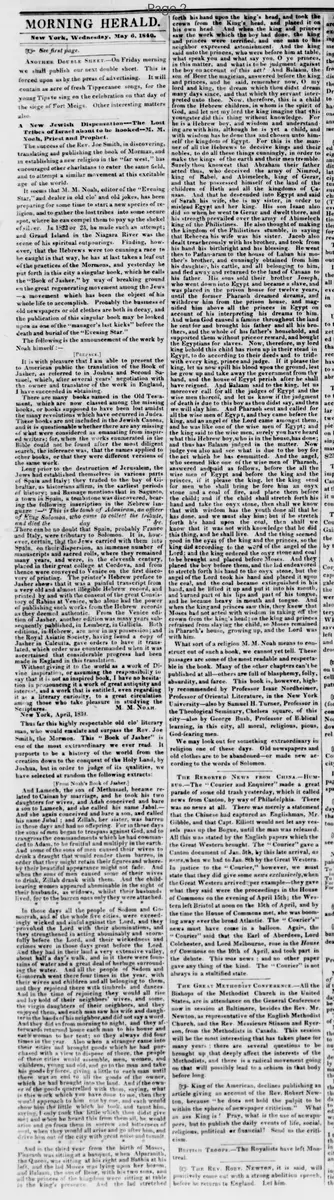
A New Jewish Dispensation—The Lost Tribes of Israel about to be hooked—M. M. Noah, Priest and Prophet.
The success of the Rev. Joe Smith, in discovering, translating and publishing the book of Mormon, and in establishing a new religion in the "far west," has encouraged other charlatans to enter the same field, and to attempt a similar movement at this excitable age of the world.
It seems that M. M. Noah, editor of the "Evening Star," and dealer in old clo' and old jokes, has been preparing for some time to start a new species of religion, and to gather the lost tribes into some secure spot, where he can compel them to pay up the shekel of silver. In 1822 or 23, he made such an attempt; and Grand Island in the Niagara River was the scene of his spiritual outpourings. Finding, however, that the Hebrews were too cunning a race to be caught in that way, he has at last taken a leaf out of the practices of the Mormons, and yesterday he put forth in this city a singular book, which he calls the "Book of Jasher," by way of breaking ground on the great regenerating movement among the Jews—a movement which has been the object of his whole life to accomplish. Probably the business of old newspapers or old clothes are both in decay, and the publication of this singular book may be looked upon as one of the "manager's last kicks" before the death and burial of the "Evening Star."
The following is the announcement of the work by Noah himself:-
[PREFACE.]
It is with pleasure that I am able to present to American public the translation of the Book of Jasher, as referred to in Joshua and Second Samuel, which, after several years' negotiation with the owner and translator of the work in England, I have succeeded in obtaining.
There are many books named in the Old Testament, which are now classed among the missing books, or books supposed to have been lost amidst the many revolutions which have occurred in Judea. These books are not included in the Jewish Canons, and it is questionable whether there are any missing of what were considered as emanating from inspired writers; for, when the works enumerated in the Bible could not be found after the most diligent search, the inference was, that the names applied to other books, or that they were different versions of the same work.
Long prior to the destruction of Jerusalem, the Jews had established themselves in various parts of Spain and Italy: they traded to the bay of Gibraltar, as historians affirm, in the earliest periods of history: and Basnage mentions that in Sagunto, a town in Spain, a tombstone was discovered, bearing the following inscription in the Hebrew language :—" This is the tomb of Adoniram, an officer of King Solomon, who came to collect the tribute, and died the day &c."
There can be no doubt that Spain, probably France and Italy, were tributary to Solomon. It is, however, certain, that the Jews carried with them into Spain, on their dispersion, an immense number of manuscripts and sacred rolls, where they remained many years, and were, in the eleventh century, placed in their great college at Cordova, and from thence were conveyed to Venice on the first discovery of printing. The printer's Hebrew preface to Jasher shows that it was a painful transcript from a very old and almost illegible Hebrew record, and printed by and with the consent of the great Consistory of Rabbins at Venice, who alone had the power of publishing such works from the Hebrew records as they deemed authentic. From the Venice edition of Jasher, another edition was many years subsequently published, in Lemberg, in Gallicia. Both editions, in Hebrew, are now in my possession; and the Royal Asiatic Society, having found a copy of Jasher in Calcutta, gave orders to have it translated, which order was countermanded when it was ascertained that considerable progress had been made in England in this translation.
Without giving it to the world as a work of Divine inspiration, or assuming the responsibility to say that it is not an inspired book, I have no hesitation in pronouncing it a work of great antiquity and interest, and a work that is entitled, even regarding it as a literary curiosity, to a great circulation among those who take pleasure in studying the Scriptures.
M. M. NOAH.
New York, April, 1839.
Thus far this highly respectable old clo' literary man, who would emulate and surpass the Rev. Joe Smith, the Mormon. This "Book of Jasher" is one of the most extraordinary we ever read. It purports to be a history of the world from the creation down to the conquest of the Holy Land, by Joshua, but in order to judge of its qualities, we have selected at random the following extracts:
[From Noah's Book of Jasher.]
And Lamech, the son of Methusael, became related to Cainan by marriage, and he took his two daughters for wives, and Adah conceived and bare a son to Lamech, and she called his name Jabal.—And she again conceived and bare a son, and called his name Jubal ; and Zillah, her sister, was barren in those days and had no offspring. For in those days the sons of men began to trespass against God, and to transgress the commandments which he had commanded to Adam, to be fruitful and multiply in the earth. And some of the sons of men caused their wives to drink a draught that would render them barren, in order that they might retain their figures and whereby their beautiful appearance might not fade. And when the sons of men caused some of their wives to drink, Zillah drank with them. And the child-bearing women appeared abominable in the sight of their husbands, as widows, whilst their husbands lived, for to the barren ones only they were attached.
In those days all the people of Sodom and Gomorrah, and of the whole five cities, were exceedingly wicked and sinful against the Lord, and they provoked the Lord with their abominations, and they strengthened in acting abominably and scornfully before the Lord, and their wickedness and crimes were in those days great before the Lord. And they had in their land a very extensive valley, about half a day's walk, and in it there were fountains of water and a great deal of herbage surrounding the water. And all the people of Sodom and Gomorrah went there four times in the year, with their wives and children and all belonging to them, and they rejoiced there with timbrels and dances. And in the time of rejoicing they would all rise and lay hold of their neighbors' wives, and some, the virgin daughters of their neighbors, and they enjoyed them, and each man saw his wife and daughter in the hands of his neighbor, and did not say a word. And they did so from morning to night, and they afterwards returned home each man to his house and each woman to her tent; so they always did four times in the year.
Also when a stranger came into their cities and brought goods which he had purchased with a view to dispose of there, the people of these cities would assemble, men, women, and children, young and old, and go to the man and take his goods by force, giving a little to each man until there was an end to all the goods of the owner, which he had brought into the land. And if the owner of the goods quarrelled with them, saying, what is this work which you have done to me, then they would approach to him one by one, and each would show him the little which he took, and taunt him, saying, I only took that little which thou didst give me: and when he heard this from them all, he would arise and go from them in sorrow and bitterness of soul, when they would all arise and go after him, and drive him out of the city with great noise and tumult.
And on the third year from the birth of Moses, Pharaoh was sitting at a banquet, when Asenath the Queen, was sitting at his right and Bathia at his left, and the lad Moses was lying upon her bosom, and Balaam, the son of Beor, with his two sons, and all the princes of the kingdom were sitting at table in the king's presence. And the lad stretched forth his hand upon the king's head, and took the crown from the King's head, and placed it on his own head. And when the king and princes saw the work which the boy had done, the king and princes were terrified, and one man to his neighbor expressed astonishment. And the king said unto the princes, who were before him at table, what speak you and what say you, O ye princes, in this matter, and what is to be judgment against the boy on account of this act? And Balaam, the son of Beor the magician, answered before the king and princes, and he said, remember now, O my lord and king, the dream which thou didst dream many days since, and that which thy servant interpreted unto thee. Now, therefore, this is a child from the Hebrew children, in whom is the spirit of God, and let not my lord the king imagine that this youngster did this thing without knowledge. For he is a Hebrew boy, and wisdom and understanding are with him, although he is yet a child, and with wisdom has he done this and chosen unto himself the kingdom of Egypt. For this is the manner of all the Hebrews to deceive kings and their nobles, to do all these things cunningly, in order to make the kings of the earth and their men tremble. Surely thou knowest that Abraham their father acted thus, who deceived the army of Nimrod, king of Babel, and Abimelech, king of Gerar, and that he possessed himself of the land of the children of Heth and all the kingdoms of Canaan. And that he descended into Egypt and said of Sarah his wife, she is my sister, in order to mislead Egypt and her king. His son Isaac also did so when he went to Gerar and dwelt there, and his strength prevailed over the army of Abimelech king of the Philistines. He also thought of making the kingdom of the Philistines stumble, in saying that Rebecca his wife was his sister. Jacob also dealt treacherously with his brother, and took from his hand his birthright and his blessing. He went then to Padan-aram to the house of Laban his mother's brother, and cunningly obtained from him his daughter, his cattle, and all belonging to him, and fled away and returned to the land of Canaan to his father. His sons sold their brother Joseph, who went down into Egypt and became a slave, and was placed in the prison house for twelve years, until the former Pharaoh dreamed dreams, and withdrew him from the prison house, and magnified him above all the princes in Egypt on account of his interpreting his dreams to him. And when God caused a famine throughout the land he sent for and brought his father and all his brothers, and the whole of his father's household, and supported them without price or reward, and bought the Egyptians for slaves. Now, therefore, my lord king behold this child has risen up in their stead in Egypt, to do according to their deeds and to trifle with every king, prince and judge. If it please the king, let us now spill his blood upon the ground, lest he grow up and take away the government from thy hand, and the house of Egypt perish after he shall have reigned. And Balaam said to the king, let us moreover call for all the judges of Egypt and the wise men thereof, and let us know if the judgment of death is due to this boy as thou didst say, and then we will slay him. And Pharaoh sent and called for all the wise men of Egypt, and they came before the king, and an angel of the Lord came amongst them, and he was like one of the wise men of Egypt; and the king said to the wise men, surely you have heard what this Hebrew boy, who is in the house, has done; and thus has Balaam judged in the matter. Now judge you also and see what is due to the boy for the act which he has committed. And the angel, who seemed like one of the wise men of Pharaoh, answered and said as follows, before all the wise men of Egypt and before the king and the princes, if it please the king, let the king send for men who shall bring before him an onyx stone and a coal of fire, and place them before the child; and if the child shall stretch forth his hand and take the onyx stone, then shall we know that with wisdom has the youth done all that he has done, and we must slay him; but if he stretch forth his hand upon the coal, then shall we know that it was not with knowledge that he did this thing, and he shall live. And the thing seemed good in the eyes of the king and the princes, so the king did according to the word of the angel of the Lord; and the king ordered the onyx stone and coal to be brought and placed before Moses. And they placed the boy before them, and the lad endeavored to stretch forth his hand to the onyx stone, but the angel of the Lord took his hand and placed it upon the coal, and the coal became extinguished in his hand, and he lifted it up and put it into his mouth, and burned part of his lips and part of his tongue, and he became heavy in mouth and tongue. And when the king and princes saw this, they knew that Moses had not acted with wisdom in taking off the crown from the king's head; so the king and princes refrained from slaying the child, so Moses remained in Pharaoh's house, growing up, and the Lord was with him.
What sort of a religion M. M. Noah means to construct out of such a book, we cannot yet tell. These passages are some of the most readable and respectable in the book. Many of the other chapters can't be published at all—others are full of blasphemy, folly, absurdity, and farce. This book is, however, highly recommended by Professor Isaac Nordheimer, Professor of Oriental Literature, in the New York University—also by Samuel H. Turner, Professor in the Theological Seminary, Chelsea square, of this city—also by George Bush, Professor of Biblical learning, in this city, all moral, religious, pious, God-fearing men.
We may look out for something extraordinary in religion one of these days. Old newspapers and old clothes are to be abandoned—or made new according to the words of Solomon.
The success of the Rev. Joe Smith, in discovering, translating and publishing the book of Mormon, and in establishing a new religion in the "far west," has encouraged other charlatans to enter the same field, and to attempt a similar movement at this excitable age of the world.
It seems that M. M. Noah, editor of the "Evening Star," and dealer in old clo' and old jokes, has been preparing for some time to start a new species of religion, and to gather the lost tribes into some secure spot, where he can compel them to pay up the shekel of silver. In 1822 or 23, he made such an attempt; and Grand Island in the Niagara River was the scene of his spiritual outpourings. Finding, however, that the Hebrews were too cunning a race to be caught in that way, he has at last taken a leaf out of the practices of the Mormons, and yesterday he put forth in this city a singular book, which he calls the "Book of Jasher," by way of breaking ground on the great regenerating movement among the Jews—a movement which has been the object of his whole life to accomplish. Probably the business of old newspapers or old clothes are both in decay, and the publication of this singular book may be looked upon as one of the "manager's last kicks" before the death and burial of the "Evening Star."
The following is the announcement of the work by Noah himself:-
[PREFACE.]
It is with pleasure that I am able to present to American public the translation of the Book of Jasher, as referred to in Joshua and Second Samuel, which, after several years' negotiation with the owner and translator of the work in England, I have succeeded in obtaining.
There are many books named in the Old Testament, which are now classed among the missing books, or books supposed to have been lost amidst the many revolutions which have occurred in Judea. These books are not included in the Jewish Canons, and it is questionable whether there are any missing of what were considered as emanating from inspired writers; for, when the works enumerated in the Bible could not be found after the most diligent search, the inference was, that the names applied to other books, or that they were different versions of the same work.
Long prior to the destruction of Jerusalem, the Jews had established themselves in various parts of Spain and Italy: they traded to the bay of Gibraltar, as historians affirm, in the earliest periods of history: and Basnage mentions that in Sagunto, a town in Spain, a tombstone was discovered, bearing the following inscription in the Hebrew language :—" This is the tomb of Adoniram, an officer of King Solomon, who came to collect the tribute, and died the day &c."
There can be no doubt that Spain, probably France and Italy, were tributary to Solomon. It is, however, certain, that the Jews carried with them into Spain, on their dispersion, an immense number of manuscripts and sacred rolls, where they remained many years, and were, in the eleventh century, placed in their great college at Cordova, and from thence were conveyed to Venice on the first discovery of printing. The printer's Hebrew preface to Jasher shows that it was a painful transcript from a very old and almost illegible Hebrew record, and printed by and with the consent of the great Consistory of Rabbins at Venice, who alone had the power of publishing such works from the Hebrew records as they deemed authentic. From the Venice edition of Jasher, another edition was many years subsequently published, in Lemberg, in Gallicia. Both editions, in Hebrew, are now in my possession; and the Royal Asiatic Society, having found a copy of Jasher in Calcutta, gave orders to have it translated, which order was countermanded when it was ascertained that considerable progress had been made in England in this translation.
Without giving it to the world as a work of Divine inspiration, or assuming the responsibility to say that it is not an inspired book, I have no hesitation in pronouncing it a work of great antiquity and interest, and a work that is entitled, even regarding it as a literary curiosity, to a great circulation among those who take pleasure in studying the Scriptures.
M. M. NOAH.
New York, April, 1839.
Thus far this highly respectable old clo' literary man, who would emulate and surpass the Rev. Joe Smith, the Mormon. This "Book of Jasher" is one of the most extraordinary we ever read. It purports to be a history of the world from the creation down to the conquest of the Holy Land, by Joshua, but in order to judge of its qualities, we have selected at random the following extracts:
[From Noah's Book of Jasher.]
And Lamech, the son of Methusael, became related to Cainan by marriage, and he took his two daughters for wives, and Adah conceived and bare a son to Lamech, and she called his name Jabal.—And she again conceived and bare a son, and called his name Jubal ; and Zillah, her sister, was barren in those days and had no offspring. For in those days the sons of men began to trespass against God, and to transgress the commandments which he had commanded to Adam, to be fruitful and multiply in the earth. And some of the sons of men caused their wives to drink a draught that would render them barren, in order that they might retain their figures and whereby their beautiful appearance might not fade. And when the sons of men caused some of their wives to drink, Zillah drank with them. And the child-bearing women appeared abominable in the sight of their husbands, as widows, whilst their husbands lived, for to the barren ones only they were attached.
In those days all the people of Sodom and Gomorrah, and of the whole five cities, were exceedingly wicked and sinful against the Lord, and they provoked the Lord with their abominations, and they strengthened in acting abominably and scornfully before the Lord, and their wickedness and crimes were in those days great before the Lord. And they had in their land a very extensive valley, about half a day's walk, and in it there were fountains of water and a great deal of herbage surrounding the water. And all the people of Sodom and Gomorrah went there four times in the year, with their wives and children and all belonging to them, and they rejoiced there with timbrels and dances. And in the time of rejoicing they would all rise and lay hold of their neighbors' wives, and some, the virgin daughters of their neighbors, and they enjoyed them, and each man saw his wife and daughter in the hands of his neighbor, and did not say a word. And they did so from morning to night, and they afterwards returned home each man to his house and each woman to her tent; so they always did four times in the year.
Also when a stranger came into their cities and brought goods which he had purchased with a view to dispose of there, the people of these cities would assemble, men, women, and children, young and old, and go to the man and take his goods by force, giving a little to each man until there was an end to all the goods of the owner, which he had brought into the land. And if the owner of the goods quarrelled with them, saying, what is this work which you have done to me, then they would approach to him one by one, and each would show him the little which he took, and taunt him, saying, I only took that little which thou didst give me: and when he heard this from them all, he would arise and go from them in sorrow and bitterness of soul, when they would all arise and go after him, and drive him out of the city with great noise and tumult.
And on the third year from the birth of Moses, Pharaoh was sitting at a banquet, when Asenath the Queen, was sitting at his right and Bathia at his left, and the lad Moses was lying upon her bosom, and Balaam, the son of Beor, with his two sons, and all the princes of the kingdom were sitting at table in the king's presence. And the lad stretched forth his hand upon the king's head, and took the crown from the King's head, and placed it on his own head. And when the king and princes saw the work which the boy had done, the king and princes were terrified, and one man to his neighbor expressed astonishment. And the king said unto the princes, who were before him at table, what speak you and what say you, O ye princes, in this matter, and what is to be judgment against the boy on account of this act? And Balaam, the son of Beor the magician, answered before the king and princes, and he said, remember now, O my lord and king, the dream which thou didst dream many days since, and that which thy servant interpreted unto thee. Now, therefore, this is a child from the Hebrew children, in whom is the spirit of God, and let not my lord the king imagine that this youngster did this thing without knowledge. For he is a Hebrew boy, and wisdom and understanding are with him, although he is yet a child, and with wisdom has he done this and chosen unto himself the kingdom of Egypt. For this is the manner of all the Hebrews to deceive kings and their nobles, to do all these things cunningly, in order to make the kings of the earth and their men tremble. Surely thou knowest that Abraham their father acted thus, who deceived the army of Nimrod, king of Babel, and Abimelech, king of Gerar, and that he possessed himself of the land of the children of Heth and all the kingdoms of Canaan. And that he descended into Egypt and said of Sarah his wife, she is my sister, in order to mislead Egypt and her king. His son Isaac also did so when he went to Gerar and dwelt there, and his strength prevailed over the army of Abimelech king of the Philistines. He also thought of making the kingdom of the Philistines stumble, in saying that Rebecca his wife was his sister. Jacob also dealt treacherously with his brother, and took from his hand his birthright and his blessing. He went then to Padan-aram to the house of Laban his mother's brother, and cunningly obtained from him his daughter, his cattle, and all belonging to him, and fled away and returned to the land of Canaan to his father. His sons sold their brother Joseph, who went down into Egypt and became a slave, and was placed in the prison house for twelve years, until the former Pharaoh dreamed dreams, and withdrew him from the prison house, and magnified him above all the princes in Egypt on account of his interpreting his dreams to him. And when God caused a famine throughout the land he sent for and brought his father and all his brothers, and the whole of his father's household, and supported them without price or reward, and bought the Egyptians for slaves. Now, therefore, my lord king behold this child has risen up in their stead in Egypt, to do according to their deeds and to trifle with every king, prince and judge. If it please the king, let us now spill his blood upon the ground, lest he grow up and take away the government from thy hand, and the house of Egypt perish after he shall have reigned. And Balaam said to the king, let us moreover call for all the judges of Egypt and the wise men thereof, and let us know if the judgment of death is due to this boy as thou didst say, and then we will slay him. And Pharaoh sent and called for all the wise men of Egypt, and they came before the king, and an angel of the Lord came amongst them, and he was like one of the wise men of Egypt; and the king said to the wise men, surely you have heard what this Hebrew boy, who is in the house, has done; and thus has Balaam judged in the matter. Now judge you also and see what is due to the boy for the act which he has committed. And the angel, who seemed like one of the wise men of Pharaoh, answered and said as follows, before all the wise men of Egypt and before the king and the princes, if it please the king, let the king send for men who shall bring before him an onyx stone and a coal of fire, and place them before the child; and if the child shall stretch forth his hand and take the onyx stone, then shall we know that with wisdom has the youth done all that he has done, and we must slay him; but if he stretch forth his hand upon the coal, then shall we know that it was not with knowledge that he did this thing, and he shall live. And the thing seemed good in the eyes of the king and the princes, so the king did according to the word of the angel of the Lord; and the king ordered the onyx stone and coal to be brought and placed before Moses. And they placed the boy before them, and the lad endeavored to stretch forth his hand to the onyx stone, but the angel of the Lord took his hand and placed it upon the coal, and the coal became extinguished in his hand, and he lifted it up and put it into his mouth, and burned part of his lips and part of his tongue, and he became heavy in mouth and tongue. And when the king and princes saw this, they knew that Moses had not acted with wisdom in taking off the crown from the king's head; so the king and princes refrained from slaying the child, so Moses remained in Pharaoh's house, growing up, and the Lord was with him.
What sort of a religion M. M. Noah means to construct out of such a book, we cannot yet tell. These passages are some of the most readable and respectable in the book. Many of the other chapters can't be published at all—others are full of blasphemy, folly, absurdity, and farce. This book is, however, highly recommended by Professor Isaac Nordheimer, Professor of Oriental Literature, in the New York University—also by Samuel H. Turner, Professor in the Theological Seminary, Chelsea square, of this city—also by George Bush, Professor of Biblical learning, in this city, all moral, religious, pious, God-fearing men.
We may look out for something extraordinary in religion one of these days. Old newspapers and old clothes are to be abandoned—or made new according to the words of Solomon.
What sub-type of article is it?
Deception Fraud
Curiosity
Extraordinary Event
What themes does it cover?
Deception
What keywords are associated?
M.M. Noah
Book Of Jasher
Lost Tribes
Jewish Dispensation
Mormon Comparison
Ancient Manuscript
Charlatan Religion
What entities or persons were involved?
M. M. Noah
Rev. Joe Smith
Where did it happen?
New York
Story Details
Key Persons
M. M. Noah
Rev. Joe Smith
Location
New York
Event Date
April 1839
Story Details
M. M. Noah publishes the Book of Jasher, presented as an ancient Hebrew text, to initiate a new Jewish dispensation and gather the lost tribes of Israel, satirized as a charlatan's scheme similar to the Mormons, with excerpts detailing biblical-era events.