Thank you for visiting SNEWPapers!
Sign up free
The New Orleans Daily Democrat
New Orleans, Orleans County, Louisiana
What is this article about?
Newspaper article interviews Mrs. Gaines on her property claims in New Orleans from Daniel Clark's estate, her intent to compromise with innocent buyers and seek reimbursement from the city for the Blanc tract purchased in 1834. Defendants, via counsel J. McConnell, plan rehearing arguing good faith possession and prior renunciation, favoring amicable settlement to avoid prolonged litigation.
Clipping
OCR Quality
Full Text
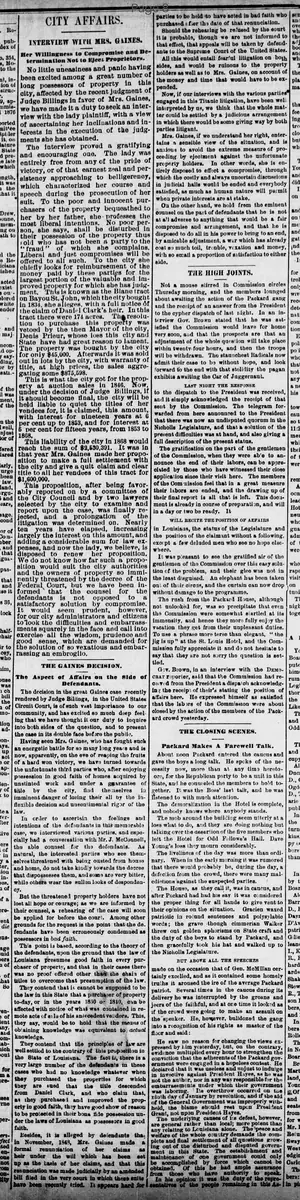
INTERVIEW WITH MRS. GAINES.
Her Willingness to Compromise and Determination Not to Eject Proprietors.
No little uneasiness and panic having been excited among a great number of long possessors of property in this city, affected by the recent judgment of Judge Billings in favor of Mrs. Gaines, we have made it a duty to seek an interview with the lady plaintiff, with a view of ascertaining her inclinations and interests in the execution of the judgments she has obtained.
The interview proved a gratifying and encouraging one. The lady was entirely free from any of the pride of victory, or of that earnest zeal and persistency approaching to belligerency, which characterized her course and speech during the prosecution of her suit. To the poor and innocent purchasers of the property bequeathed to her by her father, she professes the most liberal intentions. No poor person, she says, shall be disturbed in their possession of the property thus sold who has not been a party to the "fraud" of which she complains.
Liberal and just compromises will be offered to all such. To the city she chiefly looks for reimbursement of the money paid by these parties for the largest portion of the valuable and improved property for which she has judgment. This is known as the Blanc tract on Bayou St. John, which the city bought in 1834, she alleges, with a full notice of the claim of Daniel Clark's heir. In this tract there were 174 acres. The resolution to purchase this property was vetoed by the then Mayor of the city, Denis Prieur, whose loss this city and State have had great reason to lament.
The property was bought by the city for only $45,000. Afterwards it was sold out in lots by the city, with warranty of title, at high prices, the sales aggregating some $875,598.
This is what the city got for the property at auction sales in 1846. Now, under the decision of Judge Billings, if it should become final, the city will be held liable to quiet the titles of her vendees for, it is claimed, this amount, with interest for nineteen years at 6 per cent up to 1853, and for 8 per cent for fifteen years, from 1853 to 1868.
This liability of the city in 1868 would reach the sum of $2,530,391. It was in that year Mrs. Gaines made her proposition to make a full settlement with the city and give a quit claim and clear title to all her vendees of this tract for $1,600,000.
This proposition, after being favorably reported on by a committee of the City Council and by two lawyers selected by the city to examine and report upon the case, was finally rejected, and a prolongation of the litigation was determined on. Nearly ten years have elapsed, increasing largely the interest on this amount, and adding a considerable sum for law expenses, and now the lady, we believe, is disposed to renew her proposition.
We do not know how far such a proposition would suit the city authorities and the owners of property so imminently threatened by the decree of the Federal Court, but we have been informed that the counsel for the defendants is not opposed to a satisfactory solution by compromise.
It would seem prudent, however, for our city administrators and citizens to look the difficulties and embarrassments squarely in the face and call into exercise all the wisdom, prudence and good sense, which are demanded for the solution of so vexatious and embarrassing an embroglio.
THE GAINES DECISION.
The Aspect of Affairs on the Side of Defendants.
The decision in the great Gaines case recently rendered by Judge Billings, in the United States Circuit Court, is of such vast importance to our community, and has excited so much deep feeling that we have thought it our duty to inquire into both sides of the question, and to present the case in its double face before the public.
Having seen Mrs. Gaines, who has fought such an energetic battle for so many long years and is now, apparently, on the eve of reaping the fruits of a hard won victory, we have turned towards the unfortunate third parties who, after enjoying possession in good faith of homes acquired by unstinted work and under a guarantee of title by the city, find themselves in imminent danger of losing their all by the inflexible decision and unsentimental rigor of the law.
In order to ascertain the feelings and intentions of the defendants in this memorable case, we interviewed various parties, and especially had a conversation with Mr. J. McConnell, the able counsel for the defendants. As natural, the interested parties who see themselves threatened with being ousted from house and home, do not take kindly towards the decree that dispossesses them, and some are very bitter, while others wear the sullen looks of despondency.
But the threatened property holders have not lost all hope or courage; as we are informed by their counsel, a rehearing of the case will soon be applied for before the court. Among other grounds for the request is the point that the defendants have been erroneously condemned as possessors in bad faith.
This point is based, according to the theory of the defendants, upon the ground that the law of Louisiana presumes good faith in every purchaser of property, and that in their cases there was no proof offered other than the chain of titles to overcome that presumption of the law.
They contend that it cannot be supposed to be the law in this State that a purchaser of property to-day, or in the years 1850 or 1860, can be affected with notice of what was contained in remote acts of sale of his antecedent vendors. This, they say, would be to hold that the means of obtaining knowledge was equivalent to actual knowledge.
They contend that these principles of law are well settled to the contrary of this proposition in the State of Louisiana. The fact is, there is a very large number of the defendants in these cases who had no knowledge whatever when they purchased the properties for which they are sued that the title descended from Daniel Clark, and who claim that, as they purchased and improved the property in good faith, they have good show of reason to be protected in their bona fide possession under the laws of Louisiana as possessors in good faith.
Besides, it is alleged by defendants that in November, 1848, Mrs. Gaines made a formal renunciation of her claims as heir under the will which has been set up as the basis of her claims, and that this renunciation was made judicially by an amended bill filed in the very court in which these suits have been recently tried. It appears hard for parties to be held to have acted in bad faith who purchased after the date of that renunciation.
Should the rehearing be refused by the court it is probable, though we are not informed to that effect, that appeals will be taken by defendants to the Supreme Court of the United States.
All this would entail fearful litigation on both sides, and would be ruinous to the property holders as well as to Mrs. Gaines, on account of the money and time that would have to be expended.
Now, if our interviews with the various parties engaged in this Titanic litigation, have been well interpreted by us, we think that the whole matter could be settled by a judicious arrangement in which there would be some giving way by both parties litigant.
Mrs. Gaines, if we understand her right, entertains a sensible view of the situation, and is anxious to avoid the extreme measure of proceeding by ejectment against the unfortunate property holders. In other words, she is entirely disposed to effect a compromise, through which the costly and always uncertain discussions in judicial halls would be ended and everybody satisfied, as much as human nature will permit when private interests are at stake.
On the other hand, we hold from the eminent counsel on the part of defendants that he is not at all adverse to anything that would be a fair compromise and arrangement, and that he is disposed to do all in his power to bring to an end, by amicable adjustment, a war which has already cost so much toil, trouble, vexation and money, with so small a proportion of satisfaction to either side.
What sub-type of article is it?
What themes does it cover?
What keywords are associated?
What entities or persons were involved?
Where did it happen?
Story Details
Key Persons
Location
New Orleans, Bayou St. John
Event Date
1834 1868
Story Details
Mrs. Gaines, heir to Daniel Clark's estate, wins judgment against property holders in New Orleans for fraudulent sales; offers compromises to innocent buyers and seeks city reimbursement for Blanc tract bought in 1834 and resold; defendants argue good faith possession and prior renunciation, plan rehearing and favor settlement to end litigation.