Thank you for visiting SNEWPapers!
Sign up free
Editorial
July 9, 1915
The Richmond Palladium And Sun Telegram
Richmond, Wayne County, Indiana
What is this article about?
The editorial examines how escalating food prices in wartime Britain fueled labor discontent toward the government and war, attributing it to capitalist exploitation. It references Hubert Eva's argument that affordable food attracts workers and fosters stable communities, advocating government control of supplies to mitigate resentment.
Clipping
OCR Quality
98%
Excellent
Full Text
Food Prices. Labor and War
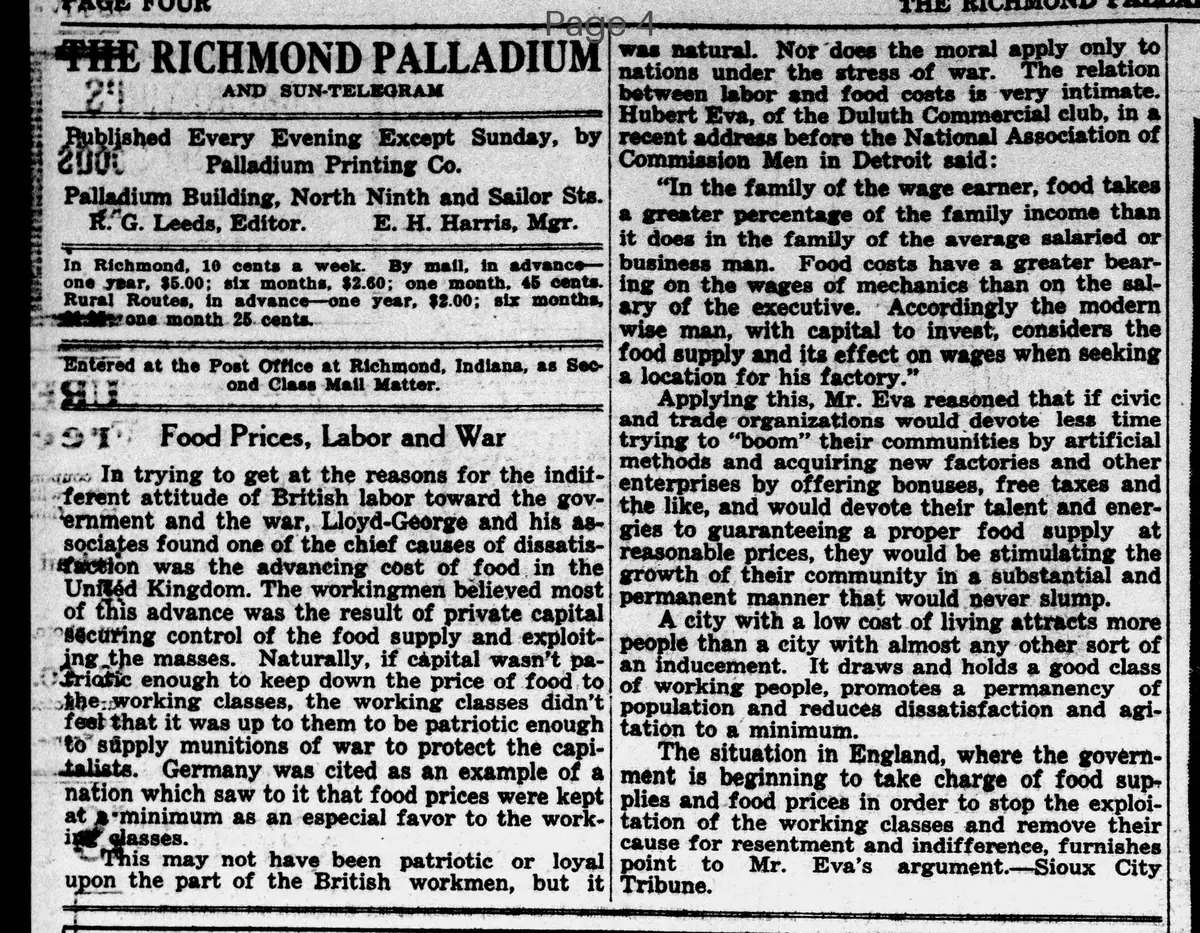
In trying to get at the reasons for the indifferent attitude of British labor toward the government and the war, Lloyd-George and his associates found one of the chief causes of dissatisfaction was the advancing cost of food in the United Kingdom. The workingmen believed most of this advance was the result of private capital securing control of the food supply and exploiting the masses. Naturally, if capital wasn't patriotic enough to keep down the price of food to the working classes, the working classes didn't feel that it was up to them to be patriotic enough to supply munitions of war to protect the capitalists. Germany was cited as an example of a nation which saw to it that food prices were kept at a minimum as an especial favor to the working classes.
This may not have been patriotic or loyal upon the part of the British workmen, but it was natural. Nor does the moral apply only to nations under the stress of war. The relation between labor and food costs is very intimate. Hubert Eva, of the Duluth Commercial club, in a recent address before the National Association of Commission Men in Detroit said:
"In the family of the wage earner, food takes a greater percentage of the family income than it does in the family of the average salaried or business man. Food costs have a greater bearing on the wages of mechanics than on the salary of the executive. Accordingly the modern wise man, with capital to invest, considers the food supply and its effect on wages when seeking a location for his factory."
Applying this, Mr. Eva reasoned that if civic and trade organizations would devote less time trying to "boom" their communities by artificial methods and acquiring new factories and other enterprises by offering bonuses, free taxes and the like, and would devote their talent and energies to guaranteeing a proper food supply at reasonable prices, they would be stimulating the growth of their community in a substantial and permanent manner that would never slump.
A city with a low cost of living attracts more people than a city with almost any other sort of an inducement. It draws and holds a good class of working people, promotes a permanency of population and reduces dissatisfaction and agitation to a minimum.
The situation in England, where the government is beginning to take charge of food supplies and food prices in order to stop the exploitation of the working classes and remove their cause for resentment and indifference, furnishes point to Mr. Eva's argument.--Sioux City Tribune.
In trying to get at the reasons for the indifferent attitude of British labor toward the government and the war, Lloyd-George and his associates found one of the chief causes of dissatisfaction was the advancing cost of food in the United Kingdom. The workingmen believed most of this advance was the result of private capital securing control of the food supply and exploiting the masses. Naturally, if capital wasn't patriotic enough to keep down the price of food to the working classes, the working classes didn't feel that it was up to them to be patriotic enough to supply munitions of war to protect the capitalists. Germany was cited as an example of a nation which saw to it that food prices were kept at a minimum as an especial favor to the working classes.
This may not have been patriotic or loyal upon the part of the British workmen, but it was natural. Nor does the moral apply only to nations under the stress of war. The relation between labor and food costs is very intimate. Hubert Eva, of the Duluth Commercial club, in a recent address before the National Association of Commission Men in Detroit said:
"In the family of the wage earner, food takes a greater percentage of the family income than it does in the family of the average salaried or business man. Food costs have a greater bearing on the wages of mechanics than on the salary of the executive. Accordingly the modern wise man, with capital to invest, considers the food supply and its effect on wages when seeking a location for his factory."
Applying this, Mr. Eva reasoned that if civic and trade organizations would devote less time trying to "boom" their communities by artificial methods and acquiring new factories and other enterprises by offering bonuses, free taxes and the like, and would devote their talent and energies to guaranteeing a proper food supply at reasonable prices, they would be stimulating the growth of their community in a substantial and permanent manner that would never slump.
A city with a low cost of living attracts more people than a city with almost any other sort of an inducement. It draws and holds a good class of working people, promotes a permanency of population and reduces dissatisfaction and agitation to a minimum.
The situation in England, where the government is beginning to take charge of food supplies and food prices in order to stop the exploitation of the working classes and remove their cause for resentment and indifference, furnishes point to Mr. Eva's argument.--Sioux City Tribune.
What sub-type of article is it?
Economic Policy
Labor
War Or Peace
What keywords are associated?
Food Prices
Labor Dissatisfaction
War Effort
Economic Policy
Working Classes
Food Supply Control
What entities or persons were involved?
Lloyd George
Hubert Eva
British Government
Germany
Sioux City Tribune
Editorial Details
Primary Topic
Impact Of Food Prices On Labor Dissatisfaction During War
Stance / Tone
Advocacy For Government Control Of Food Prices To Support Labor And Stability
Key Figures
Lloyd George
Hubert Eva
British Government
Germany
Sioux City Tribune
Key Arguments
Rising Food Prices In Britain Caused Labor Indifference To The War Effort
Workers Believed Capitalists Exploited Food Supply For Profit
Germany Kept Food Prices Low To Favor Working Classes
Food Costs Disproportionately Affect Wage Earners' Incomes
Low Food Costs Attract And Retain Workers, Promoting Community Growth
Government Intervention In Food Supply Reduces Labor Resentment