Thank you for visiting SNEWPapers!
Sign up free
Story
August 23, 1848
Richmond Palladium
Richmond, Wayne County, Indiana
What is this article about?
Report on the Women's Rights Convention in Rochester, New York, with large attendance, speeches by Lucretia Mott, Frederick Douglass, and others advocating for equal rights, property, and suffrage, while some men opposed voting rights for women. Resolutions adopted, highlighting low wages for female labor.
Clipping
OCR Quality
97%
Excellent
Full Text
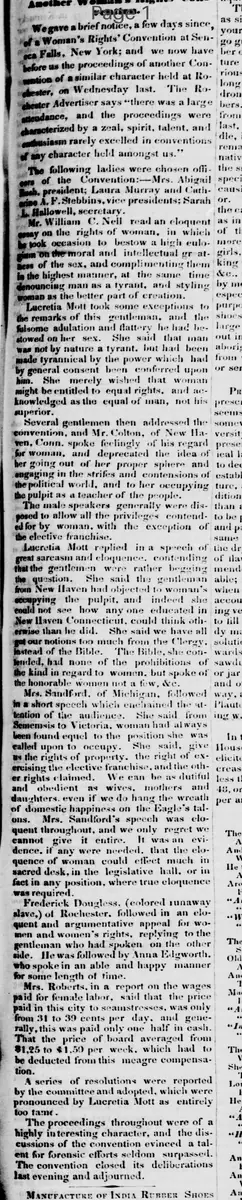
We gave a brief notice, a few days since, of the 'Woman's Rights' Convention at Seneca Falls, New York; and we now have before us the proceedings of another Convention of a similar character held at Rochester, on Wednesday last. The Rochester Advertiser says there was a large attendance, and the proceedings were characterized by a zeal, spirit, talent, and enthusiasm rarely excelled in conventions of any character held amongst us.
The following ladies were chosen officers of the Convention:--Mrs. Abigail Coch, president; Laura Murray and Catherine A. F. Stebbins, vice presidents; Sarah L. Hallowell, secretary.
Mr. William C. Nell read an eloquent essay on the rights of woman, in which he took occasion to bestow a high eulogium on the moral and intellectual graces of the sex, and complimenting them in the highest manner, at the same time denouncing man as a tyrant, and styling woman as the better part of creation.
Lucretia Mott took some exceptions to the remarks of this gentleman, and the fulsome adulation and flattery he had bestowed on her sex. She said that man was not by nature a tyrant, but had been made tyrannical by the power which had by general consent been conferred upon him. She merely wished that woman might be entitled to equal rights, and acknowledged as the equal of man, not his superior.
Several gentlemen then addressed the convention, and Mr. Colton, of New Haven, Conn., spoke feelingly of his regard for woman, and deprecated the idea of her going out of her proper sphere and engaging in the strifes and contentions of the political world, and of her occupying the pulpit as a teacher of the people.
The male speakers generally were disposed to allow all the privileges contended for by woman, with the exception of the elective franchise.
Lucretia Mott replied in a speech of great sarcasm and eloquence, contending that the gentlemen were rather begging the question. She said the gentleman from New Haven had objected to woman's occupying the pulpit, and indeed she could not see how any one educated in New Haven, Connecticut, could think otherwise than he did. She said we have all got our notions too much from the Clergy, instead of the Bible. The Bible, she contended, had none of the prohibitions of the kind in regard to women, but spoke of the honorable women not a few, etc.
Mrs. Sandford, of Michigan, followed in a short speech which enchained the attention of the audience. She said from Semiramis to Victoria, woman had always been found equal to the position she was called upon to occupy. She said, give us the rights of property, the right of exercising the elective franchise, and the other rights claimed. We can be as dutiful and obedient as wives, mothers and daughters, even if we do hang the wreath of domestic happiness on the Eagle's talons. Mrs. Sandford's speech was eloquent throughout, and we only regret we cannot give it entire. It was an evidence, if any were needed, that the eloquence of woman could effect much in the sacred desk, in the legislative hall, or in fact in any position, where true eloquence was required.
Frederick Douglass, (colored runaway slave,) of Rochester, followed in an eloquent and argumentative appeal for women's rights, replying to the gentleman who had spoken on the other side. He was followed by Anna Edgworth, who spoke in an able and happy manner for some length of time.
Mrs. Roberts, in a report on the wages paid for female labor, said that the price paid in this city to seamstresses, was only from 31 to 39 cents per day, and generally, this was paid only one half in cash. That the price of board averaged from $1.25 to $1.50 per week, which had to be deducted from this meagre compensation.
A series of resolutions were reported by the committee and adopted, which were pronounced by Lucretia Mott as entirely too tame.
The proceedings throughout were of a highly interesting character, and the discussions of the Convention evinced a talent for forensic efforts seldom surpassed. The convention closed its deliberations last evening and adjourned.
The following ladies were chosen officers of the Convention:--Mrs. Abigail Coch, president; Laura Murray and Catherine A. F. Stebbins, vice presidents; Sarah L. Hallowell, secretary.
Mr. William C. Nell read an eloquent essay on the rights of woman, in which he took occasion to bestow a high eulogium on the moral and intellectual graces of the sex, and complimenting them in the highest manner, at the same time denouncing man as a tyrant, and styling woman as the better part of creation.
Lucretia Mott took some exceptions to the remarks of this gentleman, and the fulsome adulation and flattery he had bestowed on her sex. She said that man was not by nature a tyrant, but had been made tyrannical by the power which had by general consent been conferred upon him. She merely wished that woman might be entitled to equal rights, and acknowledged as the equal of man, not his superior.
Several gentlemen then addressed the convention, and Mr. Colton, of New Haven, Conn., spoke feelingly of his regard for woman, and deprecated the idea of her going out of her proper sphere and engaging in the strifes and contentions of the political world, and of her occupying the pulpit as a teacher of the people.
The male speakers generally were disposed to allow all the privileges contended for by woman, with the exception of the elective franchise.
Lucretia Mott replied in a speech of great sarcasm and eloquence, contending that the gentlemen were rather begging the question. She said the gentleman from New Haven had objected to woman's occupying the pulpit, and indeed she could not see how any one educated in New Haven, Connecticut, could think otherwise than he did. She said we have all got our notions too much from the Clergy, instead of the Bible. The Bible, she contended, had none of the prohibitions of the kind in regard to women, but spoke of the honorable women not a few, etc.
Mrs. Sandford, of Michigan, followed in a short speech which enchained the attention of the audience. She said from Semiramis to Victoria, woman had always been found equal to the position she was called upon to occupy. She said, give us the rights of property, the right of exercising the elective franchise, and the other rights claimed. We can be as dutiful and obedient as wives, mothers and daughters, even if we do hang the wreath of domestic happiness on the Eagle's talons. Mrs. Sandford's speech was eloquent throughout, and we only regret we cannot give it entire. It was an evidence, if any were needed, that the eloquence of woman could effect much in the sacred desk, in the legislative hall, or in fact in any position, where true eloquence was required.
Frederick Douglass, (colored runaway slave,) of Rochester, followed in an eloquent and argumentative appeal for women's rights, replying to the gentleman who had spoken on the other side. He was followed by Anna Edgworth, who spoke in an able and happy manner for some length of time.
Mrs. Roberts, in a report on the wages paid for female labor, said that the price paid in this city to seamstresses, was only from 31 to 39 cents per day, and generally, this was paid only one half in cash. That the price of board averaged from $1.25 to $1.50 per week, which had to be deducted from this meagre compensation.
A series of resolutions were reported by the committee and adopted, which were pronounced by Lucretia Mott as entirely too tame.
The proceedings throughout were of a highly interesting character, and the discussions of the Convention evinced a talent for forensic efforts seldom surpassed. The convention closed its deliberations last evening and adjourned.
What sub-type of article is it?
Historical Event
What themes does it cover?
Social Manners
Justice
Moral Virtue
What keywords are associated?
Womens Rights
Convention
Rochester
Lucretia Mott
Frederick Douglass
Equal Rights
Suffrage
Female Labor
What entities or persons were involved?
Mrs. Abigail Coch
Laura Murray
Catherine A. F. Stebbins
Sarah L. Hallowell
William C. Nell
Lucretia Mott
Mr. Colton
Mrs. Sandford
Frederick Douglass
Anna Edgworth
Mrs. Roberts
Where did it happen?
Rochester, New York
Story Details
Key Persons
Mrs. Abigail Coch
Laura Murray
Catherine A. F. Stebbins
Sarah L. Hallowell
William C. Nell
Lucretia Mott
Mr. Colton
Mrs. Sandford
Frederick Douglass
Anna Edgworth
Mrs. Roberts
Location
Rochester, New York
Event Date
Wednesday Last
Story Details
Women's Rights Convention in Rochester with officers elected, speeches advocating equal rights by Lucretia Mott, Frederick Douglass, and others; opposition to suffrage from some men; report on low female wages; resolutions adopted.