Thank you for visiting SNEWPapers!
Sign up free
Story
May 28, 1915
The Kemmerer Republican
Kemmerer, Lincoln County, Wyoming
What is this article about?
Charles King, a progressive rancher in Fossil, Lincoln County, Wyoming, succeeds with intensive farming, planting 80 acres of rye, alfalfa, broom grass, clover, hulless beardless barley, field peas, and small fruits like gooseberries, currants, raspberries, and apricots, proving Wyoming soil's potential.
Clipping
OCR Quality
98%
Excellent
Full Text
A SUCCESSFUL RANCHER
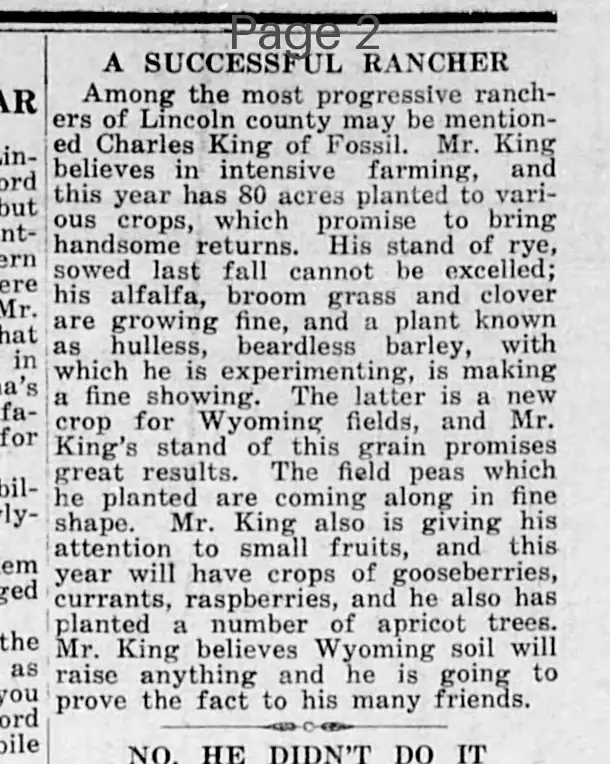
Among the most progressive ranchers of Lincoln county may be mentioned Charles King of Fossil. Mr. King believes in intensive farming, and this year has 80 acres planted to various crops, which promise to bring handsome returns. His stand of rye, sowed last fall cannot be excelled; his alfalfa, broom grass and clover are growing fine, and a plant known as hulless, beardless barley, with which he is experimenting, is making a fine showing. The latter is a new crop for Wyoming fields, and Mr. King's stand of this grain promises great results. The field peas which he planted are coming along in fine shape. Mr. King also is giving his attention to small fruits, and this year will have crops of gooseberries, currants, raspberries, and he also has planted a number of apricot trees. Mr. King believes Wyoming soil will raise anything and he is going to prove the fact to his many friends.
Among the most progressive ranchers of Lincoln county may be mentioned Charles King of Fossil. Mr. King believes in intensive farming, and this year has 80 acres planted to various crops, which promise to bring handsome returns. His stand of rye, sowed last fall cannot be excelled; his alfalfa, broom grass and clover are growing fine, and a plant known as hulless, beardless barley, with which he is experimenting, is making a fine showing. The latter is a new crop for Wyoming fields, and Mr. King's stand of this grain promises great results. The field peas which he planted are coming along in fine shape. Mr. King also is giving his attention to small fruits, and this year will have crops of gooseberries, currants, raspberries, and he also has planted a number of apricot trees. Mr. King believes Wyoming soil will raise anything and he is going to prove the fact to his many friends.
What sub-type of article is it?
Biography
Personal Triumph
What themes does it cover?
Triumph
What keywords are associated?
Progressive Rancher
Intensive Farming
Wyoming Crops
Hulless Barley
Small Fruits
Charles King
What entities or persons were involved?
Charles King
Where did it happen?
Lincoln County, Fossil, Wyoming
Story Details
Key Persons
Charles King
Location
Lincoln County, Fossil, Wyoming
Story Details
Charles King demonstrates progressive ranching by intensively farming 80 acres with rye, alfalfa, broom grass, clover, hulless beardless barley, field peas, and small fruits, achieving promising results and proving Wyoming soil's versatility.