Thank you for visiting SNEWPapers!
Sign up free
Story
December 1, 1843
The Charlotte Journal
Charlotte, Mecklenburg County, North Carolina
What is this article about?
Synopsis and extracts from Daniel Webster's Andover speech, covering his views on establishing a US Bank for currency stability, support for a moderate tariff to benefit national interests, defense of remaining in Tyler's cabinet amid Whig tensions, and reaffirmation of his Whig principles.
Clipping
OCR Quality
95%
Excellent
Full Text
From the N. York Courier and Enquirer,
Mr. Webster's Andover Speech.
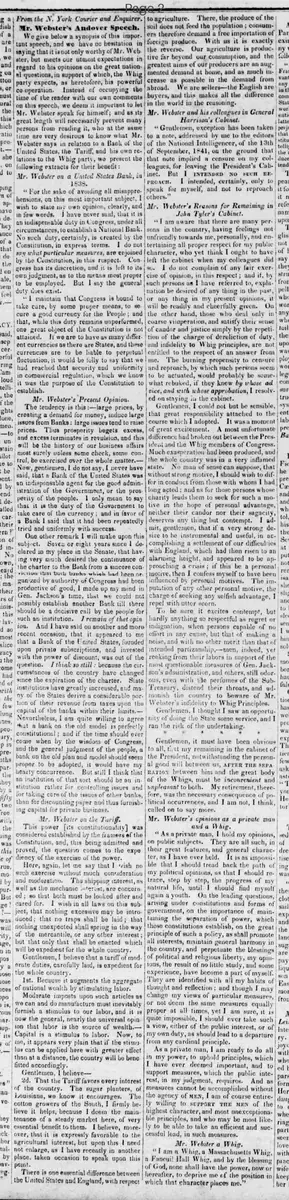
We give below a synopsis of this important speech, and we have no hesitation in saying that it is not only worthy of Mr. Webster, but meets our utmost expectations in regard to his opinions on the great national questions, in support of which, the Whig party expects, as heretofore, his powerful co-operation. Instead of occupying the time of the reader with our own comments on this speech, we deem it important to let Mr. Webster speak for himself; and as its great length will necessarily prevent many persons from reading it, who at the same time are very desirous to know what Mr. Webster says in relation to a Bank of the United States, the Tariff, and his own relations to the Whig party, we present the following extracts for their benefit:
Mr. Webster on a United States Bank, in 1838.
"For the sake of avoiding all misapprehensions, on this most important subject, I wish to state my own opinion, clearly, and in few words. I have never said, that it is an indispensable duty in Congress, under all circumstances, to establish a National Bank. No such duty, certainly, is created by the Constitution, in express terms. I do not say what particular measures, are enjoined by the Constitution, in this respect. Congress has its discretion, and it is left to its own judgment, as to the means most proper to be employed. But I say the general duty does exist.
"I maintain that Congress is bound to take care, by some proper means, to secure a good currency for the People; and that, while this duty remains unperformed one great object of the Constitution is not attained. If we are to have as many different currencies as there are States, and these currencies are to be liable to perpetual fluctuation, it would be folly to say that we had reached that security and uniformity in commercial regulation, which we know it was the purpose of the Constitution to establish."
Mr. Webster's Present Opinion.
The tendency is this:—large prices, by creating a demand for money, induce large issues from Banks: large issues tend to raise prices. Thus prosperity begets excess and excess terminates in revulsion, and this will be the history of our business affairs most surely unless some check, some control, be exercised over the whole matter. Now, gentlemen, I do not say, I never have said, that a Bank of the United States was an indispensable agent for the good administration of the Government, or the prosperity of the people. I only mean to say that it is the duty of the Government to take care of the currency; and in favor of a Bank I said that it had been repeatedly tried and uniformly with success.
One other remark I will make upon this subject. Seven or eight years since I declared in my place in the Senate, that having very much desired the continuance of the charter to the Bank from a sincere conviction such banks which had been organized by authority of Congress had been productive of good, I made up my mind in Gen. Jackson's time, that we could not possibly establish another Bank till there should be a decisive call by the people for such an institution. I remain of that opinion. And I have said on another and more recent occasion, that it appeared to me that a Bank of the United States, founded upon private subscriptions, and invested with the power of discount, was out of the question. I think so still: because the circumstances of the country have changed since the expiration of the charter. State institutions have greatly increased, and many of the States derive a considerable portion of their revenue from taxes upon the capital of the banks within their limits. Nevertheless, I am quite willing to agree that a bank on the old model is perfectly constitutional; and if the time should ever come when by the wisdom of Congress, and the general judgment of the people, a bank on the old plan and model should seem proper to be adopted, it would have my hearty concurrence. But still I think that an institution of that sort should be an institution rather for controlling issues and for taking care of the issues of other banks, than for discounting paper and thus furnishing capital for private business.
Mr. Webster on the Tariff
This power [its constitutionality] was considered established by the framers of the Constitution, and, this being admitted and proved, the question comes to the expediency of the exercise of the power. Here, again, let me say that I wish no such exercise without much consideration and moderation. The shipping interest, as well as the mechanic interest, are concerned: so that both must be looked after and cared for. I wish in all laws on this subject, that nothing excessive may be introduced; that no traps shall be laid; that nothing unexpected shall spring in the way of the mercantile, or any other interest; but that only that shall be enacted which will be expedient for the whole country.
Gentlemen, I believe that a tariff of moderate duties, carefully laid, is expedient for the whole country.
1st. Because it augments the aggregate of national wealth by stimulating labor. Moderate imposts upon such articles as we can and do manufacture must inevitably furnish a stimulus to our labor, and it is now the general, nearly the universal opinion that labor is the source of wealth. Capital is a stimulus to labor. Now, to me, it appears very plain that if the stimulus can be applied here with greater effect than at a distance, the country will be benefited accordingly.
Gentlemen, I believe—
2d. That the Tariff favors every interest of the country. The sugar planters, of Louisiana, we know it encourages. The cotton growers of the South, I firmly believe it helps, because I deem the maintenance of a steady market here, of very essential benefit to them. I believe, moreover, that it is expressly favorable to the agricultural interest, but upon this I need not enlarge, as I have recently in another place, taken occasion to speak upon this point.
There is one essential difference between the United States and England, with respect to agriculture. There, the produce of the soil does not feed the population; consumers therefore demand a free importation of foreign produce. With us it is exactly the reverse. Our agriculture is productive far beyond our consumption, and the greatest aims of our producers are an augmented demand at home, and as much increase as possible in the demand from abroad. We are sellers—the English are buyers, and this makes all the difference in the world in the reasoning.
Mr. Webster and his colleagues in General Harrison's Cabinet
"Gentlemen, exception has been taken to a note, addressed by me to the editors of the National Intelligencer, of the 13th of September, 1841, on the ground that that note implied a censure on my colleagues, for leaving the President's Cabinet. But I INTENDED NO SUCH REPROACH. I intended, certainly, only to speak for myself, and not to reproach others."
Mr. Webster's Reasons for Remaining in John Tyler's Cabinet.
"I am aware that there are many persons in the country, having feelings not unfriendly towards me, personally, and entertaining all proper respect for my public character, who yet think I ought to have left the cabinet when my colleagues did so. I do not complain of any fair exercise of opinion, in this respect; and if, by such persons as I have referred to, explanation be desired of any thing in the past, or any thing in my present opinions, it will be readily and cheerfully given. On the other hand, those who deal only in coarse vituperation, and satisfy their sense of candor and justice simply by the repetition of the charge of dereliction of duty, and infidelity to Whig principles, are not entitled to the respect of an answer from me. The burning propensity to censure and reproach, by which such persons seem to be actuated, would probably be somewhat rebuked, if they knew by whose advice, and with whose approbation, I resolved on staying in the cabinet.
Gentlemen, I could not but be sensible, that great responsibility attached to the course which I adopted. It was a moment of great excitement. A most unfortunate difference had broken out between the President and the Whig members of Congress. Much exasperation had been produced, and the whole country was in a very inflamed state. No man of sense can suppose, that without strong motive, I should wish to differ in conduct from those with whom I had long acted: and as for those persons whose charity leads them to seek for such a motive in the hope of personal advantage, neither their candor nor their sagacity, deserves any thing but contempt. I admit, gentlemen, that if a very strong desire to be instrumental and useful, in accomplishing a settlement of our difficulties with England, which had then risen to an alarming height, and appeared to be approaching a crisis; if this be a personal motive, then I confess myself to have been influenced by personal motives. The imputation of any other personal motive, the charge of seeking any selfish advantage, I repel with utter scorn.
To be sure it excites contempt, but hardly anything so respectful as regret or indignation, when persons capable of no effort in any cause, but that of making noise, and with no other merit than that of intended partizanship,—men, indeed, yet reeking from their labors in support of the most questionable measures of Gen. Jackson's administration, and others, still odorous, even with the perfumes of the Sub-Treasury, distend their throats, and admonish the country to beware of Mr. Webster's infidelity to Whig Principles.
Gentlemen, I thought I saw an opportunity of doing the State some service, and I ran the risk of the undertaking. Gentlemen, it must have been obvious to all, that my remaining in the cabinet of the President, notwithstanding the personal good will between us, AFTER THE SEPARATION between him and the great body of the Whigs, must be inconvenient and unpleasant to both. My retirement, therefore, was the necessary consequence of political occurrences, and I am not, I think, called on to say more.
Mr. Webster's opinions as a private man and a Whig.
"As a private man, I hold my opinions, on public subjects. They are all such, in their great features, and general character, as I have ever held. It is as impossible that I should tread back the path of my political opinions, as that I should retrace, step by step, the progress of my natural life, until I should find myself again a youth. On the leading questions, arising under constitutions and forms of government, on the importance of maintaining the separation of power, which those constitutions establish, on the great principle of such a policy, as shall promote all interests, maintain general harmony in the country, and perpetuate the blessings of political and religious liberty, my opinions, the result of no little study, and some experience, have become a part of myself. They are identified with all my habits of thought and reflection; and though I may change my views of particular measures, or not deem the same measures equally proper at all times, yet I am sure, it is quite impossible, I should ever take such a view, either of the public interest, or of my own duty, as should lead to a departure from any cardinal principle.
As a private man, I am ready to do all in my power, to uphold principles, which I have ever deemed important, and to support measures, which the public interest, in my judgment, requires. And as measures cannot be accomplished without the agency of men, I am of course entirely willing TO SUPPORT THE MEN of the highest character, and most unexceptionable principles, and who may be most likely to be able to take an efficient and successful lead, in such measures.
Mr. Webster a Whig.
"I am a Whig, a Massachusetts Whig a Faneuil Hall Whig, and by the blessing of God, none shall have the power, now or hereafter, to deprive me of the position in which that character places me."
Mr. Webster's Andover Speech.
We give below a synopsis of this important speech, and we have no hesitation in saying that it is not only worthy of Mr. Webster, but meets our utmost expectations in regard to his opinions on the great national questions, in support of which, the Whig party expects, as heretofore, his powerful co-operation. Instead of occupying the time of the reader with our own comments on this speech, we deem it important to let Mr. Webster speak for himself; and as its great length will necessarily prevent many persons from reading it, who at the same time are very desirous to know what Mr. Webster says in relation to a Bank of the United States, the Tariff, and his own relations to the Whig party, we present the following extracts for their benefit:
Mr. Webster on a United States Bank, in 1838.
"For the sake of avoiding all misapprehensions, on this most important subject, I wish to state my own opinion, clearly, and in few words. I have never said, that it is an indispensable duty in Congress, under all circumstances, to establish a National Bank. No such duty, certainly, is created by the Constitution, in express terms. I do not say what particular measures, are enjoined by the Constitution, in this respect. Congress has its discretion, and it is left to its own judgment, as to the means most proper to be employed. But I say the general duty does exist.
"I maintain that Congress is bound to take care, by some proper means, to secure a good currency for the People; and that, while this duty remains unperformed one great object of the Constitution is not attained. If we are to have as many different currencies as there are States, and these currencies are to be liable to perpetual fluctuation, it would be folly to say that we had reached that security and uniformity in commercial regulation, which we know it was the purpose of the Constitution to establish."
Mr. Webster's Present Opinion.
The tendency is this:—large prices, by creating a demand for money, induce large issues from Banks: large issues tend to raise prices. Thus prosperity begets excess and excess terminates in revulsion, and this will be the history of our business affairs most surely unless some check, some control, be exercised over the whole matter. Now, gentlemen, I do not say, I never have said, that a Bank of the United States was an indispensable agent for the good administration of the Government, or the prosperity of the people. I only mean to say that it is the duty of the Government to take care of the currency; and in favor of a Bank I said that it had been repeatedly tried and uniformly with success.
One other remark I will make upon this subject. Seven or eight years since I declared in my place in the Senate, that having very much desired the continuance of the charter to the Bank from a sincere conviction such banks which had been organized by authority of Congress had been productive of good, I made up my mind in Gen. Jackson's time, that we could not possibly establish another Bank till there should be a decisive call by the people for such an institution. I remain of that opinion. And I have said on another and more recent occasion, that it appeared to me that a Bank of the United States, founded upon private subscriptions, and invested with the power of discount, was out of the question. I think so still: because the circumstances of the country have changed since the expiration of the charter. State institutions have greatly increased, and many of the States derive a considerable portion of their revenue from taxes upon the capital of the banks within their limits. Nevertheless, I am quite willing to agree that a bank on the old model is perfectly constitutional; and if the time should ever come when by the wisdom of Congress, and the general judgment of the people, a bank on the old plan and model should seem proper to be adopted, it would have my hearty concurrence. But still I think that an institution of that sort should be an institution rather for controlling issues and for taking care of the issues of other banks, than for discounting paper and thus furnishing capital for private business.
Mr. Webster on the Tariff
This power [its constitutionality] was considered established by the framers of the Constitution, and, this being admitted and proved, the question comes to the expediency of the exercise of the power. Here, again, let me say that I wish no such exercise without much consideration and moderation. The shipping interest, as well as the mechanic interest, are concerned: so that both must be looked after and cared for. I wish in all laws on this subject, that nothing excessive may be introduced; that no traps shall be laid; that nothing unexpected shall spring in the way of the mercantile, or any other interest; but that only that shall be enacted which will be expedient for the whole country.
Gentlemen, I believe that a tariff of moderate duties, carefully laid, is expedient for the whole country.
1st. Because it augments the aggregate of national wealth by stimulating labor. Moderate imposts upon such articles as we can and do manufacture must inevitably furnish a stimulus to our labor, and it is now the general, nearly the universal opinion that labor is the source of wealth. Capital is a stimulus to labor. Now, to me, it appears very plain that if the stimulus can be applied here with greater effect than at a distance, the country will be benefited accordingly.
Gentlemen, I believe—
2d. That the Tariff favors every interest of the country. The sugar planters, of Louisiana, we know it encourages. The cotton growers of the South, I firmly believe it helps, because I deem the maintenance of a steady market here, of very essential benefit to them. I believe, moreover, that it is expressly favorable to the agricultural interest, but upon this I need not enlarge, as I have recently in another place, taken occasion to speak upon this point.
There is one essential difference between the United States and England, with respect to agriculture. There, the produce of the soil does not feed the population; consumers therefore demand a free importation of foreign produce. With us it is exactly the reverse. Our agriculture is productive far beyond our consumption, and the greatest aims of our producers are an augmented demand at home, and as much increase as possible in the demand from abroad. We are sellers—the English are buyers, and this makes all the difference in the world in the reasoning.
Mr. Webster and his colleagues in General Harrison's Cabinet
"Gentlemen, exception has been taken to a note, addressed by me to the editors of the National Intelligencer, of the 13th of September, 1841, on the ground that that note implied a censure on my colleagues, for leaving the President's Cabinet. But I INTENDED NO SUCH REPROACH. I intended, certainly, only to speak for myself, and not to reproach others."
Mr. Webster's Reasons for Remaining in John Tyler's Cabinet.
"I am aware that there are many persons in the country, having feelings not unfriendly towards me, personally, and entertaining all proper respect for my public character, who yet think I ought to have left the cabinet when my colleagues did so. I do not complain of any fair exercise of opinion, in this respect; and if, by such persons as I have referred to, explanation be desired of any thing in the past, or any thing in my present opinions, it will be readily and cheerfully given. On the other hand, those who deal only in coarse vituperation, and satisfy their sense of candor and justice simply by the repetition of the charge of dereliction of duty, and infidelity to Whig principles, are not entitled to the respect of an answer from me. The burning propensity to censure and reproach, by which such persons seem to be actuated, would probably be somewhat rebuked, if they knew by whose advice, and with whose approbation, I resolved on staying in the cabinet.
Gentlemen, I could not but be sensible, that great responsibility attached to the course which I adopted. It was a moment of great excitement. A most unfortunate difference had broken out between the President and the Whig members of Congress. Much exasperation had been produced, and the whole country was in a very inflamed state. No man of sense can suppose, that without strong motive, I should wish to differ in conduct from those with whom I had long acted: and as for those persons whose charity leads them to seek for such a motive in the hope of personal advantage, neither their candor nor their sagacity, deserves any thing but contempt. I admit, gentlemen, that if a very strong desire to be instrumental and useful, in accomplishing a settlement of our difficulties with England, which had then risen to an alarming height, and appeared to be approaching a crisis; if this be a personal motive, then I confess myself to have been influenced by personal motives. The imputation of any other personal motive, the charge of seeking any selfish advantage, I repel with utter scorn.
To be sure it excites contempt, but hardly anything so respectful as regret or indignation, when persons capable of no effort in any cause, but that of making noise, and with no other merit than that of intended partizanship,—men, indeed, yet reeking from their labors in support of the most questionable measures of Gen. Jackson's administration, and others, still odorous, even with the perfumes of the Sub-Treasury, distend their throats, and admonish the country to beware of Mr. Webster's infidelity to Whig Principles.
Gentlemen, I thought I saw an opportunity of doing the State some service, and I ran the risk of the undertaking. Gentlemen, it must have been obvious to all, that my remaining in the cabinet of the President, notwithstanding the personal good will between us, AFTER THE SEPARATION between him and the great body of the Whigs, must be inconvenient and unpleasant to both. My retirement, therefore, was the necessary consequence of political occurrences, and I am not, I think, called on to say more.
Mr. Webster's opinions as a private man and a Whig.
"As a private man, I hold my opinions, on public subjects. They are all such, in their great features, and general character, as I have ever held. It is as impossible that I should tread back the path of my political opinions, as that I should retrace, step by step, the progress of my natural life, until I should find myself again a youth. On the leading questions, arising under constitutions and forms of government, on the importance of maintaining the separation of power, which those constitutions establish, on the great principle of such a policy, as shall promote all interests, maintain general harmony in the country, and perpetuate the blessings of political and religious liberty, my opinions, the result of no little study, and some experience, have become a part of myself. They are identified with all my habits of thought and reflection; and though I may change my views of particular measures, or not deem the same measures equally proper at all times, yet I am sure, it is quite impossible, I should ever take such a view, either of the public interest, or of my own duty, as should lead to a departure from any cardinal principle.
As a private man, I am ready to do all in my power, to uphold principles, which I have ever deemed important, and to support measures, which the public interest, in my judgment, requires. And as measures cannot be accomplished without the agency of men, I am of course entirely willing TO SUPPORT THE MEN of the highest character, and most unexceptionable principles, and who may be most likely to be able to take an efficient and successful lead, in such measures.
Mr. Webster a Whig.
"I am a Whig, a Massachusetts Whig a Faneuil Hall Whig, and by the blessing of God, none shall have the power, now or hereafter, to deprive me of the position in which that character places me."
What sub-type of article is it?
Historical Event
Biography
What themes does it cover?
Justice
Moral Virtue
What keywords are associated?
Webster Speech
United States Bank
Tariff Policy
Whig Party
Tyler Cabinet
Currency Regulation
What entities or persons were involved?
Mr. Webster
Gen. Jackson
John Tyler
General Harrison
Where did it happen?
Andover
Story Details
Key Persons
Mr. Webster
Gen. Jackson
John Tyler
General Harrison
Location
Andover
Event Date
1841 09 13
Story Details
Extracts from Webster's speech affirming constitutional duty for national currency via bank if needed, support for moderate tariff benefiting all interests, defense of staying in Tyler's cabinet to resolve foreign issues despite Whig split, and steadfast commitment to Whig principles.