Thank you for visiting SNEWPapers!
Sign up free
Literary
December 19, 1845
American Republican And Baltimore Daily Clipper
Baltimore, Maryland
What is this article about?
In 1750s Virginia, old man sets jumping contest for suitors to win daughter Annette's hand. Local favorite Henry Carroll excels, but stranger outjumps him, then yields prize to Carroll. Years later, during Revolution, the stranger reveals himself as General Washington at Carrolls' home.
Clipping
OCR Quality
95%
Excellent
Full Text
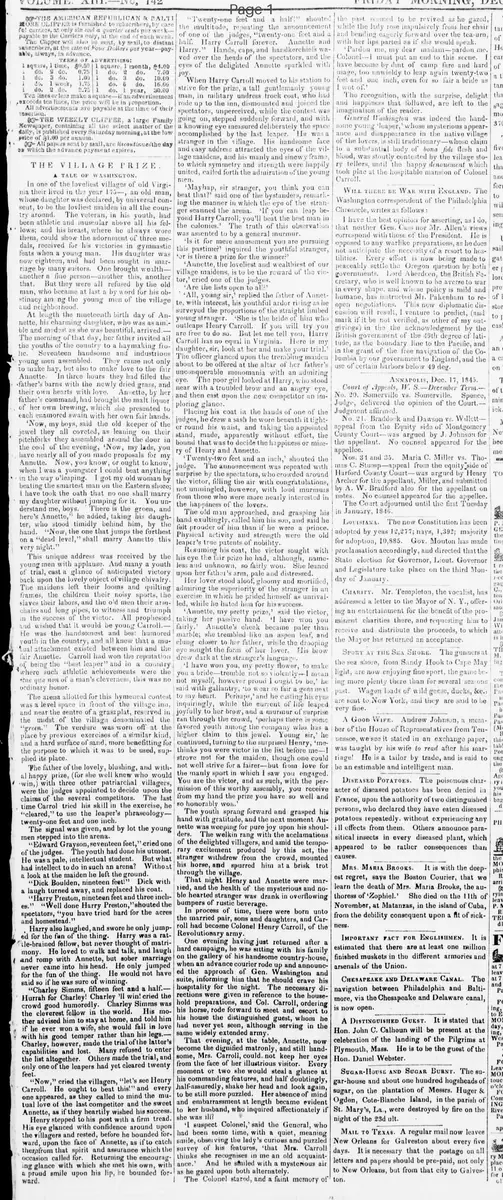
THE VILLAGE PRIZE.
TALE OF WASHINGTON.
In one of the loveliest villages of old Virginia there lived in the year 175-, an old man,
whose daughter was declared, by universal consent, to be the loveliest maiden in all the country around. The veteran, in his youth, had
been athletic and muscular above all his fellows: and his breast, where he always wore
them, could show the adornment of three medals, received for his victories in gymnastic
feats when a young man. His daughter was
now eighteen, and had been sought in marriage by many suitors. One brought wealth—
another a fine person—another this, another
that. But they were all refused by the old
man, who became at last a by-word for his obstinacy among the young men of the village
and neighborhood.
At length the nineteenth birth-day of Annette, his charming daughter, who was as amiable and modest as she was beautiful, arrived.
The morning of that day, her father invited all
the youths of the country to a haymaking frolic. Seventeen handsome and industrious
young men assembled. They came not only
to make hay, but also to make love to the fair
Annette. In three hours they had filled the
father's barns with the newly dried grass, and
their own hearts with love. Annette, by her
father's command, had brought the malt liquor
of her own brewing, which she presented to
each enamored swain with her own fair hands.
'Now, my boys,' said the old keeper of the
jewel they all coveted, as leaning on their
pitchforks they assembled around the door in
the cool of the evening, 'Now, my lads, you
have nearly all of you made proposals for my
Annette. Now, you know, or ought to know,
when I was a youngster I could beat anything
in the way of leaping. I got my old woman by
beating the smartest man on the Eastern shore;
I have took the oath that no one shall marry
my daughter without jumping for it. You understand me, boys. There is the green, and
here's Annette,' he added, taking his daughter, who stood timidly behind him, by the
hand. 'Now, the one that jumps the furthest
on a "dead level," shall marry Annette this
very night.'
This unique address was received by the
young men with applause. And many a youth
of trial, cast a glance of anticipated victory
back upon the lovely object of village chivalry.
The maidens left their looms and quilting
frames, the children their noisy sports, the
slaves their labors, and the old men their arm-chairs and long pipes, to witness and triumph
in the success of the victor. All prophesied
and wished that it would be yours, Carroll.
He was the handsomest and best humored
youth in the country, and all knew that a mutual attachment existed between him and the
fair Annette. Carroll had won the reputation
of being the "best leaper" and in a country
where such athletic achievements were the
sine qua non of a man's cleverness, this was no
ordinary honor.
The arena allotted for this hymeneal contest
was a level space in front of the village inn,
and near the centre of a grass plat, reserved in
the midst of the village denominated the
"green." The verdure was worn off at the
place by previous exercises of a similar kind,
and a hard surface of sand, more befitting for
the purpose to which it was to be used, supplied its place.
The father of the lovely, blushing, and withal happy prize, (for she well knew who would
win,) with three other patriarchal villagers,
were the judges appointed to decide upon the
claims of the several competitors. The last
time Carroll tried his skill in the exercise, he
"cleared," to use the leaper's phraseology—
twenty-one feet and one inch.
The signal was given, and by lot the young
men stepped into the arena.
"Edward Grayson, seventeen feet," cried one
of the judges. The youth had done his utmost.
He was a pale, intellectual student. But what
had intellect to do in such an arena? Without
a look at the maiden he left the ground.
"Dick Boulden, nineteen feet!" Dick with
a laugh turned away, and replaced his coat.
"Harry Preston, nineteen feet and three inches."
"Well done Harry Preston," shouted the
spectators, "you have tried hard for the acres
and homestead."
Harry also laughed, and swore he only jumped for the fun of the thing. Harry was a rattle-brained fellow, but never thought of matrimony. He loved to walk and talk, and laugh
and romp with Annette, but sober marriage
never came into his head. He only jumped
for the fun of the thing. He would not have
said so if he was sure of winning.
"Charley Simms, fifteen feet and a half."
Hurrah for Charley! Charley 'll win! cried the
crowd good humoredly. Charley Simms was
the cleverest fellow in the world. His mother advised him to stay at home, and told him
if he ever won a wife, she would fall in love
with his good temper rather than his legs.
Charley, however, made the trial of the latter's capabilities and lost. Many refused to enter
the list altogether. Others made the trial, and
only one of the leapers had yet cleared twenty
feet.
"Now," cried the villagers, "let's see Henry
Carroll. He ought to beat this!" and every
one appeared, as they called to mind the mutual love of the last competitor and the sweet
Annette, as if they heartily wished his success.
Henry stepped to his post with a firm tread.
His eye glanced with confidence around upon
the villagers and rested, before he bounded forward, upon the face of Annette, as if to catch
therefrom that spirit and assurance which the
occasion called for. Returning the encouraging glance with which she met his own, with
a proud smile upon his lip, he bounded forward.
"Twenty-one feet and a half:" shouted
the multitude, repeating the announcement
of one of the judges, "twenty-one feet and a
half. Harry Carroll forever. Annette and
Harry." Hands, caps, and handkerchiefs waved over the heads of the spectators, and the
eyes of the delighted Annette sparkled with
joy.
When Harry Carroll moved to his station to
strive for the prize, a tall gentlemanly young
man, in military undress frock coat, who had
rode up to the inn, dismounted and joined the
spectators, unperceived, while the contest was
going on, stepped suddenly forward, and with
a knowing eye measured deliberately the space
accomplished by the last leaper. He was a
stranger in the village. His handsome face
and easy address attracted the eyes of the village maidens, and his manly and sinewy frame,
to which symmetry and strength were happily
united, called forth the admiration of the young
men.
"Mayhap, sir stranger, you think you can
beat that?" said one of the bystanders, remarking the manner in which the eye of the stranger scanned the arena. "If you can leap beyond Harry Carroll, you'll beat the best man in
the colonies." The truth of this observation
was assented to by a general murmur.
"Is it for mere amusement you are pursuing
this pastime?" inquired the youthful stranger,
"or is there a prize for the winner?"
"Annette, the loveliest and wealthiest of our
village maidens, is to be the reward of the victor," cried one of the judges.
"Are the lists open to all?"
"All, young sir," replied the father of Annette, with interest, his youthful ardor rising as he surveyed the proportions of the straight limbed
young stranger. "She is the bride of him who
outleaps Henry Carroll. If you will try you
are free to do so. But let me tell you, Harry
Carroll has no equal in Virginia. Here is my
daughter, sir, look at her and make your trial."
The officer glanced upon the trembling maiden about to be offered at the altar of her father's unconquerable monomania with an admiring
eye. The poor girl looked at Harry, who stood
near with a troubled brow and an angry eye,
and then cast upon the new competitor an imploring glance.
Placing his coat in the hands of one of the
judges, he drew a sash he wore beneath it tighter round his waist, and taking the appointed
stand, made, apparently without effort, the
bound that was to decide the happiness or misery of Henry and Annette.
"Twenty-two feet and an inch," shouted the
judge. The announcement was repeated with
surprise by the spectators, who crowded around the victor, filling the air with congratulations,
not unmingled, however, with loud murmurs
from those who were more nearly interested in the happiness of the lovers.
The old man approached, and grasping his
hand exultingly, called in his son, and said he
felt prouder of him than if he were a prince.
Physical activity and strength were the old
leaper's true patents of nobility.
Resuming his coat, the victor sought with
his eye the fair prize he had, although, nameless and unknown, so fairly won. She leaned
upon her father's arm, pale and distressed.
Her lover stood aloof, gloomy and mortified,
admiring the superiority of the stranger in an
exercise in which he prided himself as unrivalled, while he hated him for his success.
"Annette, my pretty prize," said the victor,
taking her passive hand. "I have won you
fairly." Annette's cheek became paler than
marble; she trembled like an aspen leaf, and
clung closer to her father, while the drooping
eye sought the form of her lover. His brow
drew dark at the stranger's language.
"I have won you, my pretty flower, to make
you a bride—tremble not so violently—I mean
not myself, however proud I ought to be," he
said with gallantry, "to wear so fair a gem next
to my heart. Perhaps," and he casting his eyes
inquiringly, while the current of life leaped
joyfully to her brow, and a murmur of surprise
ran through the crowd, "perhaps there is some
favored youth among the company who has a
higher claim to this jewel. Young sir," he
continued, turning to the surprised Henry, "methinks you were victor in the list before me—I
strove not for the maiden, though one could
not well strive for a fairer—but from love for
the manly sport in which I saw you engaged.
You are the victor, and as such, with the permission of this worthy assembly, you receive
from my hand the prize you have so well and
so honorably won."
The youth sprang forward and grasped his
hand with gratitude, and the next moment Annette was weeping for pure joy upon his shoulders. The welkin rang with the acclamations
of the delighted villagers, and amid the temporary excitement produced by this act, the
stranger withdrew from the crowd, mounted
his horse, and spurred him at a brisk trot
through the village.
That night Henry and Annette were married, and the health of the mysterious and noble hearted stranger was drank in overflowing
bumpers of rustic beverage.
In process of time, there were born unto
the married pair, sons and daughters, and Carroll had become Colonel Henry Carroll, of the
Revolutionary army.
One evening having just returned after a
hard campaign, he was sitting with his family
on the gallery of his handsome country-house,
when an advance courier rode up and announced the approach of Gen. Washington and
suite, informing him that he should crave his
hospitality for the night. The necessary directions were given in reference to the household preparations, and Col. Carroll, ordering
his horse, rode forward to meet and escort to
his house the distinguished guest, whom he
had never yet seen, although serving in the
same widely extended army.
That evening, at the table, Annette, now
become the dignified matronly, and still handsome, Mrs. Carroll, could not keep her eyes
from the face of her illustrious visitor. Every
moment or two she would steal a glance at
his commanding features, and half doubtingly,
half-assuredly, shake her head and look again,
to be still more puzzled. Her absence of mind
and embarrassment at length became evident
to her husband, who inquired affectionately if
she was ill?
"I suspect Colonel," said the General, who
had been some time, with a quiet, meaning
smile, observing the lady's curious and puzzled
survey of his features, "that Mrs. Carroll
thinks she recognises in me an old acquaintance." And he smiled with a mysterious air
as he gazed upon both alternately.
The Colonel stared, and a faint memory of
the past seemed to be revived as he gazed
while the lady rose impulsively from her chair
and bending eagerly forward over the tea-urn,
with her lips parted as if she would speak.
"Pardon me, my dear madam—pardon me.
Colonel—I must put an end to this scene. I
have become by dint of camp fare and hard
usage, too unwieldy to leap again twenty-two
feet and one inch, even for so fair a bride as
I wot of."
The recognition, with the surprise, delight
and happiness that followed, are left to the
imagination of the reader.
General Washington was indeed the handsome young 'leaper,' whose mysterious appearance and disappearance in the native village
of the lovers, is still traditionary—whose claim
to a substantial body of bona fide flesh and
blood, was stoutly contested by the village story tellers, until the happy denouement which
took place at the hospitable mansion of Colonel
Carroll.
TALE OF WASHINGTON.
In one of the loveliest villages of old Virginia there lived in the year 175-, an old man,
whose daughter was declared, by universal consent, to be the loveliest maiden in all the country around. The veteran, in his youth, had
been athletic and muscular above all his fellows: and his breast, where he always wore
them, could show the adornment of three medals, received for his victories in gymnastic
feats when a young man. His daughter was
now eighteen, and had been sought in marriage by many suitors. One brought wealth—
another a fine person—another this, another
that. But they were all refused by the old
man, who became at last a by-word for his obstinacy among the young men of the village
and neighborhood.
At length the nineteenth birth-day of Annette, his charming daughter, who was as amiable and modest as she was beautiful, arrived.
The morning of that day, her father invited all
the youths of the country to a haymaking frolic. Seventeen handsome and industrious
young men assembled. They came not only
to make hay, but also to make love to the fair
Annette. In three hours they had filled the
father's barns with the newly dried grass, and
their own hearts with love. Annette, by her
father's command, had brought the malt liquor
of her own brewing, which she presented to
each enamored swain with her own fair hands.
'Now, my boys,' said the old keeper of the
jewel they all coveted, as leaning on their
pitchforks they assembled around the door in
the cool of the evening, 'Now, my lads, you
have nearly all of you made proposals for my
Annette. Now, you know, or ought to know,
when I was a youngster I could beat anything
in the way of leaping. I got my old woman by
beating the smartest man on the Eastern shore;
I have took the oath that no one shall marry
my daughter without jumping for it. You understand me, boys. There is the green, and
here's Annette,' he added, taking his daughter, who stood timidly behind him, by the
hand. 'Now, the one that jumps the furthest
on a "dead level," shall marry Annette this
very night.'
This unique address was received by the
young men with applause. And many a youth
of trial, cast a glance of anticipated victory
back upon the lovely object of village chivalry.
The maidens left their looms and quilting
frames, the children their noisy sports, the
slaves their labors, and the old men their arm-chairs and long pipes, to witness and triumph
in the success of the victor. All prophesied
and wished that it would be yours, Carroll.
He was the handsomest and best humored
youth in the country, and all knew that a mutual attachment existed between him and the
fair Annette. Carroll had won the reputation
of being the "best leaper" and in a country
where such athletic achievements were the
sine qua non of a man's cleverness, this was no
ordinary honor.
The arena allotted for this hymeneal contest
was a level space in front of the village inn,
and near the centre of a grass plat, reserved in
the midst of the village denominated the
"green." The verdure was worn off at the
place by previous exercises of a similar kind,
and a hard surface of sand, more befitting for
the purpose to which it was to be used, supplied its place.
The father of the lovely, blushing, and withal happy prize, (for she well knew who would
win,) with three other patriarchal villagers,
were the judges appointed to decide upon the
claims of the several competitors. The last
time Carroll tried his skill in the exercise, he
"cleared," to use the leaper's phraseology—
twenty-one feet and one inch.
The signal was given, and by lot the young
men stepped into the arena.
"Edward Grayson, seventeen feet," cried one
of the judges. The youth had done his utmost.
He was a pale, intellectual student. But what
had intellect to do in such an arena? Without
a look at the maiden he left the ground.
"Dick Boulden, nineteen feet!" Dick with
a laugh turned away, and replaced his coat.
"Harry Preston, nineteen feet and three inches."
"Well done Harry Preston," shouted the
spectators, "you have tried hard for the acres
and homestead."
Harry also laughed, and swore he only jumped for the fun of the thing. Harry was a rattle-brained fellow, but never thought of matrimony. He loved to walk and talk, and laugh
and romp with Annette, but sober marriage
never came into his head. He only jumped
for the fun of the thing. He would not have
said so if he was sure of winning.
"Charley Simms, fifteen feet and a half."
Hurrah for Charley! Charley 'll win! cried the
crowd good humoredly. Charley Simms was
the cleverest fellow in the world. His mother advised him to stay at home, and told him
if he ever won a wife, she would fall in love
with his good temper rather than his legs.
Charley, however, made the trial of the latter's capabilities and lost. Many refused to enter
the list altogether. Others made the trial, and
only one of the leapers had yet cleared twenty
feet.
"Now," cried the villagers, "let's see Henry
Carroll. He ought to beat this!" and every
one appeared, as they called to mind the mutual love of the last competitor and the sweet
Annette, as if they heartily wished his success.
Henry stepped to his post with a firm tread.
His eye glanced with confidence around upon
the villagers and rested, before he bounded forward, upon the face of Annette, as if to catch
therefrom that spirit and assurance which the
occasion called for. Returning the encouraging glance with which she met his own, with
a proud smile upon his lip, he bounded forward.
"Twenty-one feet and a half:" shouted
the multitude, repeating the announcement
of one of the judges, "twenty-one feet and a
half. Harry Carroll forever. Annette and
Harry." Hands, caps, and handkerchiefs waved over the heads of the spectators, and the
eyes of the delighted Annette sparkled with
joy.
When Harry Carroll moved to his station to
strive for the prize, a tall gentlemanly young
man, in military undress frock coat, who had
rode up to the inn, dismounted and joined the
spectators, unperceived, while the contest was
going on, stepped suddenly forward, and with
a knowing eye measured deliberately the space
accomplished by the last leaper. He was a
stranger in the village. His handsome face
and easy address attracted the eyes of the village maidens, and his manly and sinewy frame,
to which symmetry and strength were happily
united, called forth the admiration of the young
men.
"Mayhap, sir stranger, you think you can
beat that?" said one of the bystanders, remarking the manner in which the eye of the stranger scanned the arena. "If you can leap beyond Harry Carroll, you'll beat the best man in
the colonies." The truth of this observation
was assented to by a general murmur.
"Is it for mere amusement you are pursuing
this pastime?" inquired the youthful stranger,
"or is there a prize for the winner?"
"Annette, the loveliest and wealthiest of our
village maidens, is to be the reward of the victor," cried one of the judges.
"Are the lists open to all?"
"All, young sir," replied the father of Annette, with interest, his youthful ardor rising as he surveyed the proportions of the straight limbed
young stranger. "She is the bride of him who
outleaps Henry Carroll. If you will try you
are free to do so. But let me tell you, Harry
Carroll has no equal in Virginia. Here is my
daughter, sir, look at her and make your trial."
The officer glanced upon the trembling maiden about to be offered at the altar of her father's unconquerable monomania with an admiring
eye. The poor girl looked at Harry, who stood
near with a troubled brow and an angry eye,
and then cast upon the new competitor an imploring glance.
Placing his coat in the hands of one of the
judges, he drew a sash he wore beneath it tighter round his waist, and taking the appointed
stand, made, apparently without effort, the
bound that was to decide the happiness or misery of Henry and Annette.
"Twenty-two feet and an inch," shouted the
judge. The announcement was repeated with
surprise by the spectators, who crowded around the victor, filling the air with congratulations,
not unmingled, however, with loud murmurs
from those who were more nearly interested in the happiness of the lovers.
The old man approached, and grasping his
hand exultingly, called in his son, and said he
felt prouder of him than if he were a prince.
Physical activity and strength were the old
leaper's true patents of nobility.
Resuming his coat, the victor sought with
his eye the fair prize he had, although, nameless and unknown, so fairly won. She leaned
upon her father's arm, pale and distressed.
Her lover stood aloof, gloomy and mortified,
admiring the superiority of the stranger in an
exercise in which he prided himself as unrivalled, while he hated him for his success.
"Annette, my pretty prize," said the victor,
taking her passive hand. "I have won you
fairly." Annette's cheek became paler than
marble; she trembled like an aspen leaf, and
clung closer to her father, while the drooping
eye sought the form of her lover. His brow
drew dark at the stranger's language.
"I have won you, my pretty flower, to make
you a bride—tremble not so violently—I mean
not myself, however proud I ought to be," he
said with gallantry, "to wear so fair a gem next
to my heart. Perhaps," and he casting his eyes
inquiringly, while the current of life leaped
joyfully to her brow, and a murmur of surprise
ran through the crowd, "perhaps there is some
favored youth among the company who has a
higher claim to this jewel. Young sir," he
continued, turning to the surprised Henry, "methinks you were victor in the list before me—I
strove not for the maiden, though one could
not well strive for a fairer—but from love for
the manly sport in which I saw you engaged.
You are the victor, and as such, with the permission of this worthy assembly, you receive
from my hand the prize you have so well and
so honorably won."
The youth sprang forward and grasped his
hand with gratitude, and the next moment Annette was weeping for pure joy upon his shoulders. The welkin rang with the acclamations
of the delighted villagers, and amid the temporary excitement produced by this act, the
stranger withdrew from the crowd, mounted
his horse, and spurred him at a brisk trot
through the village.
That night Henry and Annette were married, and the health of the mysterious and noble hearted stranger was drank in overflowing
bumpers of rustic beverage.
In process of time, there were born unto
the married pair, sons and daughters, and Carroll had become Colonel Henry Carroll, of the
Revolutionary army.
One evening having just returned after a
hard campaign, he was sitting with his family
on the gallery of his handsome country-house,
when an advance courier rode up and announced the approach of Gen. Washington and
suite, informing him that he should crave his
hospitality for the night. The necessary directions were given in reference to the household preparations, and Col. Carroll, ordering
his horse, rode forward to meet and escort to
his house the distinguished guest, whom he
had never yet seen, although serving in the
same widely extended army.
That evening, at the table, Annette, now
become the dignified matronly, and still handsome, Mrs. Carroll, could not keep her eyes
from the face of her illustrious visitor. Every
moment or two she would steal a glance at
his commanding features, and half doubtingly,
half-assuredly, shake her head and look again,
to be still more puzzled. Her absence of mind
and embarrassment at length became evident
to her husband, who inquired affectionately if
she was ill?
"I suspect Colonel," said the General, who
had been some time, with a quiet, meaning
smile, observing the lady's curious and puzzled
survey of his features, "that Mrs. Carroll
thinks she recognises in me an old acquaintance." And he smiled with a mysterious air
as he gazed upon both alternately.
The Colonel stared, and a faint memory of
the past seemed to be revived as he gazed
while the lady rose impulsively from her chair
and bending eagerly forward over the tea-urn,
with her lips parted as if she would speak.
"Pardon me, my dear madam—pardon me.
Colonel—I must put an end to this scene. I
have become by dint of camp fare and hard
usage, too unwieldy to leap again twenty-two
feet and one inch, even for so fair a bride as
I wot of."
The recognition, with the surprise, delight
and happiness that followed, are left to the
imagination of the reader.
General Washington was indeed the handsome young 'leaper,' whose mysterious appearance and disappearance in the native village
of the lovers, is still traditionary—whose claim
to a substantial body of bona fide flesh and
blood, was stoutly contested by the village story tellers, until the happy denouement which
took place at the hospitable mansion of Colonel
Carroll.
What sub-type of article is it?
Prose Fiction
What themes does it cover?
Love Romance
Moral Virtue
Patriotism
What keywords are associated?
Washington
Jumping Contest
Virginia Village
Marriage Prize
Revolutionary War
Noble Stranger
Henry Carroll
Annette
Literary Details
Title
The Village Prize. Tale Of Washington.
Key Lines
"I Have Won You, My Pretty Flower, To Make You A Bride—Tremble Not So Violently—I Mean Not Myself, However Proud I Ought To Be," He Said With Gallantry, "To Wear So Fair A Gem Next To My Heart. Perhaps... Young Sir... You Are The Victor, And As Such... You Receive From My Hand The Prize You Have So Well And So Honorably Won."
"Pardon Me, My Dear Madam—Pardon Me. Colonel—I Must Put An End To This Scene. I Have Become By Dint Of Camp Fare And Hard Usage, Too Unwieldy To Leap Again Twenty Two Feet And One Inch, Even For So Fair A Bride As I Wot Of."