Thank you for visiting SNEWPapers!
Sign up free
The Siftings Herald
Arkadelphia, Clark County, Arkansas
What is this article about?
Johns Hopkins scientist A. Brazier Howell argues whales' highly convoluted brains challenge human intelligence theories, listing unique anatomical features that make them prime for study with benefits for human medicine. (Baltimore, Aug. 1)
Merged-components note: Science story on whales continues from page 1 to page 4; small image likely illustration, sequential reading order and proximity.
Clippings
1 of 2
OCR Quality
Full Text
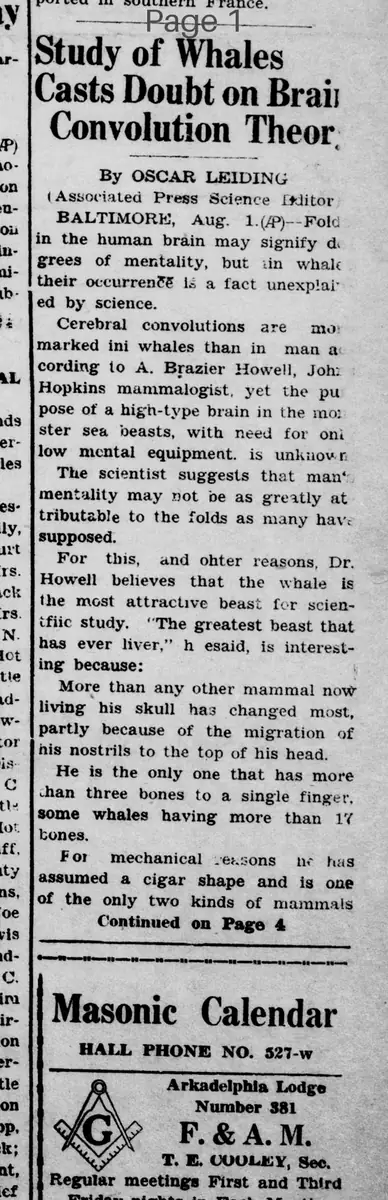
Casts Doubt on Brain
Convolution Theory
By OSCAR LEIDING
(Associated Press Science Editor)
BALTIMORE, Aug. 1.(AP)--Folds in the human brain may signify degrees of mentality, but in whales their occurrence is a fact unexplained by science.
Cerebral convolutions are more marked in whales than in man according to A. Brazier Howell, Johns Hopkins mammalogist, yet the purpose of a high-type brain in the monster sea beasts, with need for only low mental equipment, is unknown.
The scientist suggests that man's mentality may not be as greatly attributable to the folds as many have supposed.
For this, and other reasons, Dr. Howell believes that the whale is the most attractive beast for scientific study. "The greatest beast that has ever lived," he said, is interesting because:
More than any other mammal now living his skull has changed most, partly because of the migration of his nostrils to the top of his head.
He is the only one that has more than three bones to a single finger, some whales having more than 17 bones.
For mechanical reasons he has assumed a cigar shape and is one of the only two kinds of mammals whose tail has taken on a fish-like shape.
"Whalebone,"
the sieve through
which some
whales
strain their
food, occurs in no other mammal.
A whale
with a length
of 100
feet, has a gullet no more than five inches in diameter.
Sounds are transmitted by resonance through the bones of the head to an inner ear very different from that of other mammals.
He has a remarkable hide, so tender in some ways and so tough in others, and without skin glands.
He can submerge to a depth of a mile, yet can speed to the surface without being affected by the quick removal of pressure.
"A scientific understanding of the remarkable animal," Dr. Howell concluded, "would probably give knowledge that can be applied in correcting a number of serious, and even fatal, derangements of bodily functions to which man is subject."
What sub-type of article is it?
What themes does it cover?
What keywords are associated?
What entities or persons were involved?
Where did it happen?
Story Details
Key Persons
Location
Baltimore
Event Date
Aug. 1
Story Details
Johns Hopkins mammalogist A. Brazier Howell notes that whales have more cerebral convolutions than humans despite lower mental needs, questioning the link to intelligence. He highlights unique whale anatomy, such as skull changes, multiple finger bones, fish-like tail, whalebone sieve, small gullet, sound transmission, hide, and diving ability, making whales ideal for scientific study with potential human applications.