Thank you for visiting SNEWPapers!
Sign up free
The Evening Telegraph
Philadelphia, Philadelphia County, Pennsylvania
What is this article about?
A U.S. Navy officer responds to an editorial criticizing rear-admirals' conduct in the Brazil controversy, denying claims of disdain for civilian authority. He cites 1865 Navy Regulations on courtesies to diplomats and clarifies that naval officers aid but are not subordinate to ministers. The editor's note calls for further explanation of Admirals Godon and Davis's actions regarding U.S. Minister Washburn.
Clipping
OCR Quality
Full Text
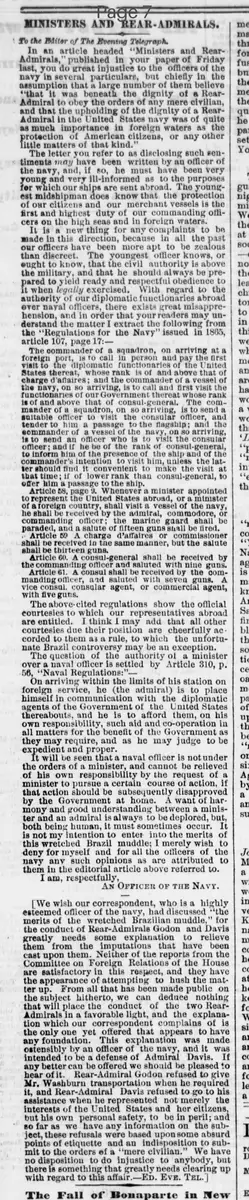
To the Editor of The Evening Telegraph.
In an article headed "Ministers and Rear-Admirals," published in your paper of Friday last, you do great injustice to the officers of the navy in several particulars, but chiefly in the assumption that a large number of them believe "that it was beneath the dignity of a Rear-Admiral to obey the orders of any mere civilian, and that the upholding of the dignity of a Rear-Admiral in the United States navy was of quite as much importance in foreign waters as the protection of American citizens, or any other little matters of that kind."
The letter you refer to as disclosing such sentiments may have been written by an officer of the navy, and, if so, he must have been very young and very ill-informed as to the purposes for which our ships are sent abroad. The youngest midshipman does know that the protection of our citizens and our merchant vessels is the first and highest duty of our commanding officers on the high seas and in foreign waters.
It is a new thing for any complaints to be made in this direction, because in all the past our officers have been more apt to be zealous than discreet. The youngest officer knows, or ought to know, that the civil authority is above the military, and that he should always be prepared to yield ready and respectful obedience to it when legally exercised. With regard to the authority of our diplomatic functionaries abroad over naval officers, there exists great misapprehension, and in order that your readers may understand the matter I extract the following from the "Regulations for the Navy" issued in 1865.
Article 107, page 17:—
The commander of a squadron, on arriving at a foreign port, is to call in person and pay the first visit to the diplomatic functionaries of the United States thereat, whose rank is of and above that of charge d'affaires; and the commander of a vessel of the navy, on so arriving, is to call and first visit the functionaries of our Government thereat whose rank is of and above that of consul-general. The commander of a squadron, on so arriving, is to send a suitable officer to visit the consular officer, and tender to him a passage to the flag-ship; and the commander of a vessel of the navy, on so arriving, is to send an officer who is to visit the consular officer; and if he be of the rank of consul-general, to inform him of the presence of the ship and of the commander's intention to visit him, unless the latter should find it convenient to make the visit at that time; if of lower rank than consul-general, to offer him a passage to the ship.
Article 58, page 9. Whenever a minister appointed to represent the United States abroad, or a minister of a foreign country, shall visit a vessel of the navy, he shall be received by the admiral, commodore, or commanding officer; the marine guard shall be paraded, and a salute of fifteen guns shall be fired.
Article 59. A charge d'affaires or commissioner shall be received in the same manner, but the salute shall be thirteen guns.
Article 60. A consul-general shall be received by the commanding officer and saluted with nine guns.
Article 61. A consul shall be received by the commanding officer, and saluted with seven guns. A vice consul, consular agent, or commercial agent, with five guns.
The above-cited regulations show the official courtesies to which our representatives abroad are entitled. I think I may add that all other courtesies due their position are cheerfully accorded to them as a rule, to which the unfortunate Brazil controversy may be an exception.
The question of the authority of a minister over a naval officer is settled by Article 310, p. 56. "Naval Regulations:—"
On arriving within the limits of his station on foreign service, he (the admiral) is to place himself in communication with the diplomatic agents of the Government of the United States thereabouts, and he is to afford them, on his own responsibility, such aid and co-operation in all matters for the benefit of the Government as they may require, and as he may judge to be expedient and proper.
It will be seen that a naval officer is not under the orders of a minister, and cannot be relieved of his own responsibility by the request of a minister to pursue a certain course of action, if that action should be subsequently disapproved by the Government at home. A want of harmony and good understanding between a minister and an admiral is always to be deplored, but, both being human, it must sometimes occur. It is not my intention to enter into the merits of this wretched Brazil muddle; I merely wish to deny for myself and for all the officers of the navy any such opinions as are attributed to them in the editorial article above referred to.
I am, respectfully,
An Officer Of The Navy.
[We wish our correspondent, who is a highly esteemed officer of the navy, had discussed the merits of the wretched Brazilian muddle," for the conduct of Rear-Admirals Godon and Davis greatly needs some explanation to relieve them from the imputations that have been cast upon them. Neither of the reports from the Committee on Foreign Relations of the House are satisfactory in this respect, and they have the appearance of attempting to hush the matter up. From all that has been made public on the subject hitherto, we can deduce nothing that will place the conduct of the two Rear-Admirals in a favorable light, and the explanation which our correspondent complains of is the only one yet offered that appears to have any foundation. This explanation was made ostensibly by an officer of the navy, and it was intended to be a defense of Admiral Davis. If any better can be offered we should be pleased to hear of it. Rear-Admiral Godon refused to give Mr. Washburn transportation when he required it, and Rear-Admiral Davis refused to go to his assistance when he represented not merely the interests of the United States and her citizens, but his own personal safety, to be in peril; and so far as we have any information on the subject, these refusals were based upon some absurd points of etiquette and an indisposition to submit to the orders of a "mere civilian." We have no disposition to do injustice to anybody, but there is something that greatly needs clearing up with regard to this affair.—ED. Eve. Tel.]
What sub-type of article is it?
What themes does it cover?
What keywords are associated?
What entities or persons were involved?
Letter to Editor Details
Author
An Officer Of The Navy
Recipient
To The Editor Of The Evening Telegraph
Main Argument
naval officers do not view obeying civilian authority as beneath their dignity; they are required to show courtesies to diplomats per navy regulations but operate independently and aid on their own responsibility, not under direct orders from ministers.
Notable Details