Thank you for visiting SNEWPapers!
Sign up free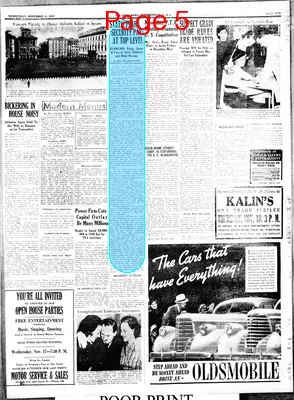
Story
November 17, 1937
The Times News
Hendersonville, Henderson County, North Carolina
What is this article about?
North Carolina's $6M social security program in 1937 aids 15,000 elderly ($9/mo avg), 8,000 children ($5), and 1,500 blind ($13), with 1938 plans to raise elderly payments by restricting to truly needy, per Commissioner Mrs. W.T. Bost.
Clipping

OCR Quality
95%
Excellent
Full Text
STATE PLANS SECURITY PAY AT TOP LEVEL
$6,000,000 Being Spent in Care of Aged, Children and Blind Persons
By WALTER DUSTMANN
United Press Staff Correspondent
(This is first of a series on the work of North Carolina state departments in 1937 and plans for 1938.—Editor's Note.)
United Press Associations.)
RALEIGH, Nov. 17.—(UP)—
The state of North Carolina's $6,000,000 social security program, already caring for 15,000 old persons, 8,000 children and 1,500 blind, faces 1938 with plans to keep payments at top levels.
While payments for aid of dependent children and the blind vary only slightly for maximums outlined in the federal program, individually old-age payments in North Carolina at present are averaging approximately $9 a month, or about half the national average, according to Mrs. W. T. Bost, state commissioner of charities and public welfare, whose department is handling social security.
"We are trying to increase the size of grants," Mrs. Bost said. "Nine dollars a month is not enough for old persons to live on. To raise this we are refusing to authorize payments under $5 and urging that no county allow payments to fall below $7 a person."
"That is our prime objective for 1938," the state's only woman commissioner explained. "We want to raise the level of payments and can only do so if we cut down the list of persons receiving payments to those actually needing the money."
Mrs. Bost explained that if payments become too generalized and "spread too thin" it will cut seriously into the amount paid each person. Instead of bettering the present $9 average the standard would fall even lower, she added.
"It is a social problem as well as one of economics," Mrs. Bost pointed out. "Those old persons who can possibly be cared for by children or relatives should never be allowed on our lists."
The vast social security program, instituted by the 1937 general assembly along federal lines, began July 1. During the first month upwards of 5,000 old persons, 3,000 children and 500 blind persons received aid payments.
By October the number receiving grants soared to 15,000 aged, 8,000 children and 1,500 blind, with payments averaging $8, $5 and $13, respectively.
Twenty-thousand old persons and a proportionate number of children and blind will be securing aid by January 1, 1938, Mrs. Bost indicated.
The number will increase gradually throughout next year until upwards of 25,000 aged will be on social security rolls, she said.
To meet the burden of caring for this large number of needy, the state has $6,000,000 available until the next general assembly meets in 1939, when additional funds will be appropriated.
Of this sum, the state is paying $1,000,000 for old persons, $500,000 for children and $185,000 for the blind. Each of the state's 100 counties—except those which have to dip into a special equalization fund for the purpose—contribute to the state's appropriation. The federal government matches dollar for dollar the combined state and county totals.
While the present old age average payment is $9, others vary from $7 to $15. Mrs. Bost explained this was because living costs of different localities were taken into consideration in allotting the grants.
$6,000,000 Being Spent in Care of Aged, Children and Blind Persons
By WALTER DUSTMANN
United Press Staff Correspondent
(This is first of a series on the work of North Carolina state departments in 1937 and plans for 1938.—Editor's Note.)
United Press Associations.)
RALEIGH, Nov. 17.—(UP)—
The state of North Carolina's $6,000,000 social security program, already caring for 15,000 old persons, 8,000 children and 1,500 blind, faces 1938 with plans to keep payments at top levels.
While payments for aid of dependent children and the blind vary only slightly for maximums outlined in the federal program, individually old-age payments in North Carolina at present are averaging approximately $9 a month, or about half the national average, according to Mrs. W. T. Bost, state commissioner of charities and public welfare, whose department is handling social security.
"We are trying to increase the size of grants," Mrs. Bost said. "Nine dollars a month is not enough for old persons to live on. To raise this we are refusing to authorize payments under $5 and urging that no county allow payments to fall below $7 a person."
"That is our prime objective for 1938," the state's only woman commissioner explained. "We want to raise the level of payments and can only do so if we cut down the list of persons receiving payments to those actually needing the money."
Mrs. Bost explained that if payments become too generalized and "spread too thin" it will cut seriously into the amount paid each person. Instead of bettering the present $9 average the standard would fall even lower, she added.
"It is a social problem as well as one of economics," Mrs. Bost pointed out. "Those old persons who can possibly be cared for by children or relatives should never be allowed on our lists."
The vast social security program, instituted by the 1937 general assembly along federal lines, began July 1. During the first month upwards of 5,000 old persons, 3,000 children and 500 blind persons received aid payments.
By October the number receiving grants soared to 15,000 aged, 8,000 children and 1,500 blind, with payments averaging $8, $5 and $13, respectively.
Twenty-thousand old persons and a proportionate number of children and blind will be securing aid by January 1, 1938, Mrs. Bost indicated.
The number will increase gradually throughout next year until upwards of 25,000 aged will be on social security rolls, she said.
To meet the burden of caring for this large number of needy, the state has $6,000,000 available until the next general assembly meets in 1939, when additional funds will be appropriated.
Of this sum, the state is paying $1,000,000 for old persons, $500,000 for children and $185,000 for the blind. Each of the state's 100 counties—except those which have to dip into a special equalization fund for the purpose—contribute to the state's appropriation. The federal government matches dollar for dollar the combined state and county totals.
While the present old age average payment is $9, others vary from $7 to $15. Mrs. Bost explained this was because living costs of different localities were taken into consideration in allotting the grants.
What sub-type of article is it?
Historical Event
What themes does it cover?
Justice
Recovery
Moral Virtue
What keywords are associated?
Social Security
North Carolina
Old Age Assistance
Dependent Children
Aid To Blind
Welfare Payments
What entities or persons were involved?
Mrs. W. T. Bost
Walter Dustmann
Where did it happen?
Raleigh, North Carolina
Story Details
Key Persons
Mrs. W. T. Bost
Walter Dustmann
Location
Raleigh, North Carolina
Event Date
1937 1938
Story Details
North Carolina's social security program, started July 1, 1937, provides aid to elderly, children, and blind with $6M budget; plans for 1938 focus on raising average payments by limiting to neediest recipients.