Thank you for visiting SNEWPapers!
Sign up free
Daily Kennebec Journal
Augusta, Kennebec County, Maine
What is this article about?
In Bangor, Maine, on April 9, 1911, authorities enforced a 10 PM bar closing and banned Sunday liquor sales, surprising the city after months of lax rules. Mayor Mullen asserted police control, while Sheriff White and County Attorney Thompson resist amid political tensions.
Clipping
OCR Quality
Full Text
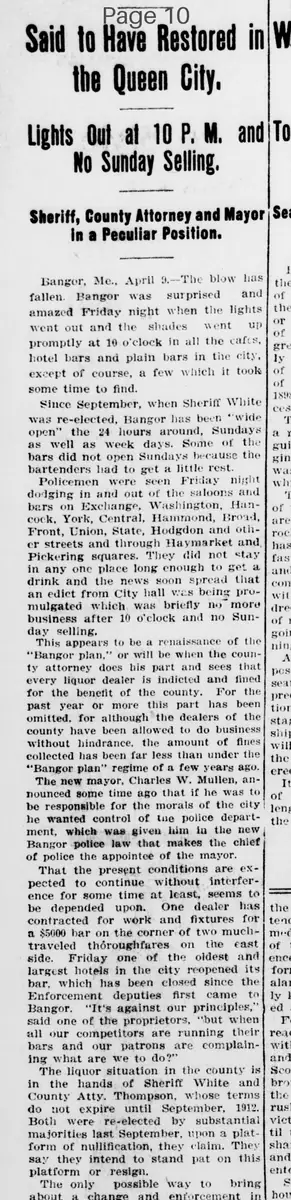
Lights Out at 10 P. M. and No Sunday Selling.
Sheriff, County Attorney and Mayor in a Peculiar Position.
Bangor, Me., April 9.--The blow has fallen. Bangor was surprised and amazed Friday night when the lights went out and the shades went up promptly at 10 o'clock in all the cafes, hotel bars and plain bars in the city, except of course, a few which it took some time to find.
Since September, when Sheriff White was re-elected, Bangor has been "wide open" the 24 hours around, Sundays as well as week days. Some of the bars did not open Sundays because the bartenders had to get a little rest.
Policemen were seen Friday night dodging in and out of the saloons and bars on Exchange, Washington, Hancock, York, Central, Hammond, Broad, Front, Union, State, Hodgdon and other streets and through Haymarket and Pickering squares. They did not stay in any one place long enough to get a drink and the news soon spread that an edict from City Hall was being promulgated which was briefly "no more business after 10 o'clock and no Sunday selling."
This appears to be a renaissance of the "Bangor plan," or will be when the county attorney does his part and sees that every liquor dealer is indicted and fined for the benefit of the county. For the past year or more this part has been omitted, for although the dealers of the county have been allowed to do business without hindrance, the amount of fines collected has been far less than under the "Bangor plan" regime of a few years ago.
The new mayor, Charles W. Mullen, announced some time ago that if he was to be responsible for the morals of the city he wanted control of the police department, which was given him in the new Bangor police law that makes the chief of police the appointee of the mayor.
That the present conditions are expected to continue without interference for some time at least, seems to be depended upon. One dealer has contracted for work and fixtures for a $5000 bar on the corner of two much-traveled thoroughfares on the east side. Friday one of the oldest and largest hotels in the city reopened its bar, which has been closed since the enforcement deputies first came to Bangor. "It's against our principles," said one of the proprietors, "but when all our competitors are running their bars and our patrons are complaining what are we to do?"
The liquor situation in the county is in the hands of Sheriff White and County Atty. Thompson, whose terms do not expire until September, 1912. Both were re-elected by substantial majorities last September, upon a platform of nullification, they claim. They say they intend to stand pat on this platform or resign.
The only possible way to bring about a change and enforcement in Penobscot county is by pressure from the Democratic State machine, and whether such pressure will be brought to bear is a problem. Mayor Mullen, a Democratic State senator, would no doubt fall in with any program, but Sheriff White's ideas might be averse to receding from his stand pat policy.
What sub-type of article is it?
What keywords are associated?
What entities or persons were involved?
Where did it happen?
Domestic News Details
Primary Location
Bangor, Me.
Event Date
April 9
Key Persons
Outcome
bars and saloons closed at 10 pm; no sunday selling enforced; potential indictments and fines for liquor dealers; some hotels reopening bars despite principles.
Event Details
Bangor bars closed promptly at 10 PM on Friday night, ending 24-hour operations including Sundays that had been allowed since September. Mayor Mullen gained control of police to enforce morals; sheriff and county attorney face pressure but stand on nullification platform until September 1912.