Thank you for visiting SNEWPapers!
Sign up free
Gazette Of The United States, & Philadelphia Daily Advertiser
Philadelphia, Philadelphia County, Pennsylvania
What is this article about?
An editorial signed 'FONTAINE' vehemently opposes Thomas M'Kean's candidacy for Governor of Pennsylvania, refuting rumors about his Irish descent, Catholicism, temper, and connections, while charging him with excessive vanity that would lead to corrupt governance. It contrasts him favorably with James Ross, urging voters to choose a steady leader over a 'political weathercock'.
Merged-components note: This is a single editorial piece continued across pages 2 and 3, merged based on sequential reading order and narrative continuity.
Clippings
1 of 2
OCR Quality
Full Text
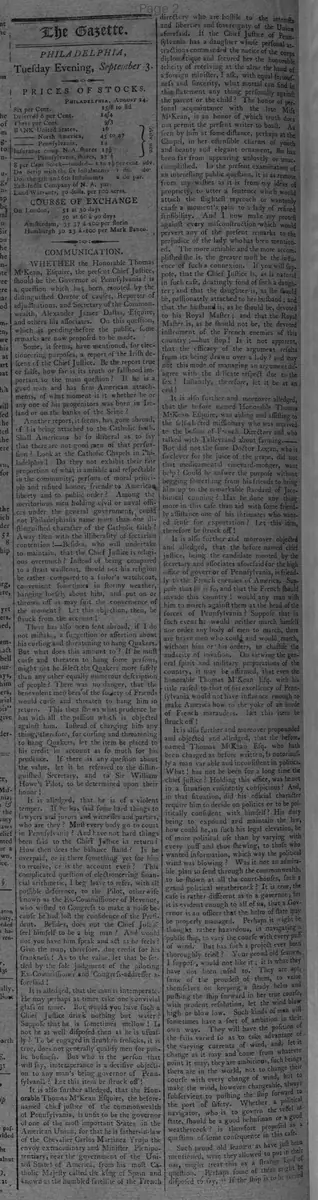
WHETHER the Honorable Thomas M'Kean, Esquire, the present Chief Justice, should be the Governor of Pennsylvania? is a question which has been mooted by the distinguished Orator of causes, Reporter of adjudications, and Secretary of the Commonwealth, Alexander James Dallas, Esquire, and others his associates. On this question, which is pending before the public, some remarks are now proposed to be made.
Some, it seems, have mentioned, for electioneering purposes, a report of the Irish descent of the Chief Justice. Be the report true or false, how far is its truth or falsehood important to the main question? If he is a good man and has firm American attachments, of what moment is it whether he or any one of his progenitors was born in Ireland or on the banks of the Seine?
Another report, it seems, has gone abroad, of his being attached to the Catholic faith. Shall Americans be so illiberal as to say that there are not good men of that persuasion? Look at the Catholic Chapels in Philadelphia! Do they not exhibit their fair proportion of what is amiable and respectable in the community, possessors of moral principle and refined honor, friends to American liberty and to public order? Among the meritorious men holding civil or naval offices under the general government, could not Philadelphians name more than one distinguished character of the Catholic faith?
A way then with the illiberality of sectarian contention!-Besides, who will undertake to maintain, that the Chief Justice is religious overmuch? Instead of being compared to a friar's waistcoat, should not his religion be rather compared to a sailor's watchcoat, convenient sometimes in stormy weather, hanging loosely about him, and put on or thrown off as may suit the convenience of the moment? Let this objection, then, be struck from the account!
There has also been sent abroad, if I do not mistake, a suggestion or assertion about his cursing and threatening to hang Quakers. But what does this amount to? If he must curse and threaten to hang some persons, might not he select the Quakers more safely than any other equally numerous description of people? There was no danger, that the benevolent members of the society of Friends would curse and threaten to hang him in return. This then shows what prudence he has with all the passion which is objected against him. Instead of charging him anything, therefore, for cursing and threatening to hang Quakers, let the item be placed to his credit in account as so much for his prudence. If there is any question about the value, let it be referred to the distinguished Secretary, and to Sir William Howe's Pilot, to be determined upon their honor!
It is alleged, that he is of a violent temper. If he has said some hard things to lawyers and jurors and witnesses and parties, who are they? Must every body go to court in Pennsylvania? And have not hard things been said to the Chief Justice in return? How then does the balance stand? Is he overpaid, or is there something yet for him to receive, or is the account even? This complicated question of electioneering financial arithmetic, I beg leave to refer, with all possible deference, to the Pilot, otherwise known as the Ex-Commissioner of Revenue, who wished to Congress to make a noise because he had lost the confidence of the President. Besides, does not the Chief Justice feel himself to be a big man? And would not you have him speak and act as he feels? Give the man, therefore, due credit for his frankness! As to the value, let that be estimated by the sole judgment of the piloting Ex-Commissioner and Congress-addressee aforesaid!
It is alleged, that the man is intemperate. He may perhaps at times take one convivial glass or more. But would you have such a Chief Justice drink nothing but water? Suppose that he is sometimes mellow! Is not he as well disposed then as he is usually? To be engaged in drunken frolicks, it is true, does not generally qualify men for public business. But who is the person that will say, intemperance is a decisive objection to any man's being governor of Pennsylvania? Let this item be struck off!
It is also further alleged, that the Honorable Thomas M'Kean Esquire, the before-named chief justice of the commonwealth of Pennsylvania, is unfit to be the governor of one of the most important States in the American Union, for that he is father-in-law of the Chevalier Carlos Martinez Yrujo the envoy extraordinary and Minister Plenipotentiary, near the government of the United States of America, from his most Catholic Majesty called the king of Spain and known as the humbled satellite of the French directory who are hostile to the interests and liberties and sovereignty of the Union aforesaid. If the Chief Justice of Pennsylvania has a daughter whose personal attractions commanded the notice of the corps diplomatique and secured her the honorable felicity of receiving at the altar the hand of a foreign minister, I ask, with equal seriousness and sincerity, what mortal can find in this statement anything personally against the parent or the child? The honor of personal acquaintance with the late Miss M'Kean, is an honor of which truth does not permit the present writer to boast. As seen by him at some distance, perhaps at the Chapel, in her ostensible charms of youth and beauty and elegant ornament, he has been far from appearing unlovely or unaccomplished. In the present examination of an interesting public question, it is as remote from my wishes as it is from my ideas of propriety, to utter a sentence which would attach the slightest reproach or wantonly cause a moment's pain to a lady of refined sensibility. And I now make my protest against every misconstruing which would pervert any of the present remarks to the prejudice of the lady who has been mentioned. The more amiable and the more accomplished she is, the greater must be the influence of such a connexion. If you will suppose, that the Chief Justice is, as is natural in such case, doatingly fond of such a daughter; and that the daughter is, as she should be, passionately attached to her husband; and that the husband is, as he should be, devoted to his Royal Master; and that the Royal Master is, as he should not be, the devoted instrument of the French enemies of this country ;-but stop! Is it not apparent, that the efficacy of the argument results from its being drawn over a lady? and may not this mode of managing an argument disagree with the delicate respect due to the sex? Instantly, therefore, let it be at an end!
It is also further and moreover alleged, that the before named Honorable Thomas M'Kean Esquire, was aiding and abetting to the self-elected missionary who was received to the bosom of French Directors and who talked with Talleyrand about farming. But did not the same Doctor Logan, who is so clever for the juice of the grape, did not that medicamental vineyard-monger, want help? Could he answer the purpose without begging something from his friends to bring him up to the remarkable standard of Jacobinical cunning? Has he done any thing more in this case than aid with some friendly assistance one of his intimates who wanted fence for exportation? Let this item, therefore be struck off!
It is also further and moreover objected and alleged, that the before named chief justice, being the candidate mooted by the Secretary and associates aforesaid for the high office of governor of Pennsylvania, is friendly to the French enemies of America. Suppose that he is so, and that the French should invade this country! would any man wish him to march against them at the head of the forces of Pennsylvania? Suppose that in such event he would neither march himself nor order any body of men to march, there are brave men who could and would march, without him or his orders, to chastise the audacity of invasion. On viewing the general spirit and military preparations of the country, it may be affirmed, that even the honorable Thomas M'Kean Esq. with his title raised to that of his excellency of Pennsylvania would not have influence enough to make America bow to the yoke of an horde of French marauders. Let this item be struck off!
It is also further and moreover propounded and objected and alleged, that the before-named Thomas M'Kean Esq. who hath been charged as before written, is notoriously a man variable and inconsistent in politics. What! has not he been for a long time the chief justice? Holding this office, was he not in a situation eminently conspicuous? And, in that situation, did his official character require him to decide on politics or to be politically consistent with himself? His duty being to expound and maintain the law, how could he, in such his legal elevation, be of more political use than by varying with every gust and thus shewing, to those who wanted information, which way the political wind was blowing? Was it not an admirable plan to send through the commonwealth, to be shown at all the court-houses, such a grand political weathercock? It is true, the case is rather different as to a governor; for it is evident enough to all of us, that a Governor is an officer that the helm of state may be properly managed. Perhaps it might be thought rather hazardous, in navigating a public ship, to vary the course with every puff of wind. But has such a project ever been thoroughly tried? Your proud old seamen, I suppose, would not like it ; it is what they have not been used to. They are apt, some of the proudest of them, to value themselves on keeping a steady helm and pushing the ship forward in her true course, with prudent resolution, let the wind blow high or blow low. Such kinds of men will sometimes have a sort of ambition in their own way. They will have the position of the sails varied so as to take advantage of the varying currents of wind, and, let it change as it may and come from whatever point it may, they are ambitious, such beings there are in the world, not to change their course with every change of wind, but to make the wind, however changeable, always subservient to pushing the ship forward to the port of safety. Whether a political state, should be a good helmsman or a good weathercock? is therefore proposed as a question of some consequence in this case.
Such proud old seamen as have just been mentioned, were they allowed to put in their question. Perhaps some of them might be disposed to say, If the ship is to be turned about with every squall, might as well have no steersman, as this as a strange kind of disposed to say, If the ship is to be turned and twisted, and toiled and whirled about with every wind, you might as well have no helm at all. If the ship is to be managed in this fashion, he will never reach her port but must founder or be wrecked. In a stormy season, do you want a weathercock for a public ship? Of what possible use would it be in a gale? At such a time, a good helmsman is what you want and what you should have. But as to a weathercock, what seaman or what merchant or what anybody else before was ever so curst with folly as to believe that a ship wants one? Place your weathercock over a brewery, or over a distillery, or sell it for old brass, or give it away to some tinker, or do with it anything else, or nothing at all but don't have it stuck up a-board the ship!" These sailors, however, are a queer sort of men. When they have followed the seas for a long time and become familiar with every sail, and every piece of rigging, and every rope, and every block and have weathered many a storm, and become acquainted with the different currents and soundings and head-lands, they affect to believe that persons who have never been on salt water are not qualified to instruct them in seamanship. As to the whole of your full-blooded American seamen, I don't remember to have seen one of them who deserved to be called a genuine, first-rate, metaphysical, cosmopolitical, French philosopher, not one who knew even the longitude and latitude of the Salines which used to lie so fatal to the vast cubic volume of the Mammoth. Again, therefore, I say, these same seamen are a queer sort of men. One of them would give away half his tobacco and half his grog-stuff for the sake of an old friend; and, in case of need, would perhaps give away all his money to help his friend cheerily on his way. If you should trust one of them with a little child, who perhaps would never do him any good, and that child should be in danger, one of these very seamen, instead of taking care of himself by running off alone, would rather expose himself to save the child, and would fight and perhaps be killed for its protection. Have not several of these same seamen, who were proud of having a good ship under foot and of doing well for their owners, stood to quarters when off inferior force, and been shot at by French corsairs? and, what is worse yet, have not they shot right back again and let out streams of French purple, and beaten off the rare friends and allies, and come into port with colours flying, and as proud as if they were American heroes? Now, whether all this sort of thing, whether all this notion of generosity and self-exposure, and this fashion of fighting and beating the fraternally plundering French pouters of liberty and equality, whether all this sort of thing, I say, does not prove them a parcel of fools and saucy fellows? Is the question, which, with all due submission, I propose to have referred to the distinguished secretary as sole arbiter. Yet, after all, there seems to be reason in some of the notions of these same old seamen, queer as they are; and, after what I have said about them, I am yet willing to acknowledge, if it is partly agreeing with them, that I do not see much use for a weathercock a-board ship. Suppose, however, that on this point, we should also take the opinion of the distinguished secretary! - He avows and avows it in the newspaper too, that the weathercock is the thing for him. And is not he a knowing man? Let this item, then, be laid out of the account for the present! With the observations already made, so far as respects the main question now pending about a governor, might we take leave of the greater part of the preceding objections which have been publicly circulated against the chief justice M'Kean. The consideration of his being a notorious weathercock in the political world, is the only one of them which is further proposed to be directly insisted on. A reason for not laying this wholly aside is, that from this fact an argument may arise in support of an objection which is yet to be stated. The objection is of a nature which should be decisive with gentlemen of reputation, decisive with electors of honest hearts and independent minds, whatever may have been the place of their birth, whatever may be their religious creed, whatever may be their general sentiments on national politics. It is an objection which applies directly to the honor and the interests of Pennsylvania in particular. The charge is especially important as relative to the office of governor. If it is clearly supportable, as I think it is, against Thomas M'Kean, his advocates may place to his credit as many specious items as they dare state and may estimate them at any value within the utmost latitude of decency; the establishment of this charge, after all the credits which a partial friendship may bring forward in his favor, must, on a fair adjustment of the whole account, irretrievably doom him to political bankruptcy. Were it not related to this charge, therefore, the item about the weathercock might now be disregarded, if any use, bearing any tolerable proportion to the expense, could be found for a weathercock on board a public ship. But where shall it be placed, or what shall be done with it after it is a-board? It will not answer to have it placed at the royal-mast-head, or on the round-house, or on the quarter-deck, or on the fore-castle. It is not fit to be in the cabin. It is worse than nothing at the wheel. What then shall be done with it? Must it be thrown overboard before the end of the cruise? Or shall it be towed away in the hospital room? Or shall it be headed up in an empty wine cask or rum puncheon? Or shall it be tumbled below for all hands to do with it as they please? Throw down to them, however, such a thing as a weathercock a-board ship! and now stand by to see what becomes of the brainless chanticleer! it flies like feathers in a whirlwind. Neither of these plans, therefore, is quite satisfactory. I think of one thing more which looks a little feasible and seems as if a weathercock might be turned to some account on board a public ship. It is, to cut up the weathercock for flaps to cover the vent holes of the cannon. But, on a moment's reflection, it is clear, that a sheet of lead would be much cheaper and much better. This, then, is a difficulty which might puzzle almost any of the Philadelphia lawyers who have only such common minds as Tilghman or Rawle. But the big mind of Dallas is different from theirs. He says, the weathercock is the very thing. Let him, therefore, point out its use for the ship! You can do many things, Mr. Dallas: But can you do this? What, however, is this charge which is yet to be brought forward in objection to M'Kean's being governor?--I answer, It is a charge, for which no talent, no knowledge, no past service, no respect for moral or religious principle, ought to be admitted as a political compensation. It is a frailty of pernicious energy, which may render all a man's other qualities useless or worse than useless for the public service. In a political view, it has the mischievous activity of artful vice and the weakness without the innocence of folly. It may render talent and knowledge and office impotent to good but powerful for evil. The frailty is more fatally destructive in a chief magistrate than in any other civil officer. In him, without producing that malediction which points at folly the steady finger of general contempt, without exciting that impetuous indignation which drags to punishment public vice, it may be followed by evils rivalling those of vice and folly united. Although the characteristic frailty to which I refer is so fatally mischievous in a public man, and especially in a chief magistrate, it is a frailty which no law can reach or adequately chastise except the law of public opinion. It is an excessive vanity which sacrifices personal honor and public duty. That the remarks as to this particular may be the better apprehended, permit me to mention one of Aesop's fables, the moral of which is so plain, that it may be felt and understood by a child! It is that of the crow and the fox. The substance of the fable may be stated thus--"An hungry fox, passing under a tree, heard a rustling over head, and, looking up, saw a crow on one of the topmost branches. A favourite morceau, which the crow was holding within his beak, instantly caught the eye, and sharpened the appetite of the fox. This fox was an old one, and had been so much in the world, that he knew the observations commonly made about the crow. To steal the piece of food out of the mouth of the crow when raised so high above all ordinary reach, was the thing for the hungry old fox to desire and attempt. There was one frailty which characterized the crow. The fox knew it well; and the slyness of his nature, aided by practice, has resolved to take advantage of this frailty, for accomplishing his object. The conversation being introduced by his complimentary wishes of health and happiness to the crow, the fox goes on to accuse common fame as a liar, and subjoins, by way of proof, that he has at length the personal satisfaction of knowing, from the evidence of his own senses, in opposition to common fame, that the beauties of the crow are of superlative elegance and whiteness. Finding this flattery acceptable, the fox expresses his high admiration of good singing, and, in a style of profound respect, intimates a wish to be personally satisfied whether the crow excels in charms of voice as much as in other accomplishments. Open gapes the crow's mouth to sing. Out drops the favorite piece, and is in the mouth of the fox, who turns up an eye, laughs at the crow, and trotting off with his prize, has left the silly thing to feel the reproach and the loss occasioned by vanity." If Thomas M'Kean is raised to the elevated situation of governor, he will be the rustling political crow of Pennsylvania; and his favorites of the moment will be interested flatterers. The parasites are the foxes, to filch from his vanity whatever is precious within his public power; and the public honor and treasure will be their port and their prey. Can this be denied? Where is the man who will say, that excessive vanity is not a characteristic frailty of the honorable Thomas M'Kean, Esquire? Whence is it that he, the chief justice of Pennsylvania, has so far disregarded his personal honor as to become notoriously a political weathercock, except from that excessive vanity which prefers the language of flattery and the glittering tinsel of office, to the manly consciousness of merited approbation? Ask judges and lawyers and jurors and witnesses and suitors and spectators, respecting his demeanor on the bench! Will they not attest, that decisions have been obtained from his vanity, which could never have been obtained by solely addressing his integrity as a man, or his impartiality as a judge? Yet if there be on earth a situation where man should not permit the semblance of flattery to approach his soul, is it not when he appears on the bench as the presiding minister, as the chief priest, in the temple of justice? Ask, if Thomas M'Kean, high and honorable as he is, when appearing under this venerable character, has not permitted himself to be addressed in terms of the most obvious adulation? Ask, what has been the effect! Ask, if he has not decided the point for the flattering advocate without once hearing the opposite party in reply! In smaller questions, smaller praise may suffice him. His vanity is tickled; his mouth opens; and out drops his judgment. More important questions may require more deliberate arrangement. Ask, however if it is not uniformly the case that, when the subject of his own admired self is covertly introduced, and gradually displayed, he will eventually relish flattery whose palpable grossness is as disgusting to others as it is grateful to himself! Ask, if he will not thus relish his own praises when he should forget himself and attend solely to the cause before him that he might judge righteous judgment! Ask, if, at such times and in such places, the utmost profusion of flattery, poured forth upon the great Thomas M'Kean, like an inundation, tumbled in cascades over a mountain of flint, has not been borne with unmoved composure! Mark this same chief justice, displaying himself in the walks of private life! There, is it not one of the easiest of human efforts to make him speak his own praise? Ask those who know him, if, when invited and uninvited by the turn of conversation, he will not dwell on the darling theme until his hearers feel for him those blushes to which his self-admiration is a stranger! Mention in his presence events in which he is known to have had some part, and ask about the importance of the scene in which he acted! Will he then be silent in his own praise? Intimate the number of places which he has at any time holden, and enquire if the weight of multiplied business was not oppressive! Ask about his conduct as a military officer during the war of the revolution, and about general Washington's conversations with him or about him? Ask about his having been in Congress, and about the difficulties of past times! Will he not instantly fly at the lure, and devour his own fame? It is not from a wish to detract from the reputation due to his public services, whatever they may in truth have been, that he is now charged with an excessive vanity, so incompatible with public duty and with personal honor. May my arm fall from the shoulder, may my tongue be paralyzed, and shame burn my cheek to cinder, sooner than I be disposed to deny the meed of merited fame to the great men who, during the revolution, did many great and worthy deeds for our nation! At the name of Washington and of great men like him, what American does not bow in respectful gratitude for their eminent achievements of patriotism? But where is the American who will presume to flatter the commander in chief of the patriot army of the revolution? Shew me the man who dare adventure on the experiment of making that accomplished gentleman and hero speak his own various services, and depict himself as the sole hero of the tale! Most assuredly, I have not intended to cast reproach on the military leader of the American revolution in mentioning his name so near to that of the honorable Thomas M'Kean, Esquire, and speaking of the general in chief of the American army, as completely contrasted to the chief justice of Pennsylvania. As to this sort of great man, this chieftain on the bench, legally honorable as he is, ask those who now support his vain pretensions to the chief magistracy, whether they have not done so, and whether they are not at present doing so, against their own individual judgment! Ask, whether they have not submitted to this proceeding, against their own personal choice, because he insisted on being crowded forward as the candidate for the chair of government, and because also they knew his obstinate and unforgiving and vindictive vanity, and thus knew that he would exert against them, with his utmost energies, all his powers and all his resources of influence, if they did not submit to his overbearing wishes for office! The evidence of this unequivocal charge might doubtless be stated in detail. But is this procedure necessary to establish it? Let application be made to any man of any party who is a person of observation and has had an opportunity of knowing the chief justice of Pennsylvania! Is there to be found among them all one man of tolerable pretensions to reputation who will have the face to deny, that, of all the public men in the commonwealth, this chief justice is one of the most excessively vain? This charge, then, of excessive vanity, is too true to be denied, too notoriously true to be evaded. Let it not, however, be imagined that the present observations are meant to convey the idea that even the honorable Thomas M'Kean, Esq. may be acceptably flattered at all times and in all places, and upon all subjects! This would be too much for the utmost capacity of human vanity. After all his praises of himself, Thomas M'Kean is still but a frail human creature The flattery, which is expected to be well relished by this frail being, should have in it something like speciousness and something like regard to incidental situation. If you wish, at some favourable time and in some favourable place, to make an experiment upon him, praise him, if you please for personal beauty, for elegance of manners, for celebrity as a lawyer, for general cleverness at various employments! praise him for military genius, for extent and profundity of legal knowledge, for general science, for political skill, for multiplicity of public trusts, for magnitude of public services! Praise him, if you please, for almost any thing and every thing which can be thought desirable and praiseworthy, except the dignified decorum with which he supports his personal authority in his own family! In a favourable moment of sunshine, the glossy stiffness of the crow might be praised as emulating the delicate beauties, the elegant contours, of the swan. The crow too might be flattered for imagined charms of a real voice. But this praising the crow for a fine singer, was doubtless bad enough. To praise a certain very praiseworthy personage for the superlative excellence of domestic government, might be thought too bad. Such flattery might be pronounced, like his vanity, too gross and palpable to escape. It might be doubted whether his repository for flattery, even if its digestive powers rivalled those of the Ostrich, would digest such extraordinary food as this would be. It would be like desiring a man to swallow a loaded little pistol with a spring-trigger, while you held a silken cord to fire it off within his stomach. No! I think, the man, whoever he might be, would not be silly enough to take such a thing down with his eyes open and with his usual senses about him. Before agreeing to it, his eyes must be sealed and he must take a different enemy into his mouth to steal away his understanding.-- Some praise may be too outrageous to be relished even in fable. In general, it might be thought carrying matters very far indeed, to praise a Crow as equalling the Eagle of the western mountains in elevation and force of character. This might be too much for moral fable: but, to subserve the cause of their inconceivable patriotism, some of the old dealers in political fiction, after giving their consciences a parting kick, might say, that it ought to pass not only as possible but as absolute truth. It would, however be carrying flattery to an extreme too inadmissible for moral and political fable, to represent a crow as rivalling the elephant sustaining the castle of imperial power. Or to put the case so as to explain the idea yet more clearly-It would be outrageous, to say, that a crow placed in the chair of state in Pennsylvania would rival, in personal authority, the famous Aurengzebe borne aloft on his war-elephant and contending for empire in the plains of Hindostan. To say this of the honorable Thomas M'Kean and to the honorable Thomas M'Kean in proper person, might embarrass the high-flown front of the exotic secretary as well as the circumlocutory gentleness of the calculating Pilot. To save their embarrassment, therefore, let it be waived, although it is plain to common sense that a man who has not capacity for government is not fit for a Governor! Shall, then, the honorable Thomas M'Kean Esquire be the governor of Pennsylvania The charge of excessive vanity being clearly fastened upon him, what would be the effects of this characteristic frailty under his administration? The character of Pennsylvania abroad, its internal honor, and particular interests. all are concerned in the event. What's the name of that open-mouthed crow who governs Pennsylvania? is a question, which no man who values the general reputation of the state would wish to have asked by strangers who might know the character, without knowing the person, of the governor. If you would avoid the public reproach of such a question--Beware of choosing the Crow to govern. Considerations, however, far more interesting to Pennsylvania are involved in the choice of a Governor. Among the numerous civil and military appointments which may for years depend on that magistrate, what will be the consequence if the appointments are to be conferred on parasites and the friends of parasites? Where are the men of exalted honor, where are the men of talent, where are the men of virtue, where in a word are the men eminently qualified for public business who would submit or desire their friends to submit to the base compliances which would secure appointments under such a system of favoritism? If men thus capable of advancing the public interests, if men thus meriting the public confidence, if men thus formed to be useful and honor their country, are to be excluded from the Governor's appointments, in what hands is the vain man to place the affairs of the state? Will not appointments obtained by dishonorable means, by parasitical arts, be also converted to dishonorable purposes? Shall lips of falsehood and tongues of deceit be characteristic of your public officers? And will not their hands be as polluted as their lips, as fraudulent as their tongues? Would not such be the consequence of such a system of parasitical favoritism? But if you are willing to discard from office whatever is honorable, whatever is manly, whatever is dignified, if you are willing to discard all those qualities which fortify and adorn the independent spirit of virtue, are you also willing to abandon to insidious sharpers the pecuniary treasures of Pennsylvania? Consider the legal provisions intended to facilitate the means of transportation and conveyance by land and water throughout the commonwealth! Consider all your various establishments of public police! Consider how much the distribution of the large sums wisely destined or to be destined for these extensive purposes must depend on the pleasure of the Governor! Consider the various opportunities of artfully misdirecting or misapplying them! Will not the favored parasites procure them to be directed as may best answer their own interested views? Consider how much may be expended in improper places, while those which are proper are wholly disregarded or but partially noticed! Consider how much may be squandered from being intrusted to incapable hands! Consider too, if honest men can form any estimate on such a subject, how much may disappear, because intrusted to hands worse than incapable! What fairness in the distribution, what judgment or fidelity in the application, of the public treasures, ought to be expected. if such is to be the general character of extensive appointments and management? Under such a system of individual degradation, of public weakness and of interested artifice, where are you to find those equal benefits, that general improvement and prosperity and wealth and honor, which have been projected with so much celebrity and with such prospects of success for Pennsylvania? This excessive vanity which is the prey of flattery, this vanity which makes a public man the pity of his friends, the scorn of his enemies, and the tool of knaves, is an evil full of deadly poison to the state. Let all good men consider whether the body politic of Pennsylvania should be destined to suffer the incalculable evils of this insidious and ferocious poison! Let all men of sense, who dare to look at the subject with a steady eye. reflect and judge whether such will not be its destiny if Thomas M'Kean is appointed its Governor! Widely different from him is James Ross of Pittsburgh. One of these two men is to be the Governor of the Commonwealth.-- Reflect with the dignity of free citizens, and choose between them! Is, then, James Ross, or is Thomas M'Kean the man whom you will delight to honor with your suffrages? What shall be the armorial bearing of your political standard? At this question, does a blushing recollection of the past make you hesitate to avow your purpose for the future? Then, Sir, congratulate yourself on that blush! It is the glow of honorable sentiment. Indulge the full return of those manly principles which are yet precious to your heart! The indulgence will be for your interest as it is to your honor. Resume, then, your noble self, and decide as becomes the respectable character of a free American! You may then smile at an electioneering weakness which no longer afflicts you, and may promptly answer without that shrinking dread of reproach. , The inquiry, therefore, is now repeated. What shall be the armorial bearing of your political standard? Shall it be the American Eagle, or an open mouthed Crow? What shall be the character of your political navigator? Say which of the two you will have, a complete Helmsman, or a complete Weathercock! FONTAINE.
What sub-type of article is it?
What keywords are associated?
What entities or persons were involved?
Editorial Details
Primary Topic
Opposition To Thomas M'kean As Governor Of Pennsylvania Due To Excessive Vanity
Stance / Tone
Strongly Anti M'kean, Satirical Mockery, Supportive Of James Ross
Key Figures
Key Arguments