Thank you for visiting SNEWPapers!
Sign up free
Story
May 26, 1859
New Hampshire Journal Of Agriculture
Manchester, Hillsborough County, New Hampshire
What is this article about?
H.W. Beecher humorously critiques a farmer leaving a plow exposed in a Western field for 'acclimation,' speculates on reasons, and dreams of the farmer's disorganized barn and house, stressing proper tool storage and domestic economy.
Clipping
OCR Quality
98%
Excellent
Full Text
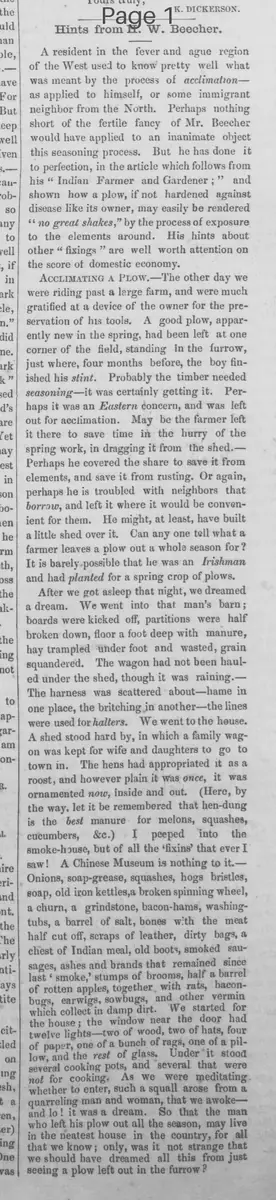
Hints from H. W. Beecher.
A resident in the fever and ague region of the West used to know pretty well what was meant by the process of acclimation—as applied to himself, or some immigrant neighbor from the North. Perhaps nothing short of the fertile fancy of Mr. Beecher would have applied to an inanimate object this seasoning process. But he has done it to perfection, in the article which follows from his "Indian Farmer and Gardener:" and shown how a plow, if not hardened against disease like its owner, may easily be rendered "no great shakes," by the process of exposure to the elements around. His hints about other "fixings" are well worth attention on the score of domestic economy.
ACCLIMATING A PLOW.—The other day we were riding past a large farm, and were much gratified at a device of the owner for the preservation of his tools. A good plow, apparently new in the spring, had been left at one corner of the field, standing in the furrow, just where, four months before, the boy finished his stint. Probably the timber needed seasoning—it was certainly getting it. Perhaps it was an Eastern concern, and was left out for acclimation. May be the farmer left it there to save time in the hurry of the spring work, in dragging it from the shed.—Perhaps he covered the share to save it from elements, and save it from rusting. Or again, perhaps he is troubled with neighbors that borrow, and left it where it would be convenient for them. He might, at least, have built a little shed over it. Can any one tell what a farmer leaves a plow out a whole season for?
It is barely possible that he was an Irishman and had planted for a spring crop of plows.
After we got asleep that night, we dreamed a dream. We went into that man's barn; boards were kicked off, partitions were half broken down, floor a foot deep with manure, hay trampled under foot and wasted, grain squandered. The wagon had not been hauled under the shed, though it was raining.—The harness was scattered about—hame in one place, the britching in another—the lines were used for halters. We went to the house. A shed stood hard by, in which a family wagon was kept for wife and daughters to go to town in. The hens had appropriated it as a roost, and however plain it was once, it was ornamented now, inside and out. (Here, by the way, let it be remembered that hen-dung is the best manure for melons, squashes, cucumbers, &c.) I peeped into the smoke-house, but of all the 'fixins' that ever I saw! A Chinese Museum is nothing to it.—Onions, soap-grease, squashes, hogs bristles, soap, old iron kettles, a broken spinning wheel, a churn, a grindstone, bacon-hams, washing-tubs, a barrel of salt, bones with the meat half cut off, scraps of leather, dirty bags, a chest of Indian meal, old boots, smoked sausages, ashes and brands that remained since last 'smoke,' stumps of brooms, half a barrel of rotten apples, together with rats, bacon-bugs, earwigs, sowbugs, and other vermin which collect in damp dirt. We started for the house; the window near the door had twelve lights—two of wood, two of hats, four of paper, one of a bunch of rags, one of a pillow, and the rest of glass. Under it stood several cooking pots, and several that were not for cooking. As we were meditating whether to enter, such a squall arose from a quarreling man and woman, that we awoke——and lo! it was a dream. So that the man who left his plow out all the season, may live in the neatest house in the country, for all that we know; only, was it not strange that we should have dreamed all this from just seeing a plow left out in the furrow?
A resident in the fever and ague region of the West used to know pretty well what was meant by the process of acclimation—as applied to himself, or some immigrant neighbor from the North. Perhaps nothing short of the fertile fancy of Mr. Beecher would have applied to an inanimate object this seasoning process. But he has done it to perfection, in the article which follows from his "Indian Farmer and Gardener:" and shown how a plow, if not hardened against disease like its owner, may easily be rendered "no great shakes," by the process of exposure to the elements around. His hints about other "fixings" are well worth attention on the score of domestic economy.
ACCLIMATING A PLOW.—The other day we were riding past a large farm, and were much gratified at a device of the owner for the preservation of his tools. A good plow, apparently new in the spring, had been left at one corner of the field, standing in the furrow, just where, four months before, the boy finished his stint. Probably the timber needed seasoning—it was certainly getting it. Perhaps it was an Eastern concern, and was left out for acclimation. May be the farmer left it there to save time in the hurry of the spring work, in dragging it from the shed.—Perhaps he covered the share to save it from elements, and save it from rusting. Or again, perhaps he is troubled with neighbors that borrow, and left it where it would be convenient for them. He might, at least, have built a little shed over it. Can any one tell what a farmer leaves a plow out a whole season for?
It is barely possible that he was an Irishman and had planted for a spring crop of plows.
After we got asleep that night, we dreamed a dream. We went into that man's barn; boards were kicked off, partitions were half broken down, floor a foot deep with manure, hay trampled under foot and wasted, grain squandered. The wagon had not been hauled under the shed, though it was raining.—The harness was scattered about—hame in one place, the britching in another—the lines were used for halters. We went to the house. A shed stood hard by, in which a family wagon was kept for wife and daughters to go to town in. The hens had appropriated it as a roost, and however plain it was once, it was ornamented now, inside and out. (Here, by the way, let it be remembered that hen-dung is the best manure for melons, squashes, cucumbers, &c.) I peeped into the smoke-house, but of all the 'fixins' that ever I saw! A Chinese Museum is nothing to it.—Onions, soap-grease, squashes, hogs bristles, soap, old iron kettles, a broken spinning wheel, a churn, a grindstone, bacon-hams, washing-tubs, a barrel of salt, bones with the meat half cut off, scraps of leather, dirty bags, a chest of Indian meal, old boots, smoked sausages, ashes and brands that remained since last 'smoke,' stumps of brooms, half a barrel of rotten apples, together with rats, bacon-bugs, earwigs, sowbugs, and other vermin which collect in damp dirt. We started for the house; the window near the door had twelve lights—two of wood, two of hats, four of paper, one of a bunch of rags, one of a pillow, and the rest of glass. Under it stood several cooking pots, and several that were not for cooking. As we were meditating whether to enter, such a squall arose from a quarreling man and woman, that we awoke——and lo! it was a dream. So that the man who left his plow out all the season, may live in the neatest house in the country, for all that we know; only, was it not strange that we should have dreamed all this from just seeing a plow left out in the furrow?
What sub-type of article is it?
Curiosity
Dream Vision
What themes does it cover?
Moral Virtue
Social Manners
What keywords are associated?
Acclimating Plow
Farm Tool Preservation
Domestic Economy
Dream Sequence
H.W. Beecher
What entities or persons were involved?
H. W. Beecher
The Farmer
Where did it happen?
A Large Farm In The Fever And Ague Region Of The West
Story Details
Key Persons
H. W. Beecher
The Farmer
Location
A Large Farm In The Fever And Ague Region Of The West
Story Details
Beecher observes a new plow left exposed in a field for months, humorously speculates on reasons like acclimation or convenience, and dreams of the farmer's disorganized barn, smoke-house, and house to illustrate poor domestic economy and tool preservation.