Thank you for visiting SNEWPapers!
Sign up free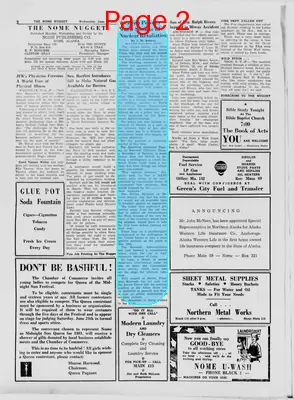
The Nome Nugget
Nome, Nome County, Alaska
What is this article about?
The US and UK warn the Soviet Union of nuclear retaliation if NATO positions in Western Europe are attacked by non-nuclear forces. France agrees, with De Gaulle emphasizing Berlin defense. This updates NATO doctrine, moving away from absorbing first strikes, amid lessons from Cuba and Laos.
Clipping

OCR Quality
Full Text
Warn Soviets of
Nuclear Retaliation
By J. M. Roberts
Associated Press News Analyst
The United States and Great Britain have warned the Soviet Union that they will use nuclear weapons if their positions in Western Europe are attacked in force.
The warning, contained in informal but apparently concerted statements, appears in the context of recent discussions to have the agreement of France.
Indeed, President De Gaulle has been ahead of both his major allies in promulgating an unyielding doctrine with regard to Berlin.
The warning also fits in with what Gen. Lauris Norstad has argued is a factual component of the military position of North Atlantic Treaty Organization forces which he commands, and follows up on a policy less succinctly expressed by the Eisenhower Administration.
The policy has also existed informally in Britain as a part of the inherent logic of her shift some years ago to a defense establishment based very largely on nuclear deterrent.
But the position is especially pointed at this time.
The American statement Tuesday by Roswell Gilpatric, Deputy Secretary of Defense, is more precise than the British in defining a contingency in which the Soviet Union could cause a nuclear war even though her attack were non-nuclear.
"The current doctrine," Gilpatric said, "is that if NATO forces were about to be overwhelmed by non-nuclear forces of Communist bloc countries, they would respond by the use of nuclear weapons."
The British Minister of Defense merely said that his country would use all available force to retaliate against an aggression.
The policy thus expressed gets farther away from the old idea that in almost all circumstances the West, because of the very natures of the countries which form the alliance, would have to take the first blow before starting nuclear war.
There may be a psychological background to the willingness of the United States to take a more specific position on the point at this time.
The Kennedy Administration has just learned a considerable lesson about the use of half-measures, because of Cuba.
In Laos, a threat of armed American intervention came too late to deter the Communists from attacks which have now set the stage for ultimate take-over.
With regard to Berlin, President Kennedy has not only told the Soviet Union that the political position of the Allies there will be defended in general, but there is now an actual delineation of military posture.
The deterrent is being pushed to the limit.
What sub-type of article is it?
What keywords are associated?
What entities or persons were involved?
Where did it happen?
Foreign News Details
Primary Location
Western Europe
Key Persons
Event Details
The United States and Great Britain warned the Soviet Union of nuclear weapons use if positions in Western Europe are attacked in force, with France's agreement. President De Gaulle promulgated an unyielding doctrine on Berlin. Gen. Lauris Norstad argued this as part of NATO's military position. Roswell Gilpatric stated that NATO would respond with nuclear weapons if overwhelmed by non-nuclear Communist forces. The British Minister of Defense said Britain would use all available force against aggression. This policy shifts from absorbing the first blow, influenced by lessons from Cuba and Laos, and delineates military posture for Berlin defense.