Thank you for visiting SNEWPapers!
Sign up free
Story
October 28, 1824
The Wilmingtonian, And Delaware Register
Wilmington, New Castle County, Delaware
What is this article about?
Captain Cochrane describes camping hardships during a pedestrian journey through Siberian Tartary, including unloading horses, clearing deep snow, building a fire, and rotating exposure to manage extreme cold for survival.
Clipping
OCR Quality
98%
Excellent
Full Text
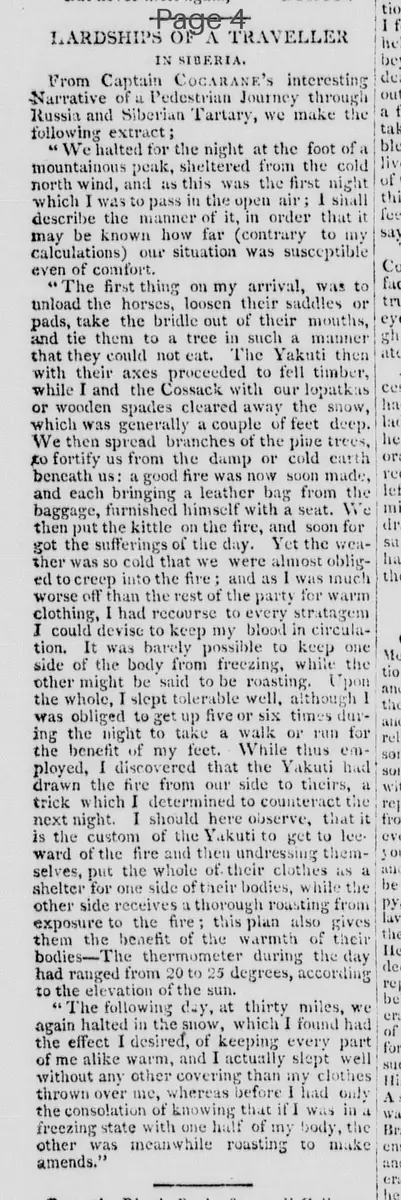
HARDSHIPS OF A TRAVELLER IN SIBERIA.
From Captain Cochrane's interesting Narrative of a Pedestrian Journey through Russia and Siberian Tartary, we make the following extract:
"We halted for the night at the foot of a mountainous peak, sheltered from the cold north wind, and as this was the first night which I was to pass in the open air: I shall describe the manner of it, in order that it may be known how far (contrary to my calculations) our situation was susceptible even of comfort.
"The first thing on my arrival, was to unload the horses, loosen their saddles or pads, take the bridle out of their mouths, and tie them to a tree in such a manner that they could not eat. The Yakuti then with their axes proceeded to fell timber, while I and the Cossack with our lopatkas or wooden spades cleared away the snow, which was generally a couple of feet deep. We then spread branches of the pine trees, to fortify us from the damp or cold earth beneath us: a good fire was now soon made, and each bringing a leather bag from the baggage, furnished himself with a seat. We then put the kettle on the fire, and soon forgot the sufferings of the day. Yet the weather was so cold that we were almost obliged to creep into the fire; and as I was much worse off than the rest of the party for warm clothing, I had recourse to every stratagem I could devise to keep my blood in circulation. It was barely possible to keep one side of the body from freezing, while the other might be said to be roasting. Upon the whole, I slept tolerably well, although I was obliged to get up five or six times during the night to take a walk or run for the benefit of my feet. While thus employed, I discovered that the Yakuti had drawn the fire from our side to theirs, a trick which I determined to counteract the next night. I should here observe, that it is the custom of the Yakuti to get to leeward of the fire and then undressing themselves, put the whole of their clothes as a shelter for one side of their bodies, while the other side receives a thorough roasting from exposure to the fire; this plan also gives them the benefit of the warmth of their bodies—The thermometer during the day had ranged from 20 to 25 degrees, according to the elevation of the sun.
"The following day, at thirty miles, we again halted in the snow, which I found had the effect I desired, of keeping every part of me alike warm, and I actually slept well without any other covering than my clothes thrown over me, whereas before I had only the consolation of knowing that if I was in a freezing state with one half of my body, the other was meanwhile roasting to make amends."
From Captain Cochrane's interesting Narrative of a Pedestrian Journey through Russia and Siberian Tartary, we make the following extract:
"We halted for the night at the foot of a mountainous peak, sheltered from the cold north wind, and as this was the first night which I was to pass in the open air: I shall describe the manner of it, in order that it may be known how far (contrary to my calculations) our situation was susceptible even of comfort.
"The first thing on my arrival, was to unload the horses, loosen their saddles or pads, take the bridle out of their mouths, and tie them to a tree in such a manner that they could not eat. The Yakuti then with their axes proceeded to fell timber, while I and the Cossack with our lopatkas or wooden spades cleared away the snow, which was generally a couple of feet deep. We then spread branches of the pine trees, to fortify us from the damp or cold earth beneath us: a good fire was now soon made, and each bringing a leather bag from the baggage, furnished himself with a seat. We then put the kettle on the fire, and soon forgot the sufferings of the day. Yet the weather was so cold that we were almost obliged to creep into the fire; and as I was much worse off than the rest of the party for warm clothing, I had recourse to every stratagem I could devise to keep my blood in circulation. It was barely possible to keep one side of the body from freezing, while the other might be said to be roasting. Upon the whole, I slept tolerably well, although I was obliged to get up five or six times during the night to take a walk or run for the benefit of my feet. While thus employed, I discovered that the Yakuti had drawn the fire from our side to theirs, a trick which I determined to counteract the next night. I should here observe, that it is the custom of the Yakuti to get to leeward of the fire and then undressing themselves, put the whole of their clothes as a shelter for one side of their bodies, while the other side receives a thorough roasting from exposure to the fire; this plan also gives them the benefit of the warmth of their bodies—The thermometer during the day had ranged from 20 to 25 degrees, according to the elevation of the sun.
"The following day, at thirty miles, we again halted in the snow, which I found had the effect I desired, of keeping every part of me alike warm, and I actually slept well without any other covering than my clothes thrown over me, whereas before I had only the consolation of knowing that if I was in a freezing state with one half of my body, the other was meanwhile roasting to make amends."
What sub-type of article is it?
Journey
Adventure
Survival
What themes does it cover?
Survival
Exploration
Misfortune
What keywords are associated?
Siberian Journey
Camping Hardships
Extreme Cold
Yakuti Customs
Fire Management
Pedestrian Travel
What entities or persons were involved?
Captain Cochrane
Yakuti
Cossack
Where did it happen?
Siberian Tartary, Foot Of A Mountainous Peak
Story Details
Key Persons
Captain Cochrane
Yakuti
Cossack
Location
Siberian Tartary, Foot Of A Mountainous Peak
Story Details
Captain Cochrane recounts halting for the night in snowy Siberian mountains, unloading horses, clearing snow, building a fire, and enduring extreme cold by rotating near the fire; on the second night, he sleeps better by keeping the fire balanced.