Thank you for visiting SNEWPapers!
Sign up free
The Kennewick Courier Reporter
Kennewick, Benton County, Washington
What is this article about?
Alfalfa fertilization experiments at Jens Lande's farm demonstrate superior yields from superphosphate compared to raw rock phosphate and unfertilized plots, with additional results from manure application on W. T. Elliott's field highlighting cost-effective phosphate use.
Clipping
OCR Quality
Full Text
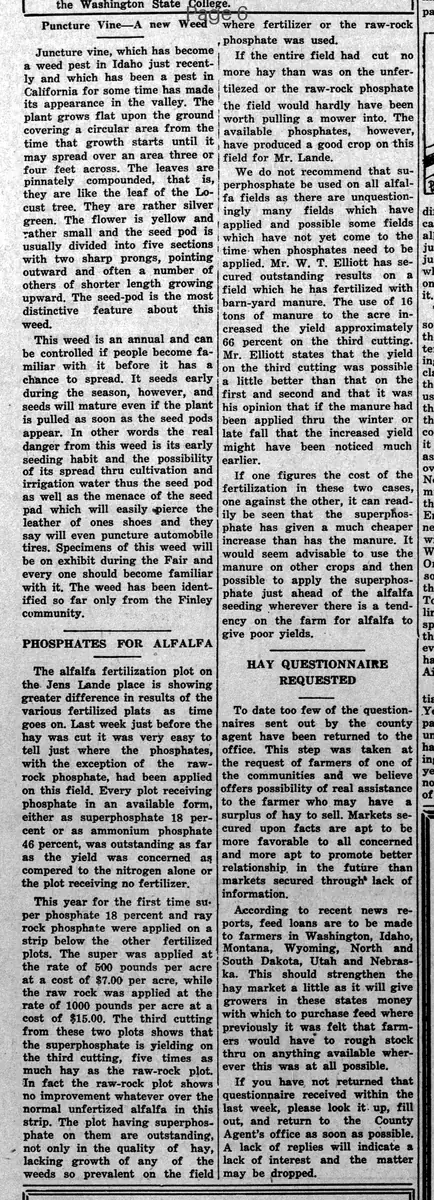
The alfalfa fertilization plot on the Jens Lande place is showing greater difference in results of the various fertilized plots as time goes on. Last week just before the hay was cut it was very easy to tell just where the phosphates, with the exception of the raw-rock phosphate, had been applied on this field. Every plot receiving phosphate in an available form, either as superphosphate 18 per cent or as ammonium phosphate 46 percent, was outstanding as far as the yield was concerned as compared to the nitrogen alone or the plot receiving no fertilizer.
This year for the first time super phosphate 18 percent and raw rock phosphate were applied on a strip below the other fertilized plots. The super was applied at the rate of 500 pounds per acre at a cost of $7.00 per acre, while the raw rock was applied at the rate of 1000 pounds per acre at a cost of $15.00. The third cutting from these two plots shows that the superphosphate is yielding on the third cutting, five times as much hay as the raw-rock plot.
In fact the raw-rock plot shows no improvement whatever over the normal unfertilized alfalfa in this strip. The plot having superphosphate on them are outstanding, not only in the quality of hay, lacking growth of any of the weeds so prevalent on the field where fertilizer or the raw-rock phosphate was used.
If the entire field had cut no more hay than was on the unfertilized or the raw-rock phosphate the field would hardly have been worth pulling a mower into. The available phosphates, however, have produced a good crop on this field for Mr. Lande.
We do not recommend that superphosphate be used on all alfalfa fields as there are unquestionably many fields which have applied and possible some fields which have not yet come to the time when phosphates need to be applied. Mr. W. T. Elliott has secured outstanding results on a field which he has fertilized with barn-yard manure. The use of 16 tons of manure to the acre increased the yield approximately 66 percent on the third cutting.
Mr. Elliott states that the yield on the third cutting was possibly a little better than that on the first and second and that it was his opinion that if the manure had been applied thru the winter or late fall that the increased yield might have been noticed much earlier.
If one figures the cost of the fertilization in these two cases, one against the other, it can readily be seen that the superphosphate has given a much cheaper increase than has the manure. It would seem advisable to use the manure on other crops and then possible to apply the superphosphate just ahead of the alfalfa seeding wherever there is a tendency on the farm for alfalfa to give poor yields.
What sub-type of article is it?
What keywords are associated?
What entities or persons were involved?
Domestic News Details
Key Persons
Outcome
superphosphate plots yielded five times more hay on third cutting than raw-rock phosphate; manure increased yield by 66% on third cutting; superphosphate more cost-effective than manure.
Event Details
Fertilization experiments on alfalfa at Jens Lande's place compared superphosphate, ammonium phosphate, raw-rock phosphate, nitrogen, and no fertilizer, showing available phosphates superior in yield and weed control. Additional test with manure on W. T. Elliott's field increased yields, but superphosphate cheaper.