Thank you for visiting SNEWPapers!
Sign up free
Story
May 31, 1906
The Oakley Eagle
Oakley, Cassia County, Idaho
What is this article about?
Geo. Van Gundy from Morgan Co., Ill., shares his experience using wood ashes as superior fertilizer for fruit trees, detailing application rates, benefits over manure, yields for various trees and vines, and potash content.
Clipping
OCR Quality
98%
Excellent
Full Text
Ashes for Fruit Trees.
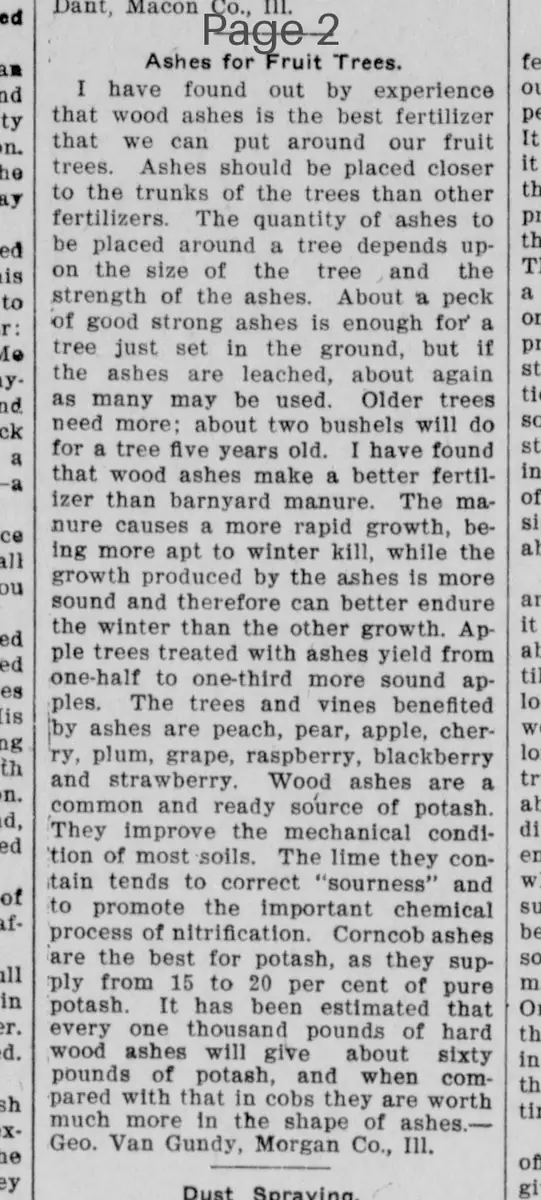
I have found out by experience that wood ashes is the best fertilizer that we can put around our fruit trees. Ashes should be placed closer to the trunks of the trees than other fertilizers. The quantity of ashes to be placed around a tree depends upon the size of the tree and the strength of the ashes. About a peck of good strong ashes is enough for a tree just set in the ground, but if the ashes are leached, about twice as many may be used. Older trees need more: about two bushels will do for a tree five years old. I have found that wood ashes make a better fertilizer than barnyard manure. The manure causes a more rapid growth, being more apt to winter kill, while the growth produced by the ashes is more sound and therefore can better endure the winter than the other growth. Apple trees treated with ashes yield from one-half to one-third more sound apples. The trees and vines benefited by ashes are peach, pear, apple, cherry, plum, grape, raspberry, blackberry and strawberry. Wood ashes are a common and ready source of potash. They improve the mechanical condition of most soils. The lime they contain tends to correct "sourness" and to promote the important chemical process of nitrification. Corncob ashes are the best for potash, as they supply from 15 to 20 per cent of pure potash. It has been estimated that every one thousand pounds of hardwood ashes will give about sixty pounds of potash, and when compared with that in cobs they are worth much more in the shape of ashes.—Geo. Van Gundy, Morgan Co., Ill.
I have found out by experience that wood ashes is the best fertilizer that we can put around our fruit trees. Ashes should be placed closer to the trunks of the trees than other fertilizers. The quantity of ashes to be placed around a tree depends upon the size of the tree and the strength of the ashes. About a peck of good strong ashes is enough for a tree just set in the ground, but if the ashes are leached, about twice as many may be used. Older trees need more: about two bushels will do for a tree five years old. I have found that wood ashes make a better fertilizer than barnyard manure. The manure causes a more rapid growth, being more apt to winter kill, while the growth produced by the ashes is more sound and therefore can better endure the winter than the other growth. Apple trees treated with ashes yield from one-half to one-third more sound apples. The trees and vines benefited by ashes are peach, pear, apple, cherry, plum, grape, raspberry, blackberry and strawberry. Wood ashes are a common and ready source of potash. They improve the mechanical condition of most soils. The lime they contain tends to correct "sourness" and to promote the important chemical process of nitrification. Corncob ashes are the best for potash, as they supply from 15 to 20 per cent of pure potash. It has been estimated that every one thousand pounds of hardwood ashes will give about sixty pounds of potash, and when compared with that in cobs they are worth much more in the shape of ashes.—Geo. Van Gundy, Morgan Co., Ill.
What sub-type of article is it?
Biography
What keywords are associated?
Wood Ashes
Fertilizer
Fruit Trees
Potash
Agriculture
Manure Comparison
What entities or persons were involved?
Geo. Van Gundy
Where did it happen?
Morgan Co., Ill.
Story Details
Key Persons
Geo. Van Gundy
Location
Morgan Co., Ill.
Story Details
Personal experience recommending wood ashes as best fertilizer for fruit trees, with application details, comparisons to manure, benefits to specific trees and vines, and potash explanations.