Thank you for visiting SNEWPapers!
Sign up free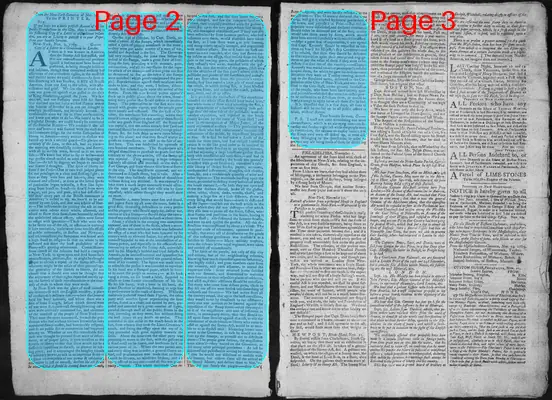
The New Hampshire Gazette And Historical Chronicle
Portsmouth, Greenland, Rockingham County, New Hampshire
What is this article about?
A letter from New York dated November 7, 1765, details the widespread outrage and organized protests across British America against the Stamp Act, focusing on events in New York where crowds destroyed effigies, sacked a major's house, and forced the delivery of stamps to the city corporation to prevent their use, ensuring business continued without them.
Merged-components note: Continuation of the letter from the New-York Gazette across pages 2 and 3, as the text flows directly from one component to the next.
Clippings
1 of 2
OCR Quality
Full Text
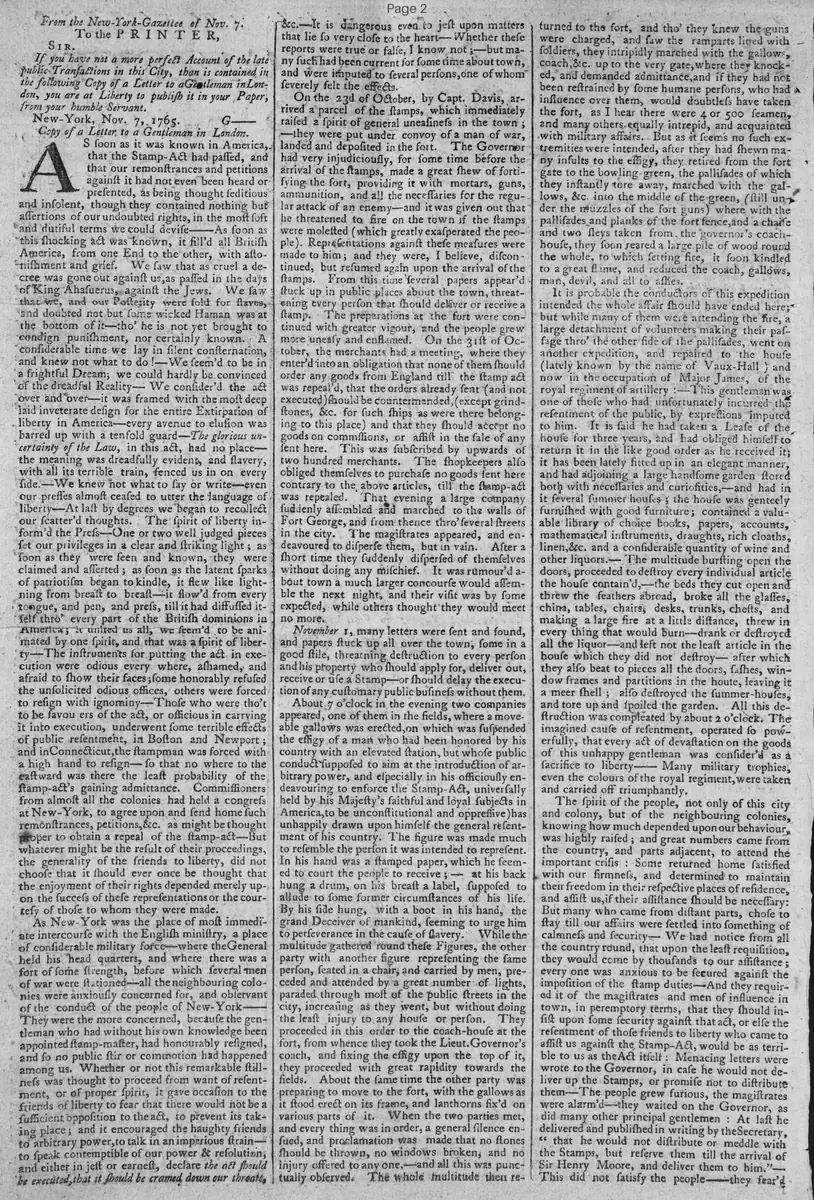
To the PRINTER,
SIR.
If you have not a more perfect Account of the late public Transactions in this City, than is contained in the following Copy of a Letter to a Gentleman in London, you are at Liberty to publish it in your Paper.
from your humble Servant.
New-York, Nov. 7, 1765.
G.
Copy of a Letter to a Gentleman in London.
Soon as it was known in America, that the Stamp-Act had passed, and that our remonstrances and petitions against it had not even been heard or presented, as being thought seditious and insolent, though they contained nothing but assertions of our undoubted rights, in the most soft and dutiful terms we could devise—As soon as this shocking act was known, it fill'd all British America, from one End to the other, with astonishment and grief. We saw that as cruel a decree was gone out against us, as passed in the days of King Ahasuerus, against the Jews. We saw that we, and our Posterity were sold for slaves, and doubted not but some wicked Haman was at the bottom of it—tho' he is not yet brought to condign punishment, nor certainly known. A considerable time we lay in silent consternation, and knew not what to do!—We seem'd to be in a frightful Dream; we could hardly be convinced of the dreadful Reality— We consider'd the Act over and over—it was framed with the most deep laid inveterate design for the entire Extirpation of liberty in America—every avenue to elusion was barred up with a tenfold guard—The glorious uncertainty of the Law, in this act, had no place—the meaning was dreadfully evident, and slavery, with all its terrible train, fenced us in on every Side.—We knew not what to say or write—even our press almost ceased to utter the language of liberty—At last by degrees we began to recollect our scatter'd thoughts. The spirit of liberty inform'd the Press—One or two well judged pieces set our privileges in a clear and striking light ; as soon as they were seen and known, they were claimed and asserted ; as soon as the latent sparks of patriotism began to kindle, it flew like lightning from breast to breast—it flow'd from every tongue, and pen, and press, till it had diffus'd itself thro' every part of the British dominions in America; it united us all, we seem'd to be animated by one spirit, and that was a spirit of liberty—The instruments for putting the Act in execution were odious every where, ashamed, and afraid to show their faces ; some honorably refused the unsolicited odious offices, others were forced to resign with ignominy—Those who were tho't to be favourers of the act, or officious in carrying it into execution, underwent some terrible effects of public resentment, in Boston and Newport ; and in Connecticut, the stampman was forced with a high hand to resign— so that no where to the eastward was there the least probability of the Stamp-act's gaining admittance. Commissioners from almost all the colonies had held a congress at New-York, to agree upon and send home such remonstrances, petitions,&c. as might be thought proper to obtain a repeal of the stamp-act—But whatever might be the result of their proceedings, the generality of the friends to liberty, did not choose that it should ever once be thought that the enjoyment of their rights depended merely upon the success of these representations or the courtesy of those to whom they were made.
As New-York was the place of most immediate intercourse with the English ministry, a place of considerable military force—where the General held his head quarters, and where there was a fort of some strength, before which several men of war were stationed —all the neighbouring colonies were anxiously concerned for, and observant of the conduct of the people of New-York— They were the more concerned, because the gentleman who had without his own knowledge been appointed stamp-master, had honourably resigned, and so no public stir or commotion had happened among us. Whether or not this remarkable stillness was thought to proceed from want of resentment, or of proper spirit, it gave occasion to the friends of liberty to fear that there would not be a sufficient opposition to the act, to prevent its taking place; and it encouraged the haughty friends to arbitrary power, to talk in an imperious strain—to speak contemptible of our power & resolution, and either in jest or earnest, declare the act should be executed, that it should be cramed down our throats, &c.—It is dangerous even to jest upon matters that lie so very close to the heart— Whether these reports were true or false, I know not ;—but many such had been current for some time about town, and were imputed to several persons,one of whom severely felt the effects.
On the 23d. of October, by Capt. Davis, arrived a parcel of the stamps, which immediately raised a spirit of general uneasiness in the town ;—they were put under convoy of a man of war, landed and deposited in the fort. The Governor had very injudiciously, for some time before the arrival of the stamps, made a great shew of fortifying the fort, providing it with mortars, guns, ammunition, and all the necessaries for the regular attack of an enemy—and it was given out that he threatened to fire on the town if the stamps were molested (which greatly exasperated the people). Representations against these measures were made to him; and they were, I believe, discontinued, but resumed again upon the arrival of the stamps. From this time several papers appear'd stuck up in public places about the town, threatening every person that should deliver or receive a stamp. The preparations at the fort were continued with greater vigour, and the people grew more uneasy and inflamed. On the 31st of October, the merchants had a meeting, where they enter'd into an obligation that none of them should order any goods from England till the stamp act was repeal'd, that the orders already sent (and not executed)should be countermanded,(except grindstones, &c. for such ships as were there belonging to this place) and that they should accept no goods on commissions, or assist in the sale of any sent here. This was subscribed by upwards of two hundred merchants. The shopkeepers also obliged themselves to purchase no goods sent here contrary to the above articles, unless the stamp-Act was repealed. That evening a large company suddenly assembled and marched to the walls of Fort George, and from thence thro'several streets in the city. The magistrates appeared, and endeavoured to disperse them, but in vain. After a short time they suddenly dispersed of themselves without doing any mischief. It was rumour'd about town a much larger concourse would assemble the next night, and their visit was by some expected, while others thought they would meet no more.
November 1, many letters were sent and found, and papers stuck up all over the town, some in a good stile, threatning destruction to every person and his property who should apply for, deliver out, receive or use a Stamp—or should delay the execution of any customary public business without them. About 7 o'clock in the evening two companies appeared, one of them in the fields, where a moveable gallows was erected,on which was suspended the effigy of a man who had been honored by his country with an elevated station, but whose public conduct supposed to aim at the introduction of arbitrary power, and especially in his officiously endeavouring to enforce the Stamp-Act, universally held by his Majesty's faithful and loyal subjects in America,to be unconstitutional and oppressive )has unhappily drawn upon himself the general resentment of his country. The figure was made much to resemble the person it was intended to represent. In his hand was a stamped paper, which he seemed to court the people to receive ; — at his back hung a drum, on his breast a label, supposed to allude to some former circumstances of his life. By his side hung, with a boot in his hand, the grand Deceiver of mankind, seeming to urge him to perseverance in the cause of slavery. While the multitude gathered round these Figures, the other party with another figure representing the same person, seated in a chair; and carried by men, preceded and attended by a great number of lights, paraded through most of the public streets in the city, increasing as they went, but without doing the least injury to any house or person. They proceeded in this order to the coach-house at the fort, from whence they took the Lieut.Governor's coach, and fixing the effigy upon the top of it, they proceeded with great rapidity towards the fields. About the same time the other party was preparing to move to the fort, with the gallows as it stood erect on its frame, and lanthorns fix'd on various parts of it. When the two parties met, and every thing was in order, a general silence ensued, and proclamation was made that no stones should be thrown, no windows broken, and no injury offered to any One, -and all this was punctually observed. The whole multitude then returned to the fort. and tho' they knew the guns were charged, and saw the ramparts lined with soldiers, they intrepidly marched with the gallows, coach, &c. up to the very gate, where they knocked. and demanded admittance.and if they had not been restrained by some humane persons, who had influence over them, would doubtless have taken the fort, as I hear there were 4 or 500 seamen, and many others-equally intrepid, and acquainted with military affairs. . But as it seems no such extremities were intended, after they had shewn many insults to the effigy, they retired from the fort gate to the bowling-green, the pallisades of which they instantly tore away, marched with the gallows, &c. into the middle of the green, (still under the muzzles of the fort guns) where with the pallisades and planks of the fort fence,and a chaise and two sleys taken from. the governor's coach-house, they soon reared a large pile. of wood round the whole, to which setting fire, it soon kindled to a great flame, and reduced the coach, gallows, man, devil, and all to ashes.
It is probable the conductors of this expedition intended the whole affair should have ended here:- but while many of them were attending the fire, a large detachment of volunteers making their passage thro' the other side of the pallisades, went on another expedition, and repaired to the house (lately known by the name of Vaux-Hall ) and now in the occupation of Major James, of the royal regiment of artillery :—This gentleman was one-of those who had unfortunately incurred the resentiment of the public, by expressions imputed to him. It is said he had taken a Lease of the house for three years, and had obliged himself to return it in the like good order as he received it; it has been lately fitted up in an elegant manner, and had adjoining a large handsome garden stored both with necessaries and curiosities, --and had in it several summer houses ; the house was genteely furnished with good furniture; contained a valuable library of choice books, papers, accounts, mathematical instruments, draughts, rich cloaths. linen,&c. and a considerable quantity of wine and other liquors.— The multitude bursting open the doors, proceeded to destroy every individual article the house contain'd,—the beds they cut open and threw the feathers abroad, broke all the glass, china, tables, chairs, desks, trunks, chests, and making a large fire at a little distance, threw in every thing that would burn—drank or destroyed all the liquor—and left not the least article in the house which they did not destroy- after which they also beat to pieces all the doors, sashes, window frames and partitions in the house, leaving it a meer shell ; also destroyed the summer-houses; and tore up and spoiled the garden. All this destruction was compleated by about 2 o'clock. The imagined cause of resentment, operated so powerfully, that every act of devastation on the goods of this unhappy gentleman was consider'd as a sacrifice to liberty— Many military trophies, even the colours of the royal regiment, were taken and carried off triumphantly.
The spirit of the people, not only of this city and colony, but of the neighbouring colonies, knowing how much depended upon our behaviour was highly raised ; and great numbers came from the country; and parts adjacent, to attend the important crisis : Some returned home satisfied with our firmness, and determined to maintain their freedom in their respective places of residence, and assist us,if their assistance should be necessary: But many who came from distant parts, chose to stay till our affairs were settled into something of calmness and security— We had notice from all the country round, that upon the least requisition, they would come by thousands to our assistance; every one was anxious to be secured against the imposition of the stamp duties-And they required it of the magistrates and men of influence in town, in peremptory terms, that they should insist upon some security against that act, or else the resentment of those friends to liberty who came to assist us against the Stamp-Act, would be as terrible to us as theAct itself : Menacing letters were wrote to the Governor, in case he would not deliver up the Stamps, or promise not to distribute them—The people grew furious, the magistrates were alarm'd— -they waited on the Governor, as did many other principal gentlemen : At last he delivered and published in writing by theSecretary, that he would not distribute or meddle with the Stamps, but reserve them till the arrival of Sir Henry Moore, and deliver them to him."
This did not satisfy the people—they feared
no deception, and were hardly restrain'd by the magistrates.- The Governor declared the same thing, and got it attested by several gentlemen of the town, and publish'd in Print.--But till the populace were dissatisfied, and declared the Stamps should either be delivered out of the fort, or they would take them away by force, which would have been attended probably with much bloodshed. -After a great deal of negotiation, it was agreed that Capt. Kennedy should be requested to take them on board his Majesty's ship Coventry--and if he refused, that then they should be delivered to the corporation upon their receipt and engagement to pay the value of them if they were either destroy'd or sent out of the country.--Captain Kennedy was waited on--but peremptorily refused to take them, for which he gave his reasons--and therefore they were on Tuesday evening, according to the stipulated terms, delivered to the Corporation of the City of New-York, and were deposited in the City-Hall, to the general satisfaction of the people, who have been since entirely quiet and peaceable--satisfied that none has either power or inclination to distribute them, or would be hardy-enough to apply for or use them if to be had: It is expected that in a few days, all sorts of business will be carried on in all public offices as usual, without stamps.
Your humble Servant, G
P. S. I must not omit mentioning one more circumstance, which is an alarming one--on Saturday and Sunday night last while the people were in commotion, the cannon on Coopey's battery, and the King's yard were all spiked up, as were also many belonging to the merchants, in order to prevent any use being made of them for obtaining the stamps.
What sub-type of article is it?
What themes does it cover?
What keywords are associated?
What entities or persons were involved?
Where did it happen?
Story Details
Key Persons
Location
New York, Fort George
Event Date
1765 10 23 To 1765 11 07
Story Details
Public outrage against the Stamp Act leads to protests in New York: merchants vow non-importation, crowds burn effigies of opponents, destroy Major James's house as a sacrifice to liberty, and force the Governor to surrender stamps to the city corporation, preventing their distribution and restoring calm.