Thank you for visiting SNEWPapers!
Sign up free
Story
April 13, 1906
Deming Graphic
Deming, Luna County, New Mexico
What is this article about?
Descriptive article on Napoleon Bonaparte's tomb in the Invalides, Paris, detailing its elaborate design, symbolic elements, lighting effects, and reflections on his life from military genius to exile, with his ashes returned in 1841.
Clipping
OCR Quality
75%
Good
Full Text
(Special Correspondence.)
I desire that my ashes shall repose on the banks of the Seine, in the midst of the French people, whom I loved so well.
This simple sentence is inscribed over the door leading to the sunken circular space under the dome of the Invalides in Paris, wherein rests, in a sarcophagus of red Finnish granite, the mortal remains of Napoleon Bonaparte. It is from the will of the greatest military genius of the age, the last earthly request of a broken man, pining to his death in the shadow of his former greatness, on a bare, wind-swept island, guarded by his former enemies.
A generation was to pass between the death of Napoleon and the honoring of his ashes by their removal to Paris, to be laid at last by the banks of the Seine. When, in 1841, the bitterness of Napoleon's acts and final overthrow had died somewhat from official minds, while the dying house of Bourbon was yet, for a time, in power, the ashes of the great Corsican were brought to France by the Prince de Joinville and were deposited in the splendid tomb prepared for it in the home the state provides.
Most Impressive Tomb.
Though tardy her recognition given the memory of the great man who for twenty years so swayed her destinies, France made amends by giving Napoleon one of the most impressive tombs in the world. Unlike most historic tombs, it is elaborate in plan, decoration and coloring, presenting an almost theatrical aspect; yet it is profoundly impressive.
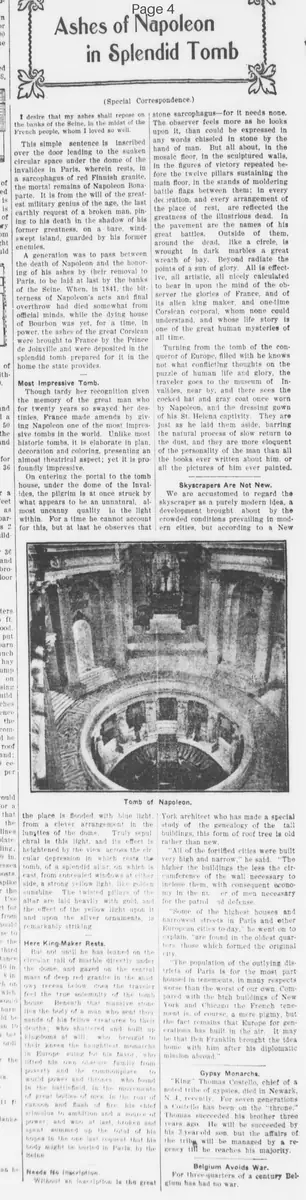
On entering the portal to the tomb house, under the dome of the Invalides, the pilgrim is at once struck by what appears to be an unnatural, almost uncanny quality in the light within. For a time he cannot account for this, but at last he observes that the place is flooded with blue light from a clever arrangement in the lunettes of the dome. Truly sepulchral is this light, and its effect is heightened by the view across the circular depression in which rests the tomb, of a splendid altar on which is cast, from concealed windows at either side, a strong yellow light like golden sunshine. The twisted pillars of the altar are laid heavily with gold, and the effect of the yellow light upon it and upon the silver ornaments, is remarkably striking.
Here King-Maker Rests.
But not until he has leaned on the circular rail of marble directly under the dome and gazed on the central mass of deep red granite in the shadow below does the traveler feel the true solemnity of the tomb house. Beneath that massive stone lie the body of a man who sent thousands of his fellow creatures to their death with hatred and balled up kingdoms at will, who brought the haughtiest monarchs in Europe only at his favor who lifted his own glory family from poverty and the commonplace to world power, and there who found in the battle field in the joy might of your bride or in the roar of cannon and fanfare of triumph his chief allurement, and at last, broken and spent, mourned in the total of his hopes in the life last request that his body might rest in Paris, by the Seine.
No Need of Inscription
With all this grandeur in the great tomb, no inscription is needed on the stone sarcophagus—for it needs none. The observer feels more as he looks upon it, than could be expressed in any words chiseled in stone by the hand of man. But all about, in the mosaic floor, in the sculptured walls, in the figures of victory repeated before the twelve pillars sustaining the main floor, in the stands of moldering battle flags between them; in every decoration, and every arrangement of the place of rest, are reflected the greatness of the illustrious dead. In the pavement are the names of his great battles. Outside of them, around the dead, like a circle, is wrought in dark marbles a great wreath of bay. Beyond radiate the points of a sun of glory. All is effective, all artistic, all nicely calculated to bear in upon the mind of the observer the glories of France, and of its alien king maker, and one-time Corsican corporal, whom none could understand, and whose life story is one of the great human mysteries of all time.
Turning from the tomb of the conqueror of Europe, filled with he knows not what conflicting thoughts on the puzzle of human life and glory, the traveler goes to the museum of Invalides, near by, and there sees the cocked hat and gray coat once worn by Napoleon, and the dressing gown of his St. Helena captivity. They are just as he laid them aside, barring the natural process of slow return to the dust, and they are more eloquent of the personality of the man than all the books ever written about him, or all the pictures of him ever painted.
I desire that my ashes shall repose on the banks of the Seine, in the midst of the French people, whom I loved so well.
This simple sentence is inscribed over the door leading to the sunken circular space under the dome of the Invalides in Paris, wherein rests, in a sarcophagus of red Finnish granite, the mortal remains of Napoleon Bonaparte. It is from the will of the greatest military genius of the age, the last earthly request of a broken man, pining to his death in the shadow of his former greatness, on a bare, wind-swept island, guarded by his former enemies.
A generation was to pass between the death of Napoleon and the honoring of his ashes by their removal to Paris, to be laid at last by the banks of the Seine. When, in 1841, the bitterness of Napoleon's acts and final overthrow had died somewhat from official minds, while the dying house of Bourbon was yet, for a time, in power, the ashes of the great Corsican were brought to France by the Prince de Joinville and were deposited in the splendid tomb prepared for it in the home the state provides.
Most Impressive Tomb.
Though tardy her recognition given the memory of the great man who for twenty years so swayed her destinies, France made amends by giving Napoleon one of the most impressive tombs in the world. Unlike most historic tombs, it is elaborate in plan, decoration and coloring, presenting an almost theatrical aspect; yet it is profoundly impressive.
On entering the portal to the tomb house, under the dome of the Invalides, the pilgrim is at once struck by what appears to be an unnatural, almost uncanny quality in the light within. For a time he cannot account for this, but at last he observes that the place is flooded with blue light from a clever arrangement in the lunettes of the dome. Truly sepulchral is this light, and its effect is heightened by the view across the circular depression in which rests the tomb, of a splendid altar on which is cast, from concealed windows at either side, a strong yellow light like golden sunshine. The twisted pillars of the altar are laid heavily with gold, and the effect of the yellow light upon it and upon the silver ornaments, is remarkably striking.
Here King-Maker Rests.
But not until he has leaned on the circular rail of marble directly under the dome and gazed on the central mass of deep red granite in the shadow below does the traveler feel the true solemnity of the tomb house. Beneath that massive stone lie the body of a man who sent thousands of his fellow creatures to their death with hatred and balled up kingdoms at will, who brought the haughtiest monarchs in Europe only at his favor who lifted his own glory family from poverty and the commonplace to world power, and there who found in the battle field in the joy might of your bride or in the roar of cannon and fanfare of triumph his chief allurement, and at last, broken and spent, mourned in the total of his hopes in the life last request that his body might rest in Paris, by the Seine.
No Need of Inscription
With all this grandeur in the great tomb, no inscription is needed on the stone sarcophagus—for it needs none. The observer feels more as he looks upon it, than could be expressed in any words chiseled in stone by the hand of man. But all about, in the mosaic floor, in the sculptured walls, in the figures of victory repeated before the twelve pillars sustaining the main floor, in the stands of moldering battle flags between them; in every decoration, and every arrangement of the place of rest, are reflected the greatness of the illustrious dead. In the pavement are the names of his great battles. Outside of them, around the dead, like a circle, is wrought in dark marbles a great wreath of bay. Beyond radiate the points of a sun of glory. All is effective, all artistic, all nicely calculated to bear in upon the mind of the observer the glories of France, and of its alien king maker, and one-time Corsican corporal, whom none could understand, and whose life story is one of the great human mysteries of all time.
Turning from the tomb of the conqueror of Europe, filled with he knows not what conflicting thoughts on the puzzle of human life and glory, the traveler goes to the museum of Invalides, near by, and there sees the cocked hat and gray coat once worn by Napoleon, and the dressing gown of his St. Helena captivity. They are just as he laid them aside, barring the natural process of slow return to the dust, and they are more eloquent of the personality of the man than all the books ever written about him, or all the pictures of him ever painted.
What sub-type of article is it?
Historical Event
Biography
What themes does it cover?
Fortune Reversal
Triumph
Tragedy
What keywords are associated?
Napoleon Tomb
Invalides Paris
Historical Tomb
Napoleon Bonaparte
Sarcophagus
Military Genius
St Helena
What entities or persons were involved?
Napoleon Bonaparte
Prince De Joinville
Where did it happen?
Invalides In Paris, Banks Of The Seine
Story Details
Key Persons
Napoleon Bonaparte
Prince De Joinville
Location
Invalides In Paris, Banks Of The Seine
Event Date
1841
Story Details
Description of Napoleon's tomb in the Invalides, its elaborate design with blue and yellow lighting, symbolic elements like battle names and victory figures, reflecting his rise from corporal to emperor, conquests, and exile on St. Helena, with ashes returned to Paris in 1841.