Thank you for visiting SNEWPapers!
Sign up free
Foster's Daily Democrat
Dover, Strafford County, New Hampshire
What is this article about?
Ernest Lee Conant, a New York lawyer who worked in Cuba, discusses the need for American-style schools, parks, public baths, and economic reforms to improve Cuban society post-slavery and lottery abolition. He views Cubans as docile and capable under fair governance, with labor wages surprisingly high due to easy living conditions.
Clipping
OCR Quality
Full Text
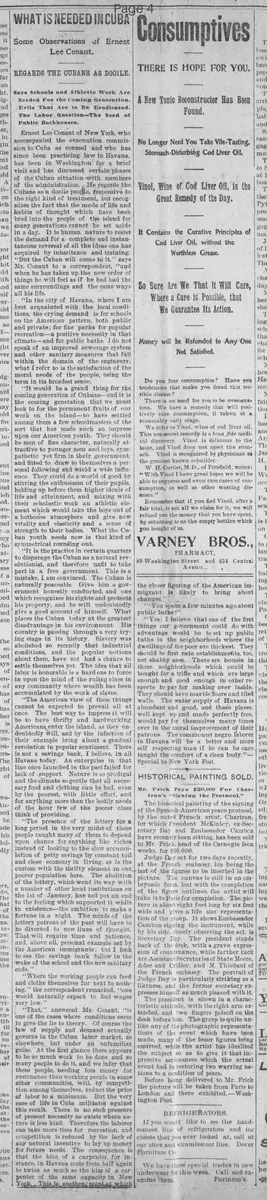
Some Observations of Ernest Lee Conant.
REGARDS THE CUBANS AS DOCILE.
Says Schools and Athletic Work Are Needed For the Coming Generation.
Evils That Are to Be Eradicated.
The Labor Question—The Need of Public Bathhouses
Ernest Lee Conant of New York, who accompanied the evacuation commission to Cuba as counsel and who has since been practicing law in Havana, has been in Washington for a brief visit and has discussed certain phases of the Cuban situation with members of the administration. He regards the Cubans as a docile people, responsive to the right kind of treatment, but recognizes the fact that the mode of life and habits of thought which have been bred into the people of the island for many generations cannot be set aside in a day. It is human nature to resist the demand for a complete and instantaneous reversal of all the ideas one has acquired by inheritance and training.
"But the Cuban will come to it," says Mr. Conant to a correspondent, "and when he has taken up the new order of things he will feel as if he had had the same surroundings and the same ways all his life.
"In the city of Havana, where I am best acquainted with the local conditions, the crying demand is for schools on the American pattern, both public and private; for fine parks for popular recreation—a positive necessity in that climate—and for public baths. I do not speak of an improved sewerage system and other sanitary measures that fall within the domain of the engineers; what I refer to is the satisfaction of the moral needs of the people, using the term in its broadest sense.
"It would be a grand thing for the coming generation of Cubans—and it is the coming generation that we must look to for the permanent fruits of our work on the island—to have settled among them a few schoolmasters of the sort that has made such an impression upon our American youth. They should be men of fine character, naturally attractive to younger men and boys, sympathetic yet firm in their government, and fitted to draw to themselves a personal following and wield a wide influence. They could do a world of good by stirring the enthusiasm of their pupils, holding up before them higher ideals of life and attainment, and mixing with their scholastic work an athletic element which would take the boys out of a hothouse atmosphere and give new vitality and elasticity and a sense of strength to their bodies. What the Cuban youth needs now is that kind of symmetrical rounding out.
"It is the practice in certain quarters to disparage the Cuban as a natural revolutionist, and therefore unfit to take part in a free government. This is a mistake, I am convinced. The Cuban is naturally peaceable. Give him a government honestly conducted, and one which recognizes his rights and protects his property, and he will undoubtedly give a good account of himself. What places the Cuban today at the greatest disadvantage in his environment. His country is passing through a very trying stage in its history. Slavery was abolished so recently that industrial conditions, and the popular notions about them, have not had a chance to settle themselves yet. The idea that all labor is honorable is a hard one to force in upon the mind of the ruling class in any community where wealth has been accumulated by the work of slaves.
"The American view of these things cannot be expected to prevail all at once. The best way to impress it will be to have thrifty and hardworking Americans enter the island, as they undoubtedly will, and by the infection of their example bring about a gradual revolution in popular sentiment. There is not a savings bank, I believe, in all Havana today. An enterprise in that line once launched in the past failed for lack of support. Nature is so prodigal and the climate so gentle that all necessary food and clothing can be had, even by the poorest, with little effort, and for anything more than the bodily needs of the hour few of the poorer class think of providing.
"The presence of the lottery for a long period in the very midst of these people taught many of them to depend upon chance for anything like riches instead of looking to the slow accumulation of petty savings by constant toil and close economy in living, as is the custom with the thrifty element in our poorer population here. The abolition of the lottery, which went its way with a number of other local institutions on the 1st of January, has not put an end to the feeling which supported it while in existence—the ambition to make a fortune in a night. The minds of the lottery patrons of the past will have to be diverted to new lines of thought. That will require time and patience, and, above all, personal example set by the American immigrants; but I look to see the savings bank follow in the wake of the school and the new sanitary code."
"Where the working people can feed and clothe themselves for next to nothing," the correspondent remarked, "one would naturally expect to find wages very low."
"That," answered Mr. Conant, "is one of the cases where conditions seem to give the lie to theory. Of course the law of supply and demand actually governs in the Cuban labor market, as elsewhere, but under an unfamiliar guise. At the first glance there appears to be so much work to be done and so many people to do it, and we infer that these people, needing less money for sustenance than working people in some other communities, will, by competition among themselves, reduce the price of labor to a minimum. But the very ease of life in Cuba militates against this result. There is no such pressure of present necessity as exists where nature is less kind. Therefore the laborer can take more time for recreation, and competition is reduced by the lack of any natural incentive to lay up money for future needs. The consequence is that the hire of a carpenter, for instance, in Havana costs from half again to twice as much as the hire of a carpenter of the same capacity in New York. This is another point at which the closer figuring of the American immigrant is likely to bring about changes.
""You spoke a few minutes ago about public baths?"
"Yes; I believe that one of the first things our government could do with advantage would be to set up public baths in the neighborhoods where the dwellings of the poor are thickest. They should be first rate establishments, too, not shabby ones. There are houses in these neighborhoods which could be bought for a trifle and which are large enough and good enough in other respects to pay for making over inside. They should have marble floors and tiled walls. The water supply of Havana is abundant and good, and these places, well kept up and made perfectly free, would pay for themselves many times over in the moral improvement of their patrons. The commonest negro laborer in Havana will be a better and more self respecting man if he can be once taught the comfort of a clean body."
Special to New York Post.
What sub-type of article is it?
What keywords are associated?
What entities or persons were involved?
Where did it happen?
Foreign News Details
Primary Location
Cuba
Key Persons
Outcome
suggestions for reforms including schools, parks, public baths, and economic changes to address post-slavery labor issues and promote american influences; lottery abolished on 1st of january.
Event Details
Ernest Lee Conant shares observations on Cuban needs: American-style education with athletics for youth, public recreation spaces, baths for sanitation and moral improvement, fair governance to counter revolutionist stereotypes, and gradual economic shifts via American immigration to instill thrift and honorable labor views after recent slavery abolition.