Thank you for visiting SNEWPapers!
Sign up free
Rhode Island Republican
Newport, Newport County, Rhode Island
What is this article about?
Letter from London, July 2, 1801, by Chief Mate of ship Thomas describes dire economic conditions in Britain: extreme poverty among the lower classes, unaffordable necessities, heavy taxation, and a temporary drop in corn prices. Contrasts favorably with American prosperity post-independence.
Clipping
OCR Quality
Full Text
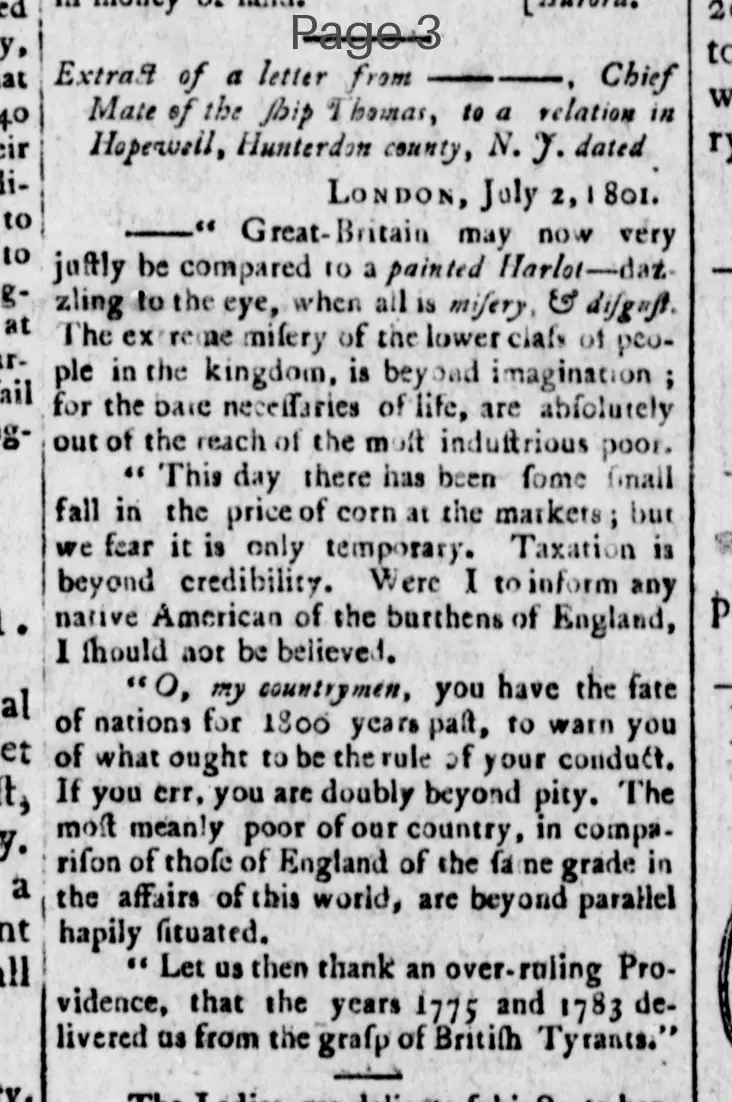
Mate of the ship Thomas, to a relation in
Hopewell, Hunterdon county, N. J. dated
London, July 2, 1801.
"Great-Britain may now very
justly be compared to a painted Harlot--dazzling to the eye, when all is misery, & disgust.
The extreme misery of the lower class of people in the kingdom, is beyond imagination;
for the basest necessaries of life, are absolutely
out of the reach of the most industrious poor.
"This day there has been some small
fall in the price of corn at the markets; but
we fear it is only temporary. Taxation is
beyond credibility. Were I to inform any
native American of the burthens of England,
I should not be believed.
"O, my countrymen, you have the fate
of nations for 1800 years past, to warn you
of what ought to be the rule of your conduct.
If you err, you are doubly beyond pity. The
most meanly poor of our country, in comparison of those of England of the same grade in the affairs of this world, are beyond parallel
happily situated.
"Let us then thank an over-ruling Providence, that the years 1775 and 1783 delivered us from the grasp of British Tyrants."
What sub-type of article is it?
What keywords are associated?
Where did it happen?
Foreign News Details
Primary Location
London
Event Date
July 2, 1801
Outcome
temporary small fall in corn prices; extreme misery and heavy taxation for the poor
Event Details
The letter portrays Great Britain as economically distressed, with the lower classes in unimaginable misery due to unaffordable basic necessities and excessive taxation. A minor, likely temporary, reduction in corn prices occurred that day. The writer contrasts this with the happier situation of the poor in America, crediting independence from British rule in 1775-1783.