Thank you for visiting SNEWPapers!
Sign up free
Editorial
November 17, 1956
Jackson Advocate
Jackson, Hinds County, Mississippi
What is this article about?
Editorial critiques the lengthy Ph.D. process for teachers, arguing it impairs inspirational teaching due to time and economic pressures. Suggests shorter requirements focused on synthesizing knowledge rather than original research, as most teachers need competence in interpretation over addition to knowledge.
Clipping
OCR Quality
98%
Excellent
Full Text
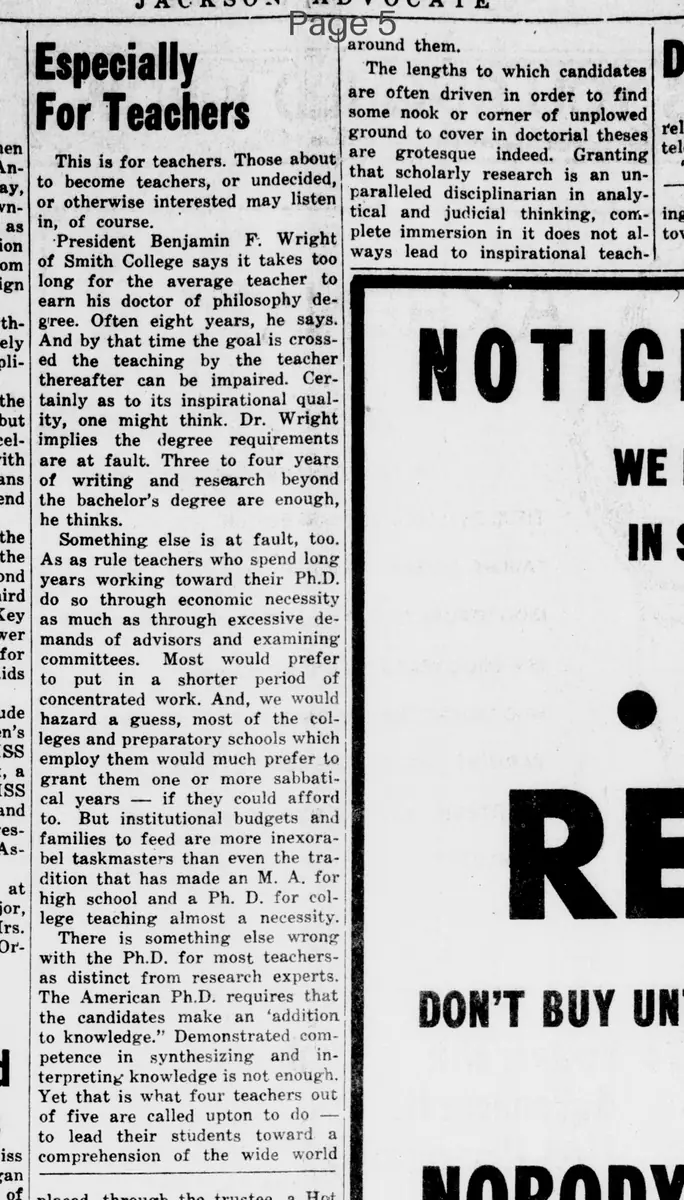
Especially For Teachers
This is for teachers. Those about to become teachers, or undecided, or otherwise interested may listen in, of course.
President Benjamin F. Wright of Smith College says it takes too long for the average teacher to earn his doctor of philosophy degree. Often eight years, he says. And by that time the goal is crossed the teaching by the teacher thereafter can be impaired. Certainly as to its inspirational quality, one might think. Dr. Wright implies the degree requirements are at fault. Three to four years of writing and research beyond the bachelor's degree are enough, he thinks.
Something else is at fault, too. As a rule teachers who spend long years working toward their Ph.D. do so through economic necessity as much as through excessive demands of advisors and examining committees. Most would prefer to put in a shorter period of concentrated work. And, we would hazard a guess, most of the colleges and preparatory schools which employ them would much prefer to grant them one or more sabbatical years - if they could afford to. But institutional budgets and families to feed are more inexorable taskmasters than even the tradition that has made an M.A. for high school and a Ph.D. for college teaching almost a necessity.
There is something else wrong with the Ph.D. for most teachers- as distinct from research experts. The American Ph.D. requires that the candidates make an addition to knowledge. Demonstrated competence in synthesizing and interpreting knowledge is not enough. Yet that is what four teachers out of five are called upon to do - to lead their students toward a comprehension of the wide world
around them.
The lengths to which candidates are often driven in order to find some nook or corner of unplowed ground to cover in doctoral theses are grotesque indeed. Granting that scholarly research is an unparalleled disciplinarian in analytical and judicial thinking, complete immersion in it does not always lead to inspirational teaching
toward the "synoptic view"?
This is for teachers. Those about to become teachers, or undecided, or otherwise interested may listen in, of course.
President Benjamin F. Wright of Smith College says it takes too long for the average teacher to earn his doctor of philosophy degree. Often eight years, he says. And by that time the goal is crossed the teaching by the teacher thereafter can be impaired. Certainly as to its inspirational quality, one might think. Dr. Wright implies the degree requirements are at fault. Three to four years of writing and research beyond the bachelor's degree are enough, he thinks.
Something else is at fault, too. As a rule teachers who spend long years working toward their Ph.D. do so through economic necessity as much as through excessive demands of advisors and examining committees. Most would prefer to put in a shorter period of concentrated work. And, we would hazard a guess, most of the colleges and preparatory schools which employ them would much prefer to grant them one or more sabbatical years - if they could afford to. But institutional budgets and families to feed are more inexorable taskmasters than even the tradition that has made an M.A. for high school and a Ph.D. for college teaching almost a necessity.
There is something else wrong with the Ph.D. for most teachers- as distinct from research experts. The American Ph.D. requires that the candidates make an addition to knowledge. Demonstrated competence in synthesizing and interpreting knowledge is not enough. Yet that is what four teachers out of five are called upon to do - to lead their students toward a comprehension of the wide world
around them.
The lengths to which candidates are often driven in order to find some nook or corner of unplowed ground to cover in doctoral theses are grotesque indeed. Granting that scholarly research is an unparalleled disciplinarian in analytical and judicial thinking, complete immersion in it does not always lead to inspirational teaching
toward the "synoptic view"?
What sub-type of article is it?
Education
What keywords are associated?
Teacher Education
Ph.D. Requirements
Inspirational Teaching
Economic Pressures
Doctoral Theses
Sabbatical Years
Knowledge Synthesis
What entities or persons were involved?
Benjamin F. Wright
Smith College
Editorial Details
Primary Topic
Critique Of Ph.D. Requirements For Teachers
Stance / Tone
Critical Of Lengthy Ph.D. Process For Educators
Key Figures
Benjamin F. Wright
Smith College
Key Arguments
Ph.D. Takes Too Long (Often 8 Years), Impairing Inspirational Teaching
Economic Necessity And Institutional Budgets Prolong The Process
Degree Requirements Demand Original Research, Not Synthesis Needed For Most Teaching
Shorter 3 4 Years Of Work Sufficient For Teachers
Sabbatical Years Preferable But Unaffordable
Grotesque Efforts To Find Novel Thesis Topics