Thank you for visiting SNEWPapers!
Sign up free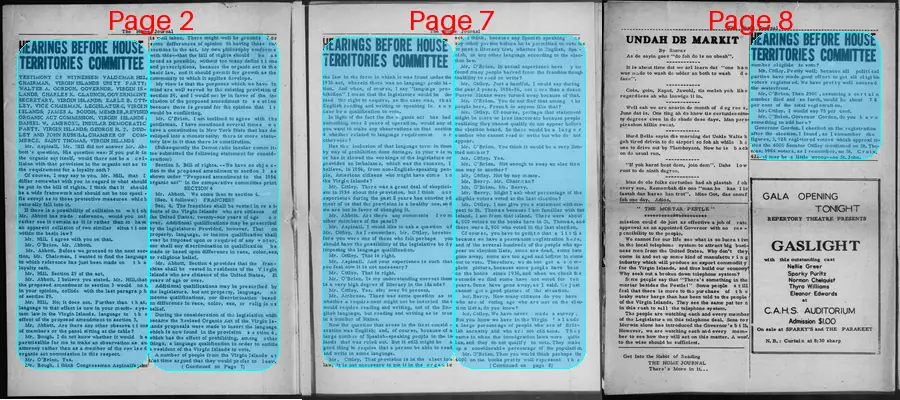
The Home Journal
Charlotte Amalie, Saint Thomas County, Virgin Islands
What is this article about?
Transcript of House Territories Committee hearings on revising the Virgin Islands Organic Act, featuring testimony from local officials on bill of rights provisions (loyalty oaths) and franchise qualifications (no language requirements), with discussions favoring retention of current language based on two years' experience.
Merged-components note: This is a single transcript of House Territories Committee hearings on Virgin Islands matters, continued across pages 2, 7, and 8; relabeled to domestic_news as it is local political news in narrative form.
Clippings
1 of 3
OCR Quality
Full Text
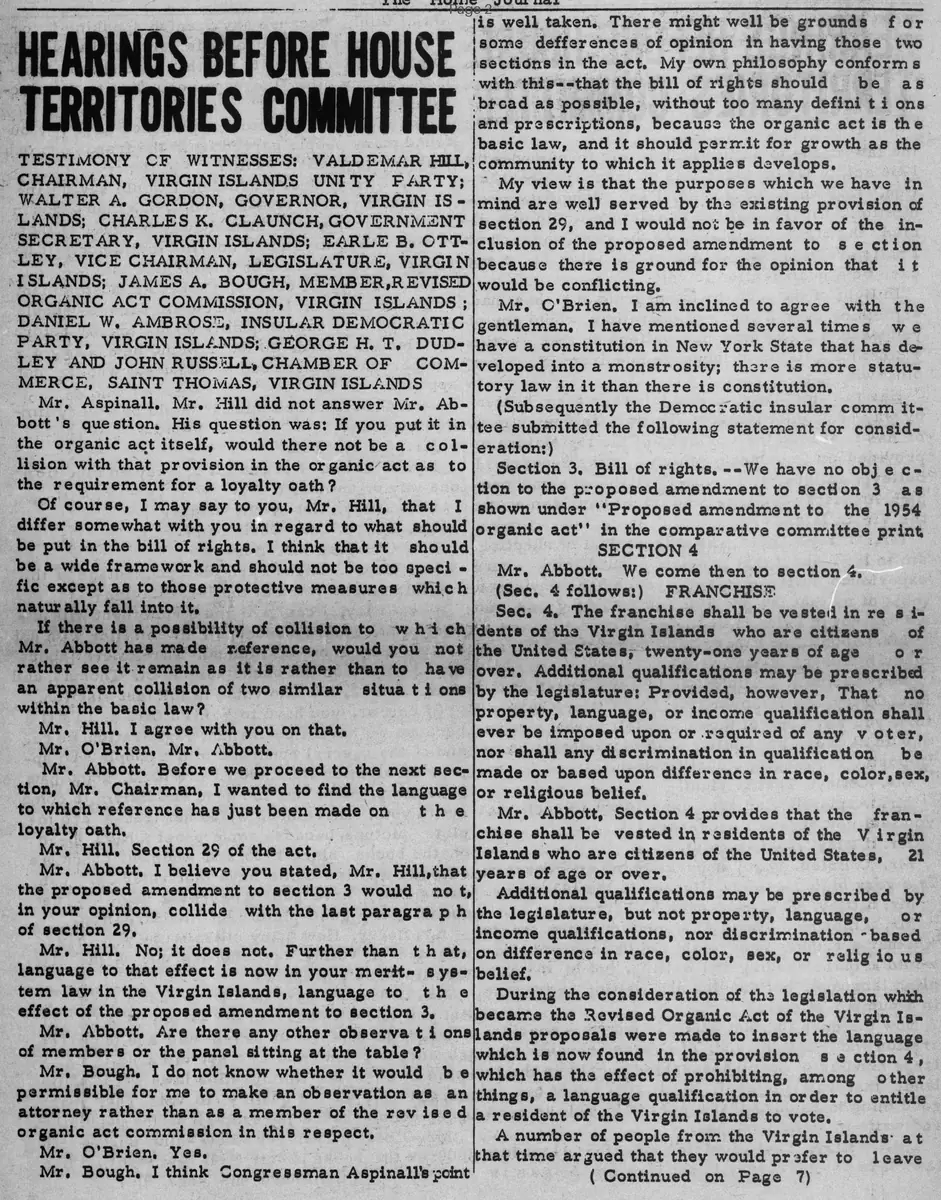
TESTIMONY OF WITNESSES: VALDEMAR HILL, CHAIRMAN, VIRGIN ISLANDS UNITY PARTY; WALTER A. GORDON, GOVERNOR, VIRGIN ISLANDS; CHARLES K. CLAUNCH, GOVERNMENT SECRETARY, VIRGIN ISLANDS; EARLE B. OTTLEY, VICE CHAIRMAN, LEGISLATURE, VIRGIN ISLANDS; JAMES A. BOUGH, MEMBER, REVISED ORGANIC ACT COMMISSION, VIRGIN ISLANDS; DANIEL W. AMBROSE, INSULAR DEMOCRATIC PARTY, VIRGIN ISLANDS; GEORGE H. T. DUDLEY AND JOHN RUSSALL, CHAMBER OF COMMERCE, SAINT THOMAS, VIRGIN ISLANDS
Mr. Aspinall. Mr. Hill did not answer Mr. Abbott's question. His question was: If you put it in the organic act itself, would there not be a collision with that provision in the organic act as to the requirement for a loyalty oath?
Of course, I may say to you, Mr. Hill, that I differ somewhat with you in regard to what should be put in the bill of rights. I think that it should be a wide framework and should not be too specific except as to those protective measures which naturally fall into it.
If there is a possibility of collision to which Mr. Abbott has made reference, would you not rather see it remain as it is rather than to have an apparent collision of two similar situations within the basic law?
Mr. Hill. I agree with you on that.
Mr. O'Brien. Mr. Abbott.
Mr. Abbott. Before we proceed to the next section, Mr. Chairman, I wanted to find the language to which reference has just been made on the loyalty oath.
Mr. Hill. Section 29 of the act.
Mr. Abbott. I believe you stated, Mr. Hill, that the proposed amendment to section 3 would not, in your opinion, collide with the last paragraph of section 29.
Mr. Hill. No; it does not. Further than that, language to that effect is now in your merit system law in the Virgin Islands, language to the effect of the proposed amendment to section 3.
Mr. Abbott. Are there any other observations of members or the panel sitting at the table?
Mr. Bough. I do not know whether it would be permissible for me to make an observation as an attorney rather than as a member of the revised organic act commission in this respect.
Mr. O'Brien. Yes.
Mr. Bough. I think Congressman Aspinall's point is well taken. There might well be grounds for some differences of opinion in having those two sections in the act. My own philosophy conforms with this—that the bill of rights should be as broad as possible, without too many definitions and prescriptions, because the organic act is the basic law, and it should permit for growth as the community to which it applies develops.
My view is that the purposes which we have in mind are well served by the existing provision of section 29, and I would not be in favor of the inclusion of the proposed amendment to section 3 because there is ground for the opinion that it would be conflicting.
Mr. O'Brien. I am inclined to agree with the gentleman. I have mentioned several times we have a constitution in New York State that has developed into a monstrosity; there is more statutory law in it than there is constitution.
(Subsequently the Democratic insular committee submitted the following statement for consideration:)
Section 3. Bill of rights.—We have no objection to the proposed amendment to section 3 as shown under "Proposed amendment to the 1954 organic act" in the comparative committee print.
SECTION 4
Mr. Abbott. We come then to section 4.
(Sec. 4 follows:) FRANCHISE
Sec. 4. The franchise shall be vested in residents of the Virgin Islands who are citizens of the United States, twenty-one years of age or over. Additional qualifications may be prescribed by the legislature: Provided, however, That no property, language, or income qualification shall ever be imposed upon or required of any voter, nor shall any discrimination in qualification be made or based upon difference in race, color, sex, or religious belief.
Mr. Abbott. Section 4 provides that the franchise shall be vested in residents of the Virgin Islands who are citizens of the United States, 21 years of age or over. Additional qualifications may be prescribed by the legislature, but not property, language, or income qualifications, nor discrimination based on difference in race, color, sex, or religious belief.
During the consideration of this legislation which became the Revised Organic Act of the Virgin Islands proposals were made to insert the language which is now found in the provision section 4, which has the effect of prohibiting, among other things, a language qualification in order to entitle a resident of the Virgin Islands to vote.
A number of people from the Virgin Islands at that time argued that they would prefer to leave
the law in the form in which it was found under the 1936 act, wherein there was no language prohibition. And when, of course, I say 'language prohibition' I mean that the legislature would be denied the right to require, as the case was, that English reading and writing or speaking in any case be a qualification to vote.
In light of the fact that the organic act has had something over 2 years of operation, would any of you want to make any observations on that section 4 whether related to language requirement or otherwise?
Has the inclusion of that language term in there by way of prohibition done damage, in your view, or has it slowed the workings of the legislature or provided an imbalance, which was the concern, I believe, in 1954, from non-English-speaking people, American citizens who might have come to the Virgin Islands?
Mr. Ottley. There was a great deal of skepticism in 1954 about this provision, but I think our experience during the past 2 years has convinced most of us that the provision is a healthy one, and we are not in favor of changing it.
Mr. Abbott. Are there any comments from other members of the panel?
Mr. Aspinall. I would like to ask a question of Mr. Ottley. As I remember, Mr. Ottley, heretofore you were one of those who felt perhaps you should have the possibility of the legislative body imposing the language qualification.
Mr. Ottley. That is right.
Mr. Aspinall. And your experience is such that you feel now it is not necessary?
Mr. Ottley. That is right.
Mr. O'Brien. Is my understanding correct there is a very high degree of literacy in the islands?
Mr. Ottley. Yes, sir; over 90 percent.
Mr. Ambrose. There was some question as to whether a requirement might not be inserted that would require reading and writing, not of the English language, but reading and writing as is true in a number of States.
Now the question that arose in the first consideration was English; and, of course, because of a large number of Spanish-speaking people in the islands that was ruled out. But it still might be a good thing to require that a person be able to read and write in some language.
Mr. Ottley. That provision is in the election law; it is not necessary to put it in the organic act, I think, because any Spanish speaking or any other person before he is permitted to vote has to pass a literacy test, whether in English, Spanish, or any other language according to the election law.
Mr. O'Brien. In actual experience have you found many people barred from the franchise through inability to read or write?
Mr. Ottley. Just a handful. I would say during the past 2 years, 1954-56, not more than a dozen Puerto Ricans were turned away because of that.
Mr. O'Brien. You do not find that among the people here, French or anyone like that?
Mr. Ottley. Of course, perhaps that statement might be more or less inaccurate because people realizing they cannot qualify do not appear before the election board. So there would be a larger number who cannot read or write but who do not appear.
Mr. O'Brien. You think it would be a very limited number?
Mr. Ottley. Yes.
Mr. O'Brien. Not enough to sway an election one way or another?
Mr. Ottley. Not by any means.
Mr. Berry. Mr. Chairman?
Mr. O'Brien. Mr. Berry.
Mr. Berry. Might I ask what percentage of the eligible voters voted at the last election?
Mr. Ottley. I can give you a statement with respect to St. Thomas because I am familiar with that island. I am from that island. There were about 4,000 voters on the books here in St. Thomas, and there were 2,900 who voted in the last election. Of course, you have to go into that a little because we have a permanent registration here, and of the several hundreds of the people who appear on election lists, some are dead, some have gone away, some are too aged and infirm to come out to vote. Therefore, we do not get a complete picture, because some people have been on the books since 1936, and when we check the records we find some have not voted for ten years. Some have gone away, as I said. We just cannot get a good picture of the situation.
Mr. Berry. How many citizens do you have who are of voting age who are not on the election lists, do you know?
Mr. Ottley. We have never made a survey. But you know we have in the Virgin Islands a large percentage of people who are of British ancestry and who are not citizens. They came in when the immigration laws were quite lax, and they do not qualify to vote. They make up a considerable percentage of the population.
Mr. O'Brien. Then you would think perhaps the 4000 on the books pretty well represent the
number eligible to vote?
Mr. Ottley. Pretty well; because all political parties have made good effort to get all eligible voters registered. We have pretty well covered the waterfront.
Mr. O'Brien. Then 29 or, assuming a certain number died and so forth, would be about 75 per cent of the total registration.
Mr. Ottley. I would say 75 per cent.
Mr. O'Brien. Governor Gordon, do you have something to add here?
Governor Gordon. I checked on the registration after the election. I found, as I remember the figures, 3,926 registered voters which approximates the 4000 Senator Ottley mentioned on St. Thomas; 3984 voters, as I remember, on St. Croix; 422--I may be a little wrong--on St. John.
What sub-type of article is it?
What keywords are associated?
What entities or persons were involved?
Where did it happen?
Domestic News Details
Primary Location
Virgin Islands
Event Date
1954 1956
Key Persons
Outcome
witnesses generally agree to retain current provisions on bill of rights and franchise without amendments; high literacy rate (over 90%); low number of disenfranchised voters; voter turnout around 75%; registration figures: st. thomas ~3,926, st. croix ~3,984, st. john ~422.
Event Details
House Territories Committee hears testimony from Virgin Islands officials on proposed amendments to the Revised Organic Act. Discussion on Section 3 (bill of rights and loyalty oaths) favors broad framework without conflicting specifics, citing Section 29. Section 4 (franchise) review confirms no need for language qualifications after two years' experience; literacy tests in election law suffice; minimal impact on voting from non-English speakers.