Thank you for visiting SNEWPapers!
Sign up free
Alexandria Daily Gazette, Commercial & Political
Alexandria, Virginia
What is this article about?
Naval engagement on May 16, 1811, between British sloop Little Belt (Capt. Bingham) and U.S. frigate President (Commodore Rodgers) off Cape Charles, resulting in 32 British casualties and ship damage. Diplomatic correspondence between U.S. Secretary Monroe and British envoys Morier and Foster seeks amicable resolution amid impressment tensions.
Merged-components note: Merged continuation of diplomatic correspondence on foreign affairs across pages based on text flow and sequential reading order.
Clippings
1 of 2
OCR Quality
Full Text
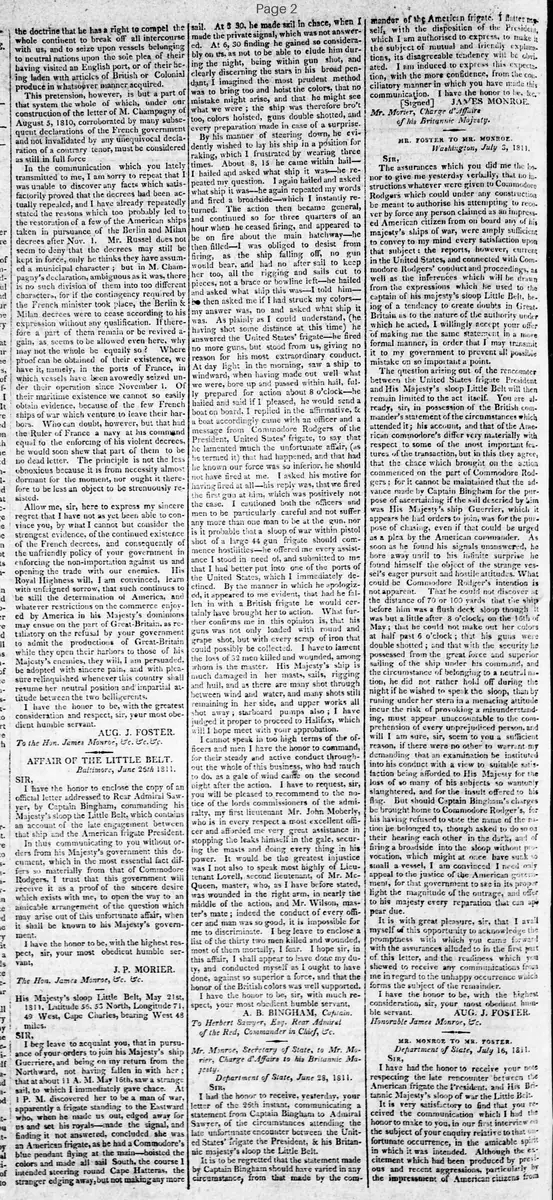
Baltimore, June 25th 1811.
SIR,
I have the honor to enclose the copy of an official letter addressed to Rear Admiral Sawyer, by Captain Bingham, commanding his Majesty's sloop the Little Belt, which contains an account of the late engagement between that ship and the American frigate President.
In thus communicating to you without orders from his Majesty's government this document, which in the most essential fact differs so materially from that of Commodore Rodgers, I trust that this government will receive it as a proof of the sincere desire which exists with me, to open the way to an amicable arrangement of the question which may arise out of this unfortunate affair, when it shall be known to his Majesty's government.
I have the honor to be, with the highest respect, sir, your most obedient humble servant,
J. P. MORIER.
The Hon. James Monroe, &c. &c.
His Majesty's sloop Little Belt, May 21st, 1811. Latitude 56, 53 North, Longitude 71, 49 West, Cape Charles, bearing West 48 miles.
SIR,
I beg leave to acquaint you, that in pursuance of your orders to join his Majesty's ship Guerriere, and being on my return from the Northward, not having fallen in with her; that at about 11 A. M. May 16th, saw a strange sail, to which I immediately gave chase. At 1 P. M. discovered her to be a man of war, apparently a frigate standing to the Eastward who, when he made us out, edged away for us and set his royals--made the signal, and finding it not answered, concluded she was an American frigate, as he had a Commodore's blue pendant flying at the main--hoisted the colors and made all sail South, the course I intended steering round Cape Hatteras, the stranger edging away, but not making any more sail. At 3 30, he made sail in chase, when I made the private signal, which was not answered; and during the night, being within gun shot, and clearly discerning the stars in his broad pendant, I imagined the most prudent method was to bring too and hoist the colors, that no mistake might arise, and that he might see what we were; the ship was therefore bro't too, colors hoisted, guns double shotted, and every preparation made in case of a surprise. By his manner of steering down, he evidently wished to lay his ship in a position for raking, which I frustrated by wearing three times. About 8, 15 he came within hail--I hailed and asked what ship it was--he repeated my question. I again hailed and asked what ship it was--he again repeated my words and fired a broadside which I instantly returned. The action then became general, and continued so for three quarters of an hour when he ceased firing, and appeared to be on fire about the main hatchway--he then filled--I was obliged to desist from firing, as the ship falling off, no gun would bear, and had no after sail to keep her too, all the rigging and sails cut to pieces, not a brace or bowline left--he hailed and asked what ship this was--I told him--he then asked me if I had struck my colors--my answer was, no and asked what ship it was. As plainly as I could understand, (he having shot some distance at this time) he answered the United States' frigate--he fired no more guns, but stood from us, giving no reason for his most extraordinary conduct.
At day light in the morning, saw a ship to windward, when having made out well what we were, bore up and passed within hail, fully prepared for action about 8 o'clock--he hailed and said if I pleased, he would send a boat on board. I replied in the affirmative, & a boat accordingly came with an officer and a message from Commodore Rodgers of the President, United States' frigate, to say that he lamented much the unfortunate affair, (as he termed it) that had happened. and that had he known our force was so inferior. he should not have fired at me. I asked his motive for having fired at all--his reply was. that we fired the first gun at him, which was positively not the case. I cautioned both the officers and men to be particularly careful and not suffer any more than one man to be at the gun, nor is it probable that a sloop of war within pistol shot of a large 44 gun frigate should commence hostilities--he offered me every assistance I stood in need of, and submitted to me that I had better put into one of the ports of the United States, which I immediately declined. By the manner in which he apologized, it appeared to me evident, that had he fallen in with a British frigate he would certainly have brought her to action. What further confirms me in this opinion is, that his guns was not only loaded with round and grape shot, but with every scrap of iron that could possibly be collected. I have to lament the loss of 32 men killed and wounded, among whom is the master. His Majesty's ship is much damaged in her masts, sails, rigging and hull, and as there are many shot through between wind and water, and many shots still remaining in her side, and upper works all shot away; starboard pumps also; I have judged it proper to proceed to Halifax, which will I hope meet with your approbation.
I cannot speak in too high terms of the officers and men I have the honor to command, for their steady and active conduct throughout the whole of this business, who had much to do, as a gale of wind came on the second night after the action. I have to request, sir, you will be pleased to recommend to the notice of the lords commissioners of the admiralty, my first lieutenant Mr. John Moberly, who is in every respect a most excellent officer and afforded me very great assistance in stopping the leaks himself in the gale, securing the masts and doing every thing in his power. It would be the greatest injustice was I not also to speak most highly of Lieutenant Lovell, second lieutenant, of Mr. McQueen, master, who, as I have before stated, was wounded in the right arm, in nearly the middle of the action, and Mr. Wilson, master's mate; indeed the conduct of every officer and man was so good, it is impossible for me to discriminate. I beg leave to enclose a list of the thirty two men killed and wounded, most of them mortally, I fear. I hope sir, in this affair, I shall appear to have done my duty, and conducted myself as I ought to have done, against so superior a force, and that the honor of the British colors was well supported.
I have the honor to be, sir, with much respect, your most obedient humble servant,
A. B. BINGHAM, Captain.
To Herbert Sawyer, Esq. Rear Admiral of the Red, Commander in Chief, &c.
Mr. Monroe, Secretary of State, to Mr. Morier, Charge d'Affaires to his Britannic Majesty.
Department of State, June 28, 1811.
SIR,
I had the honor to receive, yesterday, your letter of the 26th instant, communicating a statement from Captain Bingham to Admiral Sawyer, of the circumstances attending the late unfortunate encounter between the United States' frigate the President, & his Britannic majesty's sloop the Little Belt.
It is to be regretted that the statement made by Captain Bingham should have varied in any circumstance, from that made by the commander of the American frigate. I flatter myself, with the disposition of the President which I am authorised to express, to make it the subject of mutual and friendly explanations, its disagreeable tendency will be obviated. I am induced to express this expectation, with the more confidence, from the conciliatory manner in which you have made this communication. I have the honor to be, &c.
[SIGNED]
JAMES MONROE.
Mr. Morier, Charge d' Affaires of his Britannic Majesty.
MR. FOSTER TO MR. MONROE.
Washington, July 3, 1811.
SIR,
The assurances which you did me the honor to give me yesterday verbally, that no instructions whatever were given to Commodore Rodgers which could under any construction be meant to authorise his attempting to recover by force any person claimed as an impressed American citizen from on board any of his majesty's ships of war, were amply sufficient to convey to my mind every satisfaction upon that subject: the reports, however, current in the United States, and connected with Commodore Rodgers' conduct and proceedings, as well as the inferences which will be drawn from the expressions which he used to the captain of his majesty's sloop Little Belt, being of a tendency to create doubts in Great-Britain as to the nature of the authority under which he acted, I willingly accept your offer of making me the same statement in a more formal manner, in order that I may transmit it to my government to prevent all possible mistake on so important a point.
The question arising out of the rencounter between the United States frigate President and His Majesty's sloop Little Belt will then remain limited to the act itself. You are already, sir, in possession of the British commander's statement of the circumstances which attended it; his account, and that of the American commodore's differ very materially with respect to some of the most important features of the transaction, but in this they agree, that the chase which brought on the action commenced on the part of Commodore Rodgers; for it cannot be maintained that the advance made by Captain Bingham for the purpose of ascertaining if the sail descried by him was His Majesty's ship Guerriere, which it appears he had orders to join, was for the purpose of chasing, even if that could be urged as a plea by the American commander. As soon as he found his signals unanswered, he bore away until to his infinite surprise he found himself the object of the strange vessel's eager pursuit and hostile attitudes. What could be Commodore Rodgers' intention is not apparent. That he could not discover at the distance of 70 or 100 yards that the ship before him was a flush deck sloop though it was but a little after 8 o'clock, on the 16th of May; that he could not make out her colors at half past 6 o'clock; that his guns were double shotted; and that with the security he possessed from the great force and superior sailing of the ship under his command, and the circumstance of belonging to a Neutral nation, he did not rather hold off during the night if he wished to speak the sloop, than by running under her stern in a menacing altitude incur the risk of provoking a misunderstanding, must appear unaccountable to the comprehension of every unprejudiced person, and will I am sure, sir, seem to you a sufficient reason, if there were no other to warrant my demanding that an examination be instituted into his conduct with a view to suitable satisfaction being afforded to His Majesty for the loss of so many of his subjects so wantonly slaughtered, and for the insult offered to his flag. But should Captain Bingham's charges be brought home to Commodore Rodgers, for his having refused to state the name of the nation he belonged to, though asked to do so on their hearing each other in the dark, and of firing a broadside into the sloop without provocation, which might at once have sunk so small a vessel, I am convinced I need only appeal to the justice of the American government, for that government to see in its proper light the magnitude of the outrage, and offer to his majesty every reparation that can appear due.
It is with great pleasure, sir, that I avail myself of this opportunity to acknowledge the promptness with which you came forward with the assurances alluded to in the first part of this letter, and the readiness which you shewed to receive any communications from me in regard to the unhappy occurrence which forms the subject of the remainder.
I have the honor to be, with the highest consideration, sir, your most obedient humble servant.
AUG. J. FOSTER.
Honorable James Monroe, &c.
MR. MONROE TO MR. FOSTER.
Department of State, July 16, 1811.
SIR,
I have had the honor to receive your note respecting the late rencounter between the American frigate the President, and His Britannic Majesty's sloop of war the Little Belt.
It is very satisfactory to find that you received the communication which I had the honor to make to you, in our first interview on the subject of your enquiry relative to that unfortunate occurrence, in the amicable spirit in which it was intended. Although the excitement which had been produced by previous and recent aggressions, particularly by the impressment of American citizens from merchant vessels, and from the public armed ships of the United States, had imposed on Commodore Rodgers the duty of the utmost vigilance, and had induced the government to give him an extent of discretion in the use of force, proportioned to the imminence of the danger, with which it was believed the safety of the ships under his command might be threatened, yet it was not the intention of the government that he should commit hostilities on any British ship, which had not been guilty of a previous aggression.
American vessels, even on the coast of the United States, was great, yet no order had been given by the government, for the recovery-by force, of any citizens so impressed, from any British ship of war. The orders given to the commanders of the frigates and other armed vessels of the United States were for the protection of their coast, and of their commerce within the legitimate limits.
I need not repeat to you, sir, the sincere regret of this government, that such an encounter took place, and more especially that it should have produced the unfortunate consequences which attended it.
I have the honor to be, &c.
(Signed)
JAS. MONROE.
Aug. J. Foster, Esq. &c.
What sub-type of article is it?
What keywords are associated?
What entities or persons were involved?
Where did it happen?
Foreign News Details
Primary Location
Off Cape Charles
Event Date
May 16, 1811
Key Persons
Outcome
32 british killed and wounded; little belt damaged in masts, sails, rigging, hull; proceeds to halifax; no further firing; diplomatic exchanges for explanations and satisfaction.
Event Details
British sloop Little Belt chased what it thought was HMS Guerriere but encountered U.S. frigate President. Night engagement ensued with mutual hails; President fired first broadside per British account, action lasted 45 minutes. President appeared on fire but filled away. Rodgers later expressed regret, claiming ignorance of inferior force and alleging British fired first. Correspondence highlights tensions over impressment and seeks mutual explanations.