Thank you for visiting SNEWPapers!
Sign up free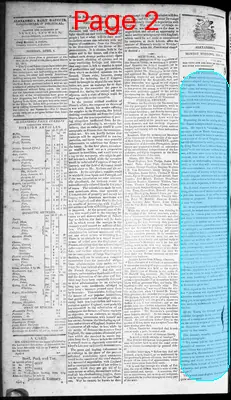
Editorial
April 6, 1812
Alexandria Daily Gazette, Commercial & Political
Alexandria, Virginia
What is this article about?
Editorial critiques Col. Duane's Aurora article on inadequacies in Congress's war measures: inefficient volunteer act, faulty militia arms, unprepared fortifications, conditional loan, unpopular taxes; doubts serious war intent.
Clipping

OCR Quality
95%
Excellent
Full Text
OUR PROSPECTS.
Col. Duane entirely disapproves of the war measures adopted during the present session of Congress. Indeed if his statements can be relied upon, our strength is yet mostly on paper. The article to which we allude is in reply to a parade in the Intelligencer some days ago, which was calculated to produce an impression that we were prepared to encounter the whole world.
The act for raising 50,000 volunteers Mr. Duane declares to be utterly inefficient. Respecting the act for arming the militia, Mr. Duane indulges himself in unusual pleasantry. He says it is "admirable, if they be not such arms as Tench Coxe provides; in such case it would be better to arm them with each a copy of the act of Congress; they cannot kill themselves by reading, as they might by firing Tench Coxe's rifles or German fire locks."—At this rate, our soldiers, in case of war, will have more cause to fear their own weapons than those of their enemy. This would be an embarrassing situation—sure of death, do what they will: attended, however, with this consolation, that it will be a much greater proof of bravery to fight than to run. But this singular misfortune will be attached to their valor,—that so far from being serviceable, it will be injurious, to their country!
The Colonel observes that the act authorizing detachments of militia would have been a judicious measure, if the militia had been classed, as proposed. This he thinks ought to have been done.
On the act to complete fortifications on the seaboard, he makes some curious remarks.— He says he "could point out a most important work in which there were not four rounds of powder: in another not an ounce; in another not an ounce; guns dismounted or without carriages; no timber laid in to make any and it should be laid in a rear at least to make serviceable carriages; nay, we know of a case in which an artillery officer was ordered to make a carriage which should be so economically (or comically) constructed, as to fit 24 or 36 pounders; we could enumerate (he continues) other facts equally astonishing: in one word, there are no works on the seaboard in state of defence at this moment," &c.
Jefferson appointed to a very distinguished post in the army, he must be allowed to possess some knowledge of military affairs. If his statement be correct, are we not in a pretty situation to go to war
With regard to the Loan. Col. Duane says that "its wisdom will depend upon the consideration whether it be made a private speculating job, or an open public loan."
Mr. Gallatin perfectly understands what is meant by this hint.
Of the Taxes, the Colonel positively asserts that the people do not nor ever will approve of a stamp act or excise, which he says are the entering wedges of tyranny, &c. Let the Republicans who sanction these things ponder on that remark.
The Aurora's remarks conclude with the following paragraph:
"We cannot believe that there is any expectation of war—we do not believe it—because if there was any serious intention or expectation of it, the conviction would render it necessary to reverse the whole order of proceeding, and resort to men of understanding in such affairs, instead of fooling away time and money, and public character, in such manner."
This is such plain English, that comment it quite unnecessary.
Col. Duane entirely disapproves of the war measures adopted during the present session of Congress. Indeed if his statements can be relied upon, our strength is yet mostly on paper. The article to which we allude is in reply to a parade in the Intelligencer some days ago, which was calculated to produce an impression that we were prepared to encounter the whole world.
The act for raising 50,000 volunteers Mr. Duane declares to be utterly inefficient. Respecting the act for arming the militia, Mr. Duane indulges himself in unusual pleasantry. He says it is "admirable, if they be not such arms as Tench Coxe provides; in such case it would be better to arm them with each a copy of the act of Congress; they cannot kill themselves by reading, as they might by firing Tench Coxe's rifles or German fire locks."—At this rate, our soldiers, in case of war, will have more cause to fear their own weapons than those of their enemy. This would be an embarrassing situation—sure of death, do what they will: attended, however, with this consolation, that it will be a much greater proof of bravery to fight than to run. But this singular misfortune will be attached to their valor,—that so far from being serviceable, it will be injurious, to their country!
The Colonel observes that the act authorizing detachments of militia would have been a judicious measure, if the militia had been classed, as proposed. This he thinks ought to have been done.
On the act to complete fortifications on the seaboard, he makes some curious remarks.— He says he "could point out a most important work in which there were not four rounds of powder: in another not an ounce; in another not an ounce; guns dismounted or without carriages; no timber laid in to make any and it should be laid in a rear at least to make serviceable carriages; nay, we know of a case in which an artillery officer was ordered to make a carriage which should be so economically (or comically) constructed, as to fit 24 or 36 pounders; we could enumerate (he continues) other facts equally astonishing: in one word, there are no works on the seaboard in state of defence at this moment," &c.
Jefferson appointed to a very distinguished post in the army, he must be allowed to possess some knowledge of military affairs. If his statement be correct, are we not in a pretty situation to go to war
With regard to the Loan. Col. Duane says that "its wisdom will depend upon the consideration whether it be made a private speculating job, or an open public loan."
Mr. Gallatin perfectly understands what is meant by this hint.
Of the Taxes, the Colonel positively asserts that the people do not nor ever will approve of a stamp act or excise, which he says are the entering wedges of tyranny, &c. Let the Republicans who sanction these things ponder on that remark.
The Aurora's remarks conclude with the following paragraph:
"We cannot believe that there is any expectation of war—we do not believe it—because if there was any serious intention or expectation of it, the conviction would render it necessary to reverse the whole order of proceeding, and resort to men of understanding in such affairs, instead of fooling away time and money, and public character, in such manner."
This is such plain English, that comment it quite unnecessary.
What sub-type of article is it?
Military Affairs
Economic Policy
Partisan Politics
What keywords are associated?
War Preparations
Military Readiness
Congressional Acts
Fortifications
Militia Arming
Taxes
Loan
Partisan Critique
What entities or persons were involved?
Col. Duane
Congress
Jefferson
Tench Coxe
Mr. Gallatin
Republicans
Aurora
Editorial Details
Primary Topic
Criticism Of Congressional War Preparations
Stance / Tone
Strongly Critical Of Government Readiness And Measures
Key Figures
Col. Duane
Congress
Jefferson
Tench Coxe
Mr. Gallatin
Republicans
Aurora
Key Arguments
Volunteer Act Inefficient
Militia Arming Act Provides Faulty Weapons
Militia Detachments Should Be Classed
Seaboard Fortifications Unprepared And Lacking Supplies
Loan's Wisdom Depends On Public Vs. Private Handling
Stamp Act And Excise Taxes Are Tyrannical And Unpopular
No Serious Expectation Of War, Leading To Misguided Proceedings