Thank you for visiting SNEWPapers!
Sign up free
Editorial
April 8, 1956
Atlanta Daily World
Atlanta, Fulton County, Georgia
What is this article about?
Editorial by William Gordon discusses a young man's release from prison after five years for associating with a bad crowd at 18, critiques societal and parental negligence in guiding youth, and calls for prevention to reduce juvenile crime nationwide.
Clipping
OCR Quality
95%
Excellent
Full Text
THE NATION'S CAPITAL
REVIEWING THE NEWS
WILLIAM GORDON
Managing Editor: Atlanta Daily World
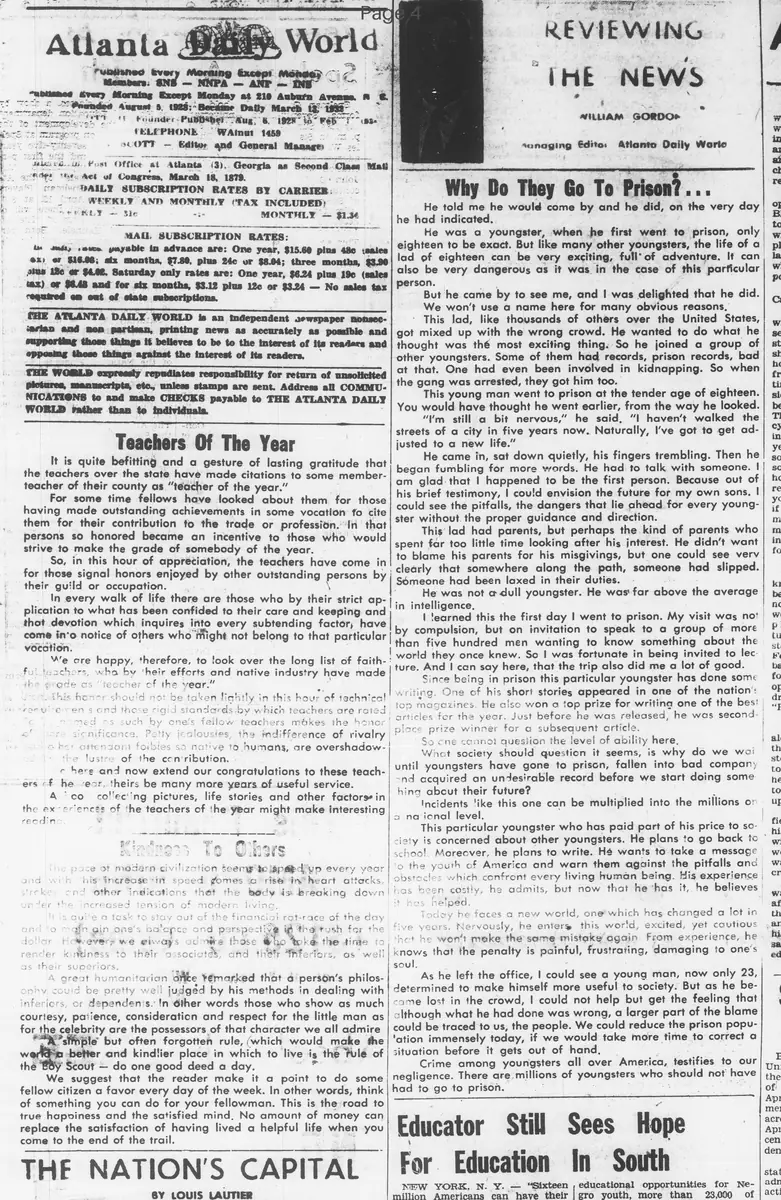
Why Do They Go To Prison?
He told me he would come by and he did, on the very day he had indicated.
He was a youngster, when he first went to prison, only eighteen to be exact. But like many other youngsters, the life of a lad of eighteen can be very exciting, full of adventure. It can also be very dangerous as it was in the case of this particular person.
But he came by to see me, and I was delighted that he did.
We won't use a name here for many obvious reasons.
This lad, like thousands of others over the United States, got mixed up with the wrong crowd. He wanted to do what he thought was the most exciting thing. So he joined a group of other youngsters. Some of them had records, prison records, bad at that. One had even been involved in kidnapping. So when the gang was arrested, they got him too.
This young man went to prison at the tender age of eighteen.
You would have thought he went earlier, from the way he looked.
"I'm still a bit nervous," he said. "I haven't walked the streets of a city in five years now. Naturally, I've got to get adjusted to a new life."
He came in, sat down quietly, his fingers trembling. Then he began fumbling for more words. He had to talk with someone. I am glad that I happened to be the first person. Because out of his brief testimony, I could envision the future for my own sons. I could see the pitfalls, the dangers that lie ahead for every youngster without the proper guidance and direction.
This lad had parents, but perhaps the kind of parents who spent far too little time looking after his interest. He didn't want to blame his parents for his misgivings, but one could see very clearly that somewhere along the path, someone had slipped. Someone had been lax in their duties.
He was not a dull youngster. He was far above the average in intelligence.
I learned this the first day I went to prison. My visit was not by compulsion, but on invitation to speak to a group of more than five hundred men wanting to know something about the world they once knew. So I was fortunate in being invited to lecture. And I can say here, that the trip also did me a lot of good.
Since being in prison this particular youngster has done some writing. One of his short stories appeared in one of the nation's top magazines. He also won a top prize for writing one of the best articles for the year. Just before he was released, he was second-place prize winner for a subsequent article.
So one cannot question the level of ability here.
What society should question it seems, is why do we wait until youngsters have gone to prison, fallen into bad company and acquired an undesirable record before we start doing something about their future?
Incidents like this one can be multiplied into the millions on a national level.
This particular youngster who has paid part of his price to society is concerned about other youngsters. He plans to go back to school. Moreover, he plans to write. He wants to take a message to the youth of America and warn them against the pitfalls and obstacles which confront every living human being. His experience has been costly, he admits, but now that he has it, he believes it has helped.
Today he faces a new world, one which has changed a lot in five years. Nervously, he enters this world, excited, yet cautious that he won't make the same mistake again. From experience, he knows that the penalty is painful, frustrating, damaging to one's soul.
As he left the office, I could see a young man, now only 23, determined to make himself more useful to society. But as he became lost in the crowd, I could not help but get the feeling that although what he had done was wrong, a larger part of the blame could be traced to us, the people. We could reduce the prison population immensely today, if we would take more time to correct a situation before it gets out of hand.
Crime among youngsters all over America, testifies to our negligence. There are millions of youngsters who should not have had to go to prison.
REVIEWING THE NEWS
WILLIAM GORDON
Managing Editor: Atlanta Daily World
Why Do They Go To Prison?
He told me he would come by and he did, on the very day he had indicated.
He was a youngster, when he first went to prison, only eighteen to be exact. But like many other youngsters, the life of a lad of eighteen can be very exciting, full of adventure. It can also be very dangerous as it was in the case of this particular person.
But he came by to see me, and I was delighted that he did.
We won't use a name here for many obvious reasons.
This lad, like thousands of others over the United States, got mixed up with the wrong crowd. He wanted to do what he thought was the most exciting thing. So he joined a group of other youngsters. Some of them had records, prison records, bad at that. One had even been involved in kidnapping. So when the gang was arrested, they got him too.
This young man went to prison at the tender age of eighteen.
You would have thought he went earlier, from the way he looked.
"I'm still a bit nervous," he said. "I haven't walked the streets of a city in five years now. Naturally, I've got to get adjusted to a new life."
He came in, sat down quietly, his fingers trembling. Then he began fumbling for more words. He had to talk with someone. I am glad that I happened to be the first person. Because out of his brief testimony, I could envision the future for my own sons. I could see the pitfalls, the dangers that lie ahead for every youngster without the proper guidance and direction.
This lad had parents, but perhaps the kind of parents who spent far too little time looking after his interest. He didn't want to blame his parents for his misgivings, but one could see very clearly that somewhere along the path, someone had slipped. Someone had been lax in their duties.
He was not a dull youngster. He was far above the average in intelligence.
I learned this the first day I went to prison. My visit was not by compulsion, but on invitation to speak to a group of more than five hundred men wanting to know something about the world they once knew. So I was fortunate in being invited to lecture. And I can say here, that the trip also did me a lot of good.
Since being in prison this particular youngster has done some writing. One of his short stories appeared in one of the nation's top magazines. He also won a top prize for writing one of the best articles for the year. Just before he was released, he was second-place prize winner for a subsequent article.
So one cannot question the level of ability here.
What society should question it seems, is why do we wait until youngsters have gone to prison, fallen into bad company and acquired an undesirable record before we start doing something about their future?
Incidents like this one can be multiplied into the millions on a national level.
This particular youngster who has paid part of his price to society is concerned about other youngsters. He plans to go back to school. Moreover, he plans to write. He wants to take a message to the youth of America and warn them against the pitfalls and obstacles which confront every living human being. His experience has been costly, he admits, but now that he has it, he believes it has helped.
Today he faces a new world, one which has changed a lot in five years. Nervously, he enters this world, excited, yet cautious that he won't make the same mistake again. From experience, he knows that the penalty is painful, frustrating, damaging to one's soul.
As he left the office, I could see a young man, now only 23, determined to make himself more useful to society. But as he became lost in the crowd, I could not help but get the feeling that although what he had done was wrong, a larger part of the blame could be traced to us, the people. We could reduce the prison population immensely today, if we would take more time to correct a situation before it gets out of hand.
Crime among youngsters all over America, testifies to our negligence. There are millions of youngsters who should not have had to go to prison.
What sub-type of article is it?
Crime Or Punishment
Social Reform
What keywords are associated?
Youth Crime
Prison Experiences
Societal Negligence
Parental Guidance
Rehabilitation
What entities or persons were involved?
Young Ex Prisoner
Parents
Society
Youth Of America
Editorial Details
Primary Topic
Causes Of Youth Imprisonment And Societal Negligence
Stance / Tone
Critique Of Societal And Parental Failure In Guiding Youth Away From Crime
Key Figures
Young Ex Prisoner
Parents
Society
Youth Of America
Key Arguments
Youth Join Wrong Crowds Due To Excitement And Lack Of Guidance
Parents And Society Fail To Provide Proper Direction
Intelligent Youth Can Reform And Contribute If Supported
Society Should Act Before Youth Enter Prison
Experiences In Prison Highlight Need For Prevention Over Punishment