Thank you for visiting SNEWPapers!
Sign up free
The Minnesota Pioneer
Saint Paul, Ramsey County, Minnesota
What is this article about?
Lord John Russell's speech in the House of Commons defends government foreign policy, dismisses House of Lords' censure as irrelevant, and asserts control by Commons. Debate involves D'Israeli defending Lords' resolution; a supportive resolution for government policy is set for Monday vote amid cheers.
Clipping
OCR Quality
Full Text
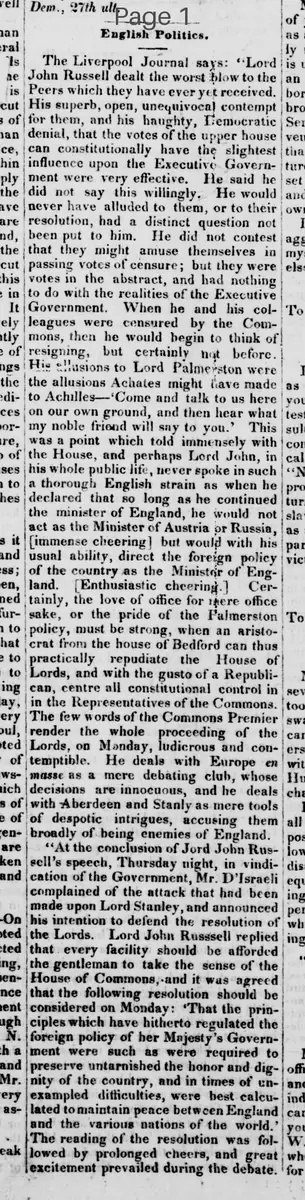
The Liverpool Journal says: "Lord John Russell dealt the worst blow to the Peers which they have ever yet received. His superb, open, unequivocal contempt for them, and his haughty, democratic denial, that the votes of the upper house can constitutionally have the slightest influence upon the Executive Government were very effective. He said he did not say this willingly. He would never have alluded to them, or to their resolution, had a distinct question not been put to him. He did not contest that they might amuse themselves in passing votes of censure; but they were votes in the abstract, and had nothing to do with the realities of the Executive Government. When he and his colleagues were censured by the Commons, then he would begin to think of resigning, but certainly not before.
His allusions to Lord Palmerston were the allusions Achates might have made to Achilles--'Come and talk to us here on our own ground, and then hear what my noble friend will say to you.' This was a point which told immensely with the House, and perhaps Lord John, in his whole public life, never spoke in such a thorough English strain as when he declared that so long as he continued the minister of England, he would not act as the Minister of Austria or Russia, [immense cheering] but would with his usual ability, direct the foreign policy of the country as the Minister of England. [Enthusiastic cheering.] Certainly, the love of office for the office sake, or the pride of the Palmerston policy, must be strong, when an aristocrat from the house of Bedford can thus practically repudiate the House of Lords, and with the gusto of a Republican, centre all constitutional control in the Representatives of the Commons.
The few words of the Commons Premier render the whole proceeding of the Lords, on Monday, ludicrous and contemptible. He deals with Europe en masse as a mere debating club, whose decisions are innocuous, and he deals with Aberdeen and Stanley as mere tools of despotic intrigues, accusing them broadly of being enemies of England.
"At the conclusion of Lord John Russell's speech, Thursday night, in vindication of the Government, Mr. D'Israeli complained of the attack that had been made upon Lord Stanley, and announced his intention to defend the resolution of the Lords. Lord John Russell replied that every facility should be afforded the gentleman to take the sense of the House of Commons, --and it was agreed that the following resolution should be considered on Monday: That the principles which have hitherto regulated the foreign policy of her Majesty's Government were such as were required to preserve untarnished the honor and dignity of the country, and in times of unexampled difficulties, were best calculated to maintain peace between England and the various nations of the world.'
The reading of the resolution was followed by prolonged cheers, and great excitement prevailed during the debate.
What sub-type of article is it?
What keywords are associated?
What entities or persons were involved?
Where did it happen?
Foreign News Details
Primary Location
England
Event Date
Thursday Night; Monday
Key Persons
Outcome
resolution to affirm government's foreign policy principles scheduled for monday consideration; prolonged cheers and excitement in house.
Event Details
Lord John Russell delivered a speech expressing contempt for the House of Lords' resolution censuring the government, stating it has no influence on the Executive. He emphasized that only censure by the Commons would prompt resignation. Allusions to Lord Palmerston urged him to debate in the Commons. Russell affirmed directing England's foreign policy independently of Austria or Russia. D'Israeli complained of attack on Stanley and intended to defend Lords' resolution. Russell agreed to facilitate a Commons vote on a resolution supporting the government's foreign policy principles for maintaining honor, dignity, and peace.