Thank you for visiting SNEWPapers!
Sign up free
Letter to Editor
February 21, 1851
Virginia Free Press
Charles Town, Jefferson County, West Virginia
What is this article about?
An opinion piece advocating life assurance as a moral and practical necessity for merchants, salaried workers, mechanics, and laborers to protect families from destitution after the breadwinner's death, countering excuses like cost and highlighting its role in personal character and societal stability.
Clipping
OCR Quality
95%
Excellent
Full Text
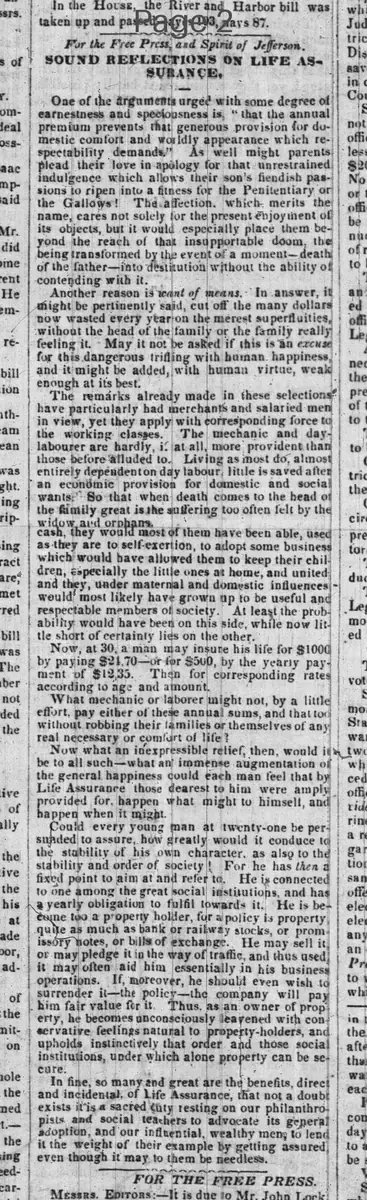
For the Free Press and Spirit of Jefferson.
SOUND REFLECTIONS ON LIFE ASSURANCE.
One of the arguments urged with some degree of earnestness and speciousness is, 'that the annual premium prevents that generous provision for domestic comfort and worldly appearance which respectability demands.' As well might parents plead their love in apology for that unrestrained indulgence which allows their son's fiendish passions to ripen into a fitness for the Penitentiary or the Gallows! The affection which merits the name, cares not solely for the present enjoyment of its objects, but it would especially place them beyond the reach of that insupportable doom, the being transformed by the event of a moment—death of the father—into destitution without the ability of contending with it.
Another reason is want of means. In answer, it might be pertinently said, cut off the many dollars now wasted every year on the merest superfluities, without the head of the family or the family really feeling it. May it not be asked if this is an excuse for this dangerous trifling with human happiness and it might be added, with human virtue, weak enough at its best.
The remarks already made in these selections have particularly had merchants and salaried men in view, yet they apply with corresponding force to the working classes.
The mechanic and day-labourer are hardly, if at all, more provident than those before alluded to. Living as most do, almost entirely dependent on day labour, little is saved after an economic provision for domestic and social wants? So that when death comes to the head of the family great is the suffering too often felt by the widow and orphans.
With the small sums they would most of them have been able, used as they are to self-exertion, to adopt some business which would have allowed them to keep their children, especially the little ones at home, and united and they, under maternal and domestic influences would most likely have grown up to be useful and respectable members of society. At least the probability would have been on this side, while now little short of certainty lies on the other.
Now, at 30, a man may insure his life for $1000 by paying $21.70—or for $500, by the yearly payment of $12.35. Then for corresponding rates according to age and amount.
What mechanic or laborer might not, by a little effort, pay either of these annual sums, and that too without robbing their families or themselves of any real necessary or comfort of life?
Now what an inexpressible relief, then, would it be to all such—what an immense augmentation of the general happiness could each man feel that by Life Assurance those dearest to him were amply provided for, happen what might to himself, and happen when it might.
Could every young man at twenty-one be persuaded to assure, how greatly would it conduce to the stability of his own character, as also to the stability and order of society! For he has then a fixed point to aim at and refer to. He is connected to one among the great social institutions, and has a yearly obligation to fulfil towards it. He is become too a property holder, for a policy is property quite as much as bank or railway stocks, or promissory notes, or bills of exchange. He may sell it or may pledge it in the way of traffic, and thus used it may often aid him essentially in his business operations. If, moreover, he should even wish to surrender it—the policy—the company would give him fair value for it. Thus, as an owner of property, he becomes unconsciously leavened with conservative feelings natural to property-holders, and upholds instinctively that order and those social institutions, under which alone property can be secure.
SOUND REFLECTIONS ON LIFE ASSURANCE.
One of the arguments urged with some degree of earnestness and speciousness is, 'that the annual premium prevents that generous provision for domestic comfort and worldly appearance which respectability demands.' As well might parents plead their love in apology for that unrestrained indulgence which allows their son's fiendish passions to ripen into a fitness for the Penitentiary or the Gallows! The affection which merits the name, cares not solely for the present enjoyment of its objects, but it would especially place them beyond the reach of that insupportable doom, the being transformed by the event of a moment—death of the father—into destitution without the ability of contending with it.
Another reason is want of means. In answer, it might be pertinently said, cut off the many dollars now wasted every year on the merest superfluities, without the head of the family or the family really feeling it. May it not be asked if this is an excuse for this dangerous trifling with human happiness and it might be added, with human virtue, weak enough at its best.
The remarks already made in these selections have particularly had merchants and salaried men in view, yet they apply with corresponding force to the working classes.
The mechanic and day-labourer are hardly, if at all, more provident than those before alluded to. Living as most do, almost entirely dependent on day labour, little is saved after an economic provision for domestic and social wants? So that when death comes to the head of the family great is the suffering too often felt by the widow and orphans.
With the small sums they would most of them have been able, used as they are to self-exertion, to adopt some business which would have allowed them to keep their children, especially the little ones at home, and united and they, under maternal and domestic influences would most likely have grown up to be useful and respectable members of society. At least the probability would have been on this side, while now little short of certainty lies on the other.
Now, at 30, a man may insure his life for $1000 by paying $21.70—or for $500, by the yearly payment of $12.35. Then for corresponding rates according to age and amount.
What mechanic or laborer might not, by a little effort, pay either of these annual sums, and that too without robbing their families or themselves of any real necessary or comfort of life?
Now what an inexpressible relief, then, would it be to all such—what an immense augmentation of the general happiness could each man feel that by Life Assurance those dearest to him were amply provided for, happen what might to himself, and happen when it might.
Could every young man at twenty-one be persuaded to assure, how greatly would it conduce to the stability of his own character, as also to the stability and order of society! For he has then a fixed point to aim at and refer to. He is connected to one among the great social institutions, and has a yearly obligation to fulfil towards it. He is become too a property holder, for a policy is property quite as much as bank or railway stocks, or promissory notes, or bills of exchange. He may sell it or may pledge it in the way of traffic, and thus used it may often aid him essentially in his business operations. If, moreover, he should even wish to surrender it—the policy—the company would give him fair value for it. Thus, as an owner of property, he becomes unconsciously leavened with conservative feelings natural to property-holders, and upholds instinctively that order and those social institutions, under which alone property can be secure.
What sub-type of article is it?
Persuasive
Informative
Reflective
What themes does it cover?
Social Issues
Morality
Commerce Trade
What keywords are associated?
Life Assurance
Family Provision
Social Stability
Insurance Premiums
Working Classes
Providence
Property Ownership
What entities or persons were involved?
Free Press And Spirit Of Jefferson
Letter to Editor Details
Recipient
Free Press And Spirit Of Jefferson
Main Argument
life assurance is essential for protecting families from poverty after the breadwinner's death, refuting objections like cost by suggesting cuts to luxuries, and it fosters personal responsibility, property ownership, and societal stability.
Notable Details
Compares Neglecting Insurance To Parental Indulgence Leading To Crime
Provides Specific Premium Examples: $21.70 For $1000 At Age 30
Equates Life Insurance Policy To Other Forms Of Property Like Stocks Or Notes