Thank you for visiting SNEWPapers!
Sign up free
The Virginia Gazette
Richmond, Williamsburg, Richmond County, Virginia
What is this article about?
Phocion responds to critics Honetus and Aristides in a Virginia newspaper, defending his prior letters on North Carolina events. He critiques the Governor's harsh treatment of Captain Peron as improper but presumes innocence until proven guilty, condemns the Regulators' violent resistance, justifies the Riot Act, and defends lawyers against general censure. Dated Edenton, NC, January 13, 1772.
Merged-components note: This is a continuation of the same letter to the editor across pages, signed Phocion. The second component was mislabeled as domestic_news but is part of the letter.
Clippings
1 of 2
OCR Quality
Full Text
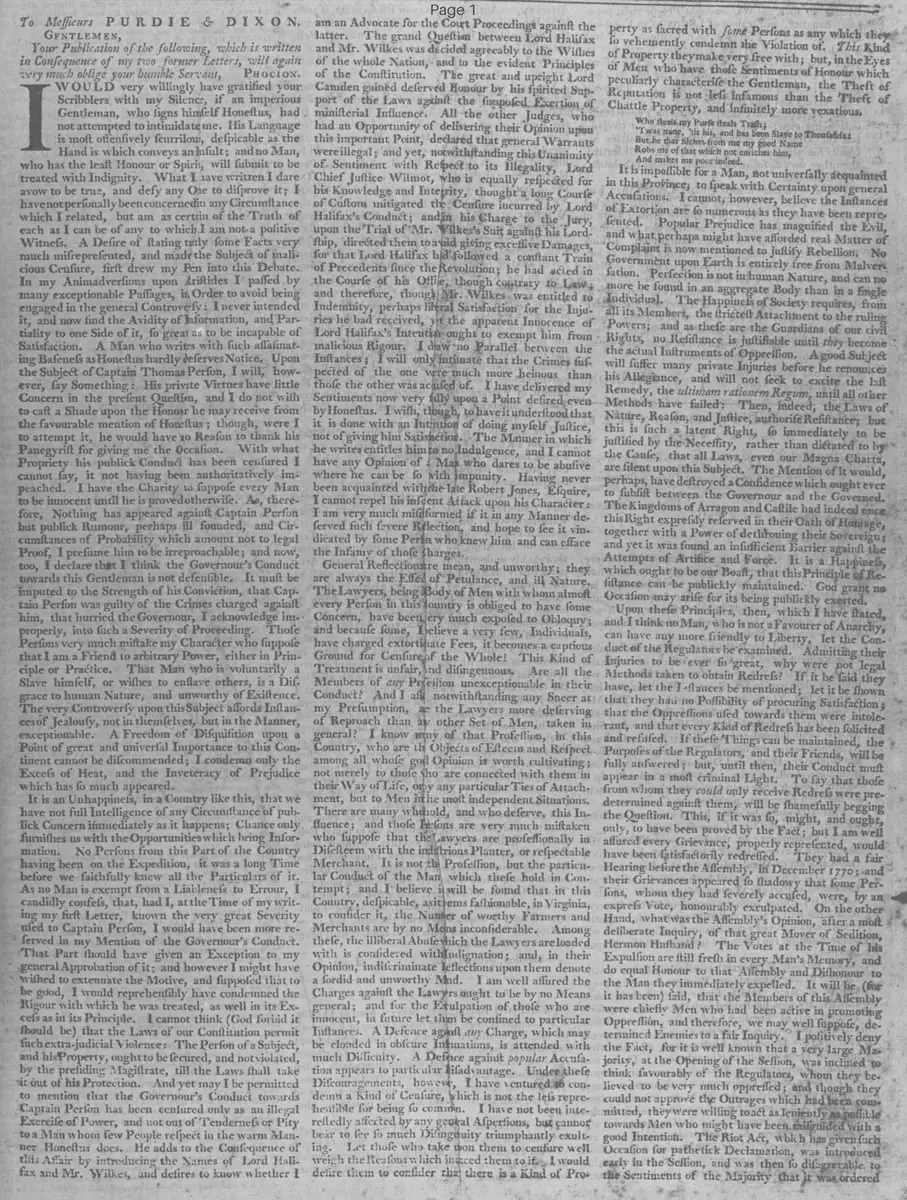
GENTLEMEN,
Your Publication of the following, which is written in Consequence of my two former Letters, will again very much oblige your humble Servant, Phocion.
I WOULD very willingly have gratified your Scribblers with my Silence, if an imperious Gentleman, who signs himself Honetus, had not attempted to intimidate me. His Language is most offensively scurrilous, despicable as the Hand which conveys an Insult; and no Man, who has the least Honour or Spirit, will submit to be treated with Indignity. What I have written I dare avow to be true, and defy any One to disprove it; I have not personally been concerned in any Circumstance which I related, but am as certain of the Truth of each as I can be of any to which I am not a positive Witness. A Desire of stating truly some Facts very much misrepresented, and made the Subject of malicious Censure, first drew my Pen into this Debate. In my Animadversions upon Aristides I passed by many exceptionable Passages, in Order to avoid being engaged in the general Controversy: I never intended it, and now find the Avidity of Information, and Partiality to one Side of it, so great as to be incapable of Satisfaction. A Man who writes with such inflaming Bitterness as Honetus hardly deserves Notice. Upon the Subject of Captain Thomas Peron, I will, however, say Something: His private Virtues have little Concern in the present Question, and I do not wish to cast a Shade upon the Honour he may receive from the favourable mention of Honetus: though, were I to attempt it, he would have no Reason to thank his Panegyrist for giving me the Occasion. With what Propriety his publick Conduct has been censured I cannot say, it not having been authoritatively impeached. I have the Charity to suppose every Man to be innocent until he is proved otherwise. As, therefore, Nothing has appeared against Captain Peron but publick Rumour, perhaps ill founded, and Circumstances of Probability which amount not to legal Proof, I presume him to be irreproachable; and now, too, I declare that I think the Governour's Conduct towards this Gentleman is not defensible. It must be imputed to the Strength of his Conviction, that Captain Peron was guilty of the Crimes charged against him, that hurried the Governour, I acknowledge improperly, into such a Severity of Proceeding. Those Persons very much mistake my Character who suppose that I am a Friend to arbitrary Power, either in Principle or Practice. That Man who is voluntarily a Slave himself, or wishes to enslave others, is a Disgrace to human Nature, and unworthy of Existence. The very Controversy upon this Subject affords Instances of Jealousy, not in themselves, but in the Manner, exceptionable. A Freedom of Disquisition upon a Point of great and universal Importance to this Continent cannot be discommended; I condemn only the Excess of Heat, and the Inveteracy of Prejudice which has so much appeared.
It is an Unhappiness, in a Country like this, that we have not full Intelligence of any Circumstance of publick Concern immediately as it happens; Chance only furnishes us with the Opportunities which bring Information. No Persons from this Part of the Country having been on the Expedition, it was a long Time before we fully knew all the Particulars of it. As no Man is exempt from a Liableness to Error, I candidly confess, that, had I, at the Time of my writing my first Letter, known the very great Severity used to Captain Peron, I would have been more reserved in my Mention of the Governour's Conduct. That Part should have given an Exception to my general Approbation of it; and however I might have wished to extenuate the Motive, and supposed that to be good, I would reprehensibly have condemned the Rigour with which he was treated; as well in its Excesses as in its Principle. I cannot think (God forbid it should be) that the Laws of our Constitution permit such extra-judicial Violence: The Person of a Subject, and his Property, ought to be secured, and not violated, by the presiding Magistrate, till the Laws shall take it out of his Protection. And yet may I be permitted to mention that the Governour's Conduct towards Captain Peron has been censured only as an illegal Exercise of Power, and not out of Tenderness or Pity to a Man whom few People respect in the warm Manner Honetus does. He adds to the Consequence of this Affair by introducing the Names of Lord Halifax and Mr. Wilkes, and desires to know whether I am an Advocate for the Court Proceedings against the latter. The grand Question between Lord Halifax and Mr. Wilkes was decided agreeably to the Wishes of the whole Nation, and to the evident Principles of the Constitution. The great and upright Lord Camden gained deserved Honour by his spirited Support of the Laws against the supposed Exertion of ministerial Influence. All the other Judges, who had an Opportunity of delivering their Opinion upon this important Point, declared that general Warrants were illegal; and yet, notwithstanding this Unanimity of Sentiment with Respect to its Illegality, Lord Chief Justice Wilmot, who is equally respected for his Knowledge and Integrity, thought a long Course of Custom mitigated the Censure incurred by Lord Halifax's Conduct; and in his Charge to the Jury, upon the Trial of Mr. Wilkes's Suit against his Lordship, directed them to avoid giving excessive Damages, for that Lord Halifax had followed a constant Train of Precedents since the Revolution; he had acted in the Course of his Office, though contrary to Law; and therefore, though Mr. Wilkes was entitled to Indemnity, perhaps liberal Satisfaction for the Injuries he had received, yet the apparent Innocence of Lord Halifax's Intentions ought to exempt him from malicious Rigour. I draw no Parallel between the Instances; I will only intimate that the Crimes suspected of the one were much more heinous than those the other was accused of. I have delivered my Sentiments now very fully upon a Point desired even by Honetus. I wish, though, to have it understood that it is done with an Intention of doing myself Justice, not of giving him Satisfaction. The Manner in which he writes entitles him to no Indulgence, and I cannot have any Opinion of a Man who dares to be abusive where he can be so with Impunity. Having never been acquainted with the late Robert Jones, Esquire, I cannot repel his indecent Attack upon his Character: I am very much misinformed if it in any Manner deserved such severe Reflection, and hope to see it vindicated by some Person who knew him and can efface the Infamy of those Charges.
General Reflections are mean, and unworthy; they are always the Effect of Petulance, and ill Nature. The Lawyers, being a Body of Men with whom almost every Person in this Country is obliged to have some Concern, have been very much exposed to Obloquy; and because some, I believe a very few, Individuals, have charged extortionate Fees, it becomes a captious Ground for Censure of the Whole! This Kind of Treatment is unfair, and disingenuous. Are all the Members of any Profession unexceptionable in their Conduct? And I ask, notwithstanding any Sneer at my Presumption, are the Lawyers more deserving of Reproach than any other Set of Men, taken in general? I know many of that Profession, in this Country, who are the Objects of Esteem and Respect among all whose good Opinion is worth cultivating; not merely to those who are connected with them in their Way of Life, or by any particular Ties of Attachment, but to Men in the most independent Situations. There are many who hold, and who deserve, this Influence: and those Persons are very much mistaken who suppose that the Lawyers are professionally in Disesteem with the industrious Planter, or respectable Merchant. It is not the Profession, but the particular Conduct of the Man which they hold in Contempt; and I believe it will be found that in this Country, despicable as it seems fashionable, in Virginia, to consider it, the Number of worthy Farmers and Merchants are by no Means inconsiderable. Among these, the illiberal Abuse which the Lawyers are loaded with is considered with Indignation; and, in their Opinion, indiscriminate Reflections upon them denote a sordid and unworthy Mind. I am well assured the Charges against the Lawyers ought to be by no Means general; and for the Exculpation of those who are innocent, in future let them be confined to particular Instances. A Defence against any Charge, which may be cloaked in obscure Insinuations, is attended with much Difficulty. A Defence against popular Accusation appears to particular Disadvantage. Under these Discouragements, however, I have ventured to condemn a Kind of Censure, which is not the less reprehensible for being so common. I have not been interestedly affected by any general Aspersions, but cannot bear to see so much Disingenuity triumphantly exulting. Let those who take upon them to censure well weigh the Reasons which induced them to it. I would desire them to consider that there is a Kind of Property as sacred with Some Persons as any which they so vehemently condemn the Violation of. This Kind of Property they make very free with; but, in the Eyes of Men who have those Sentiments of Honour which peculiarly characterise the Gentleman, the Theft of Reputation is not less infamous than the Theft of Chattel Property, and infinitely more vexatious.
Who steals my Purse steals Trash; 'Twas mine, 'tis his, and has been Slave to Thousands But he that filches from me my good Name Robs me of that which not enriches him, And makes me poor indeed.
It is impossible for a Man, not universally acquainted in this Province, to speak with Certainty upon general Accusations. I cannot, however, believe the Instances of Extortion are so numerous as they have been represented. Popular Prejudice has magnified the Evil, and what perhaps might have afforded real Matter of Complaint is now mentioned to justify Rebellion. No Government upon Earth is entirely free from Malversation. Perfection is not in human Nature, and can no more be found in an aggregate Body than in a single Individual. The Happiness of Society requires, from all its Members, the strictest Attachment to the ruling Powers; and as these are the Guardians of our civil Rights, no Resistance is justifiable until they become the actual Instruments of Oppression. A good Subject will suffer many private Injuries before he renounces his Allegiance, and will not seek to excite the last Remedy, the ultima ratio Regum, until all other Methods have failed: Then, indeed, the Laws of Nature, Reason, and Justice, authorize Resistance; but this is such a latent Right, so immediately to be justified by the Necessity, rather than dictated to by the Cause, that all Laws, even our Magna Charta, are silent upon this Subject. The Mention of it would, perhaps, have destroyed a Confidence which ought ever to subsist between the Governour and the Governed. The Kingdoms of Arragon and Castile had indeed once this Right expressly reserved in their Oath of Homage, together with a Power of dethroning their Sovereign; and yet it was found an insufficient Barrier against the Attempts of Artifice and Force. It is a Happiness, which ought to be our Boast, that this Principle of Resistance can be publicly maintained. God grant no Occasion may arise for its being publicly exerted.
Upon these Principles, then, which I have stated, and I think no Man, who is not a Favourer of Anarchy, can have any more friendly to Liberty, let the Conduct of the Regulators be examined. Admitting their Injuries to be ever so great, why were not legal Methods taken to obtain Redress? If it be said they have, let the Instances be mentioned; let it be shown that they had no Possibility of procuring Satisfaction; that the Oppressions used towards them were intolerable, and that every Kind of Redress has been solicited and refused. If these Things can be maintained, the Purposes of the Regulators, and their Friends, will be fully answered; but, until then, their Conduct must appear in a most criminal Light. To say that those from whom they could only receive Redress were pre-determined against them, will be shamefully begging the Question. This, if it was so, might, and ought, only, to have been proved by the Fact; but I am well assured every Grievance, properly represented, would have been satisfactorily redressed. They had a fair Hearing before the Assembly, in December 1770; and their Grievances appeared so shadowy that some Persons, whom they had severely accused, were, by an express Vote, honourably exculpated. On the other Hand, what was the Assembly's Opinion, after a most deliberate Inquiry, of that great Mover of Sedition, Herman Husband? The Votes at the Time of his Expulsion are still fresh in every Man's Memory, and do equal Honour to that Assembly and Dishonour to the Man they immediately expelled. It will be (for it has been) said, that the Members of this Assembly were chiefly Men who had been active in promoting Oppression, and therefore, we may well suppose, determined Enemies to a fair Inquiry. I positively deny the Fact, for it is well known that a very large Majority, at the Opening of the Session, was inclined to think favourably of the Regulators, whom they believed to be very much oppressed; and though they could not approve the Outrages which had been committed, they were willing to act as leniently as possible towards Men who might have been misguided with a good Intention. The Riot Act, which has given such Occasion for pathetic Declamation, was introduced early in the Session, and was then so disagreeable to
to lie upon the Table, which is generally considered
as a silent Way of rejecting; but when a full Hearing
had been given to every Complaint, the House began
to consider the proper Remedies to be applied. Other
Bills having been proposed and rejected, the Riot Act
was ordered to be read a second Time, and passed.
It then soon met with the Approbation of both Houses.
The Issue of their Inquiry convinced them of its Ne-
cessity, and it was accordingly adopted. Before I
dismiss it, I will ask whether there was more Occa-
sion for such an Act in England, at the Time it was
there passed, when it ever had no temporary Clause,
and is in Force at this Day, or in Pennsylvania, where
such a One passed in the very same Month with ours,
than in North Carolina, when a Spirit of Sedition had
appeared in a great Part of the Province that threaten-
ed Confusion to the Whole, and could not be equalled
by the Laws in Being. In England, the Fears of an
Attempt from the Pretender were thought a sufficient
Motive for such an Act, among a People rich, popu-
lous, haughty, and jealous of Liberty to an Extreme.
In Pennsylvania, I suppose such Causes as we had
urged them to pass it; and I presume it will not be
pretended that the People in general, or the Asem-
bly in Particular, in that Province, are less attached
to Liberty than in any Part of America. The only
Difference I can find between their Act and ours is
in the Time of their Existence, that for Pennsylvania
only being enacted for one Month, ours for twelve;
but the Difference between the two Countries ac-
counts for this, one being compact and well settled,
the other very diffusive in Extent, and its Inhabitants
very scattered.
I have been drawn into greater Length than I in-
tended. I was carried away by an Impetus, which I
could not resist. No other Motive than a Love of
Truth has influenced me, for no Man can speak more
disinterestedly upon this Subject than myself. I think
I have as much publick Spirit as Hon. St—s, or any
such fiery Declaimers; and though he may have Rea-
sons to wish that my Informations may be suppressed,
I cannot believe they will be generally disagreeable to
the People of your Province. I presume they have
not taken a Side, and are ready to hear every Thing
on the Subject with unprejudiced Attention. I ho-
nour a candid Spirit of Inquiry, as much as I detest
abusive Language and Insinuations.
Edenton, North Carolina,
PHOCION.
January 13, 1772.
What sub-type of article is it?
What themes does it cover?
What keywords are associated?
What entities or persons were involved?
Letter to Editor Details
Author
Phocion
Recipient
Messieurs Purdie & Dixon
Main Argument
phocion defends his prior writings against critics, acknowledges the governor's improper severity toward captain peron but presumes innocence, condemns the regulators' illegal resistance and justifies the riot act as necessary, and defends lawyers from indiscriminate censure while advocating legal redress over rebellion.
Notable Details