Thank you for visiting SNEWPapers!
Sign up free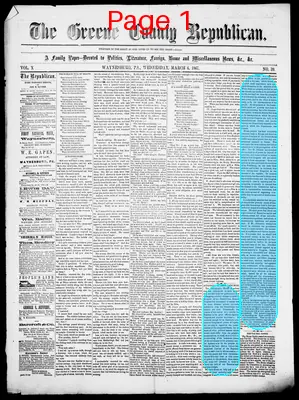
Editorial
March 6, 1867
The Greene County Republican
Waynesburg, Greene County, Pennsylvania
What is this article about?
This editorial criticizes President Johnson's usurpation of power and defends Congress's constitutional authority in Reconstruction, contrasting autocratic vs. democratic rule and urging support for representative institutions over executive caprice.
Clipping
OCR Quality
95%
Excellent
Full Text
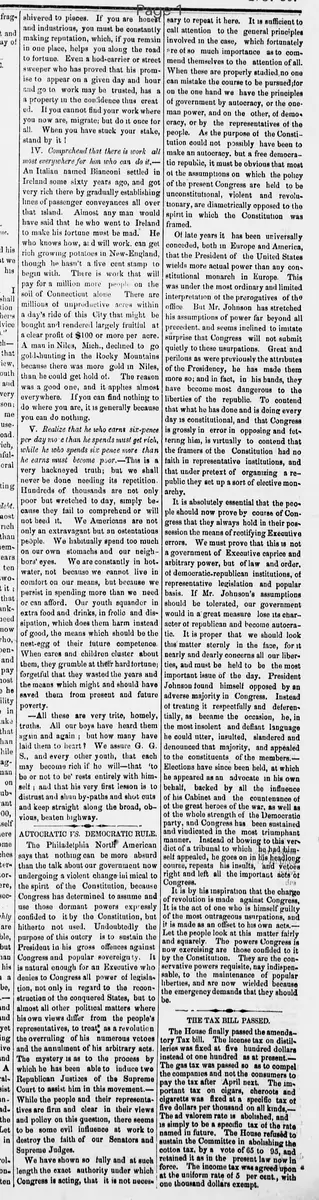
AUTOCRATIC VS. DEMOCRATIC RULE.
The Philadelphia North American says that nothing can be more absurd than the talk about our government now undergoing a violent change inimical to the spirit of the Constitution, because Congress has determined to assume and use those dormant powers expressly confided to it by the Constitution, but hitherto not used. Undoubtedly the purpose of this outcry is to sustain the President in his gross offences against Congress and popular sovereignty. It is natural enough for an Executive who denies to Congress all power of legislation, not only in regard to the reconstruction of the conquered States, but to almost all other political matters where his own views differ from the people's representatives, to treat as a revolution the overruling of his numerous vetoes and the annulment of his arbitrary acts.
The mystery is as to the process by which he has been able to induce two Republican Justices of the Supreme Court to assist him in this movement.—While the people and their representatives are firm and clear in their views and policy on this question, there seems to be some evil influence at work to destroy the faith of our Senators and Supreme Judges.
We have shown so fully and at such length the exact authority under which Congress is acting, that it is not necessary to repeat it here. It is sufficient to call attention to the general principles involved in the case, which fortunately are of so much importance as to commend themselves to the attention of all. When these are properly studied, no one can mistake the course to be pursued; for on the one hand we have the principles of government by autocracy, or the one-man power, and on the other, of democracy, or by the representatives of the people. As the purpose of the Constitution could not possibly have been to make an autocracy, but a free democratic republic, it must be obvious that most of the assumptions on which the policy of the present Congress are held to be unconstitutional, violent and revolutionary, are diametrically opposed to the spirit in which the Constitution was framed.
Of late years it has been universally conceded, both in Europe and America, that the President of the United States wields more actual power than any constitutional monarch in Europe. This was under the most ordinary and limited interpretation of the prerogatives of the office. But Mr. Johnson has stretched his assumptions of power far beyond all precedent, and seems inclined to imitate surprise that Congress will not submit quietly to these usurpations. Great and perilous as were previously the attributes of the Presidency, he has made them more so; and in fact, in his hands, they have become most dangerous to the liberties of the republic. To contend that what he has done and is doing every day is constitutional, and that Congress is grossly in error in opposing and fettering him, is virtually to contend that the framers of the Constitution had no faith in representative institutions, and that under pretext of organizing a republic they set up a sort of elective monarchy.
It is absolutely essential that the people should now prove by course of Congress that they always hold in their possession the means of rectifying Executive errors. We must prove that this is not a government of Executive caprice and arbitrary power, but of law and order, of democratic-republican institutions, of representative legislation and popular basis. If Mr. Johnson's assumptions should be tolerated, our government would in a great measure lose its character of republican and become autocratic.
It is proper that we should look this matter sternly in the face, for it nearly and dearly concerns all our liberties, and must be held to be the most important issue of the day. President Johnson found himself opposed by an adverse majority in Congress. Instead of treating it respectfully and deferentially, as became the occasion, he, in the most insolent and defiant language he could utter, insulted, slandered and denounced that majority, and appealed to the constituents of the members.—Elections have since been held, at which he appeared as an advocate in his own behalf, backed by all the influence of his Cabinet and the countenance of the great heroes of the war, as well as of the whole strength of the Democratic party, and Congress has been sustained and vindicated in the most triumphant manner. Instead of bowing to this verdict of a tribunal to which he had himself appealed, he goes on in his headlong course, repeats his insults, and vetoes right and left all the important acts of Congress.
It is by his inspiration that the charge of revolution is made against Congress. It is the act of one who is himself guilty of the most outrageous usurpations, and it is made as an offset to his own acts.—Let the people look at this matter fairly and squarely. The powers Congress is now exercising are those confided to it by the Constitution. They are the conservative powers requisite, nay indispensable, to the maintenance of popular liberties, and are now wielded because the emergency demands that they should be.
The Philadelphia North American says that nothing can be more absurd than the talk about our government now undergoing a violent change inimical to the spirit of the Constitution, because Congress has determined to assume and use those dormant powers expressly confided to it by the Constitution, but hitherto not used. Undoubtedly the purpose of this outcry is to sustain the President in his gross offences against Congress and popular sovereignty. It is natural enough for an Executive who denies to Congress all power of legislation, not only in regard to the reconstruction of the conquered States, but to almost all other political matters where his own views differ from the people's representatives, to treat as a revolution the overruling of his numerous vetoes and the annulment of his arbitrary acts.
The mystery is as to the process by which he has been able to induce two Republican Justices of the Supreme Court to assist him in this movement.—While the people and their representatives are firm and clear in their views and policy on this question, there seems to be some evil influence at work to destroy the faith of our Senators and Supreme Judges.
We have shown so fully and at such length the exact authority under which Congress is acting, that it is not necessary to repeat it here. It is sufficient to call attention to the general principles involved in the case, which fortunately are of so much importance as to commend themselves to the attention of all. When these are properly studied, no one can mistake the course to be pursued; for on the one hand we have the principles of government by autocracy, or the one-man power, and on the other, of democracy, or by the representatives of the people. As the purpose of the Constitution could not possibly have been to make an autocracy, but a free democratic republic, it must be obvious that most of the assumptions on which the policy of the present Congress are held to be unconstitutional, violent and revolutionary, are diametrically opposed to the spirit in which the Constitution was framed.
Of late years it has been universally conceded, both in Europe and America, that the President of the United States wields more actual power than any constitutional monarch in Europe. This was under the most ordinary and limited interpretation of the prerogatives of the office. But Mr. Johnson has stretched his assumptions of power far beyond all precedent, and seems inclined to imitate surprise that Congress will not submit quietly to these usurpations. Great and perilous as were previously the attributes of the Presidency, he has made them more so; and in fact, in his hands, they have become most dangerous to the liberties of the republic. To contend that what he has done and is doing every day is constitutional, and that Congress is grossly in error in opposing and fettering him, is virtually to contend that the framers of the Constitution had no faith in representative institutions, and that under pretext of organizing a republic they set up a sort of elective monarchy.
It is absolutely essential that the people should now prove by course of Congress that they always hold in their possession the means of rectifying Executive errors. We must prove that this is not a government of Executive caprice and arbitrary power, but of law and order, of democratic-republican institutions, of representative legislation and popular basis. If Mr. Johnson's assumptions should be tolerated, our government would in a great measure lose its character of republican and become autocratic.
It is proper that we should look this matter sternly in the face, for it nearly and dearly concerns all our liberties, and must be held to be the most important issue of the day. President Johnson found himself opposed by an adverse majority in Congress. Instead of treating it respectfully and deferentially, as became the occasion, he, in the most insolent and defiant language he could utter, insulted, slandered and denounced that majority, and appealed to the constituents of the members.—Elections have since been held, at which he appeared as an advocate in his own behalf, backed by all the influence of his Cabinet and the countenance of the great heroes of the war, as well as of the whole strength of the Democratic party, and Congress has been sustained and vindicated in the most triumphant manner. Instead of bowing to this verdict of a tribunal to which he had himself appealed, he goes on in his headlong course, repeats his insults, and vetoes right and left all the important acts of Congress.
It is by his inspiration that the charge of revolution is made against Congress. It is the act of one who is himself guilty of the most outrageous usurpations, and it is made as an offset to his own acts.—Let the people look at this matter fairly and squarely. The powers Congress is now exercising are those confided to it by the Constitution. They are the conservative powers requisite, nay indispensable, to the maintenance of popular liberties, and are now wielded because the emergency demands that they should be.
What sub-type of article is it?
Constitutional
Partisan Politics
What keywords are associated?
Constitutional Powers
Presidential Usurpation
Reconstruction Policy
Autocracy Vs Democracy
Congressional Authority
What entities or persons were involved?
President Johnson
Congress
Supreme Court Justices
Philadelphia North American
Democratic Party
Editorial Details
Primary Topic
Congressional Authority Versus Presidential Usurpation In Reconstruction
Stance / Tone
Strongly Pro Congress And Anti Johnson, Advocating Democratic Rule
Key Figures
President Johnson
Congress
Supreme Court Justices
Philadelphia North American
Democratic Party
Key Arguments
Congress Is Using Dormant Constitutional Powers Appropriately
President Johnson's Actions Are Usurpations Threatening Republican Liberties
The Constitution Establishes Democratic, Not Autocratic, Government
Johnson's Vetoes And Insults Defy Popular Sovereignty
Elections Vindicated Congress Against Johnson's Appeals