Thank you for visiting SNEWPapers!
Sign up free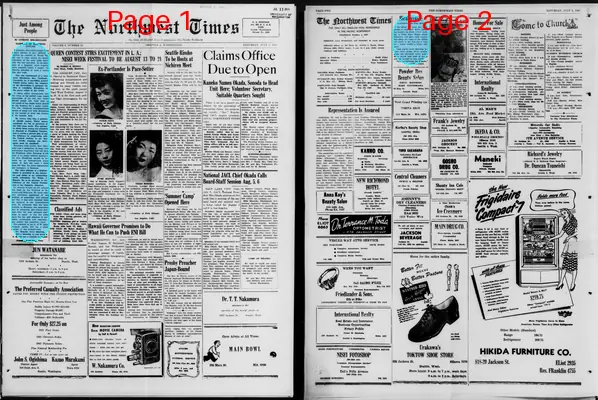
The Northwest Times
Seattle, King County, Washington
What is this article about?
Editorial highlights two hopeful signs for peace: Rev. Tanimoto's campaign to make Hiroshima a global peace center, backed by atomic bomb survivors' petition to President Truman, and Dr. Ralph J. Bunche's warnings on prejudice and minorities as threats to peace during a campus visit. Quotes student editorial praising Bunche.
Merged-components note: Continuation of editorial from page 1 to page 2, including the quoted student editorial on Dr. Bunche.
Clippings
1 of 2
OCR Quality
Full Text
Sometimes, the world horizon looks mighty gloomy. It isn't difficult to conjure up pictures of World War III. and to some extent the deadly efficiency of the next mass homicide. But now and then, we see glimpses of a brighter, more hopeful, more peaceful future. I caught two fleeting glimpses of such a future this past week.
One was represented in a man from Hiroshima, Rev. Tanimoto. Currently, he is travelling around United States under the auspices of the Methodists to promote the idea of rebuilding Hiroshima as the peace center of the world. It seems rather incongruent that the scene of the world's most tragic destruction of the last war, where 200,000 people lost their lives as the result of one single bomb, should be the impetus for a peace center. Yet, Rev. Tanimoto enthusiastically speaks of peace and with Hiroshima as the symbol of what can happen if his mission fails.
He carries with him a petition of 100,000 names. These names constitute the list of survivors of the 1945 atom bomb. The message to which these names are attached is directed to President Truman, and it carries a potent plea to use his influence in cooperating with the United Nations to see that such deadly weapons are never again used by mankind.
Sometime next month, Rev. Tanimoto and a delegation of some very well-known Americans will call upon the President. After listening to his aims, it no longer seemed incongruent that Hiroshima should be the locale for an international peace center. In fact, the more I dwell upon the idea, the more appropriate and necessary, it becomes.
The other glimpse of a brighter future is embodied in the character and vision of an outstanding world statesman, Dr. Ralph J. Bunche. He is no stranger to the followers of the United Nations and of the Palestine situation. Dr. Bunche is here on the campus this week for the Institute of International Relations. He made some very pertinent appraisals of the problem of minorities, and pointed out that it has now elevated from the national to the international level. He intimated that the basic problem in Palestine was essentially that of minorities. His central message that the most ominous challenge to peace is not the atom bomb but the ugly shadows of prejudice, intolerance and injustice—was quietly, but forcefully made.
The editorial in the U. of W. Daily probably speaks well for a great number of the student-body:
"Dr. Bunche, we're listening.
We're listening to you because to us you are a symbol--a symbol
(Continued on Page Two)"
Hirabayashi
(Continued from Page One)
of the things we know the world should be and isn't. We're listening because we know you're working to bring these things about.
Tolerance, fair play, calm reasoning—these are some of the things you typify to us. You are a voice for a better world—a better citizenry.
"And maybe we're listening because we're afraid. We're worried about the direction we're going. We're afraid your kind of people will not prevail in this world.
"So we're listening. Dr. Bunche."
—Cliff Cernick
What sub-type of article is it?
What keywords are associated?
What entities or persons were involved?
Editorial Details
Primary Topic
Glimpses Of Brighter Future Through Peace Initiatives In Hiroshima And Against Prejudice
Stance / Tone
Hopeful Promotion Of Peace And Tolerance
Key Figures
Key Arguments