Thank you for visiting SNEWPapers!
Sign up free
Story
June 16, 1861
New York Daily Tribune
New York, New York County, New York
What is this article about?
Adjutant Schaffner's account of the Union night encounter with friendly forces near Big Bethel and the subsequent disorganized battle against Confederates, highlighting command confusion, friendly fire, and Major Winthrop's brave death.
Clipping
OCR Quality
95%
Excellent
Full Text
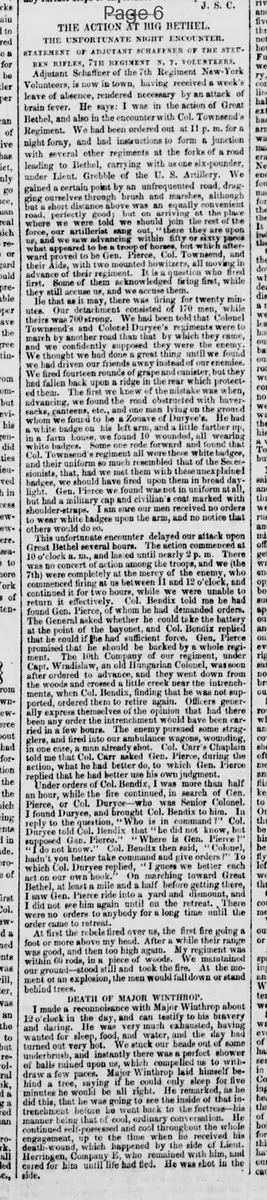
THE ACTION AT BIG BETHEL.
THE UNFORTUNATE NIGHT ENCOUNTER.
STATEMENT OF ADJUTANT SCHAFFNER OF THE STEUBEN RIFLES, 7TH REGIMENT N. Y. VOLUNTEERS.
Adjutant Schaffner of the 7th Regiment New-York Volunteers, is now in town, having received a week's leave of absence, rendered necessary by an attack of brain fever. He says: I was in the action of Great Bethel, and also in the encounter with Col. Townsend's Regiment. We had been ordered out at 11 p. m. for a night foray, and had instructions to form a junction with several other regiments at the forks of a road leading to Bethel, carrying with us one six-pounder, under Lieut. Greble of the U. S. Artillery. We gained a certain point by an unfrequented road, dragging ourselves through brush and marshes, although but a short distance above was an equally convenient road, perfectly good; but on arriving at the place where we were told we should join the rest of the force, our artillerist sang out, "there they are upon us," and we saw advancing within fifty or sixty paces what appeared to be a troop of horses, but which afterward proved to be Gen. Pierce, Col. Townsend, and their Aids, with two mounted howitzers, all moving in advance of their regiment. It is a question who fired first. Some of them acknowledged firing first, while they still accuse us, and we accuse them.
Be that as it may, there was firing for twenty minutes. Our detachment consisted of 170 men, while theirs was 700 strong. We had been told that Colonel Townsend's and Colonel Duryee's regiments were to march by another road than that by which they came, and we confidently supposed they were the enemy. We thought we had done a great thing until we found we had driven our friends away instead of our enemies. We fired fourteen rounds of grape and canister, but they had fallen back upon a ridge in the rear which protected them. The first we knew of the mistake was when, advancing, we found the road obstructed with haver-sacks, canteens, etc., and one man lying on the ground whom we found to be a Zouave of Duryee's. He had a white badge on his left arm, and a little farther up, we found 10 wounded all wearing white badges. Some one rode forward and found that Col. Townsend's regiment all wore these white badges, and their uniform so much resembled that of the Secessionists, that, had we met them with these unexplained badges, we should have fired upon them in broad daylight. Gen. Pierce we found was not in uniform at all but had a military cap and civilian's coat marked with shoulder-straps. I am sure our men received no orders to wear white badges upon the arm, and no notice that others would do so.
This unfortunate encounter delayed our attack upon Great Bethel several hours. The action commenced at 10 o'clock a. m., and lasted until nearly 2 p. m. There was no concert of action among the troops, and we (the 7th) were completely at the mercy of the enemy, who commenced firing at us between 11 and 12 o'clock, and continued it for two hours, while we were unable to return it effectively. Col. Bendix told me he had found Gen. Pierce, of whom he had demanded orders. The General asked whether he could take the battery at the point of the bayonet, and Col. Bendix replied that he could if he had sufficient force. Gen. Pierce promised that he should be backed by a whole regiment. The 10th Company of our regiment, under Capt. Wladislaw, an old Hungarian Colonel, was soon after ordered to advance, and they went down from the woods and crossed a little creek near the intrenchments, when Col. Bendix, finding that he was not supported, ordered them to retire again. Officers generally express themselves of the opinion that had there been any order the intrenchment would have been carried in a few hours. The enemy pursued some stragglers and fired into our ambulance wagons wounding in one case, a man already shot. Col. Carr's Chaplain told me that Col. Carr asked Gen. Pierce, during the action, what he had better do, to which Gen. Pierce replied that he had better use his own judgment.
Under orders of Col. Bendix, I was more than half an hour, while the fire continued, in search of Gen. Pierce, or Col. Duryee—who was Senior Colonel. I found Duryee, and brought Col. Bendix to him. In reply to the question, "Who is in command?" Col. Duryee told Col. Bendix that "he did not know, but supposed Gen. Pierce." "Where is Gen. Pierce?" "I do not know." Col. Bendix then said, "Colonel, hadn't you better take command and give orders?" To which Col. Duryee replied, "I guess we better each act on our own hook."
On marching toward Great Bethel, at least a mile and a half before getting there, I saw Gen. Pierce ride into a yard and dismount, and I did not see him again until on the retreat. There were no orders to anybody for a long time until the order came to retreat.
At first the rebels fired over us, the first fire going a foot or more above my head. After a while their range was good, and then too high again. My regiment was within 60 rods, in a piece of woods. We maintained our ground—stood still and took the fire. At the moment of an explosion, the men would fall down or stand behind trees.
DEATH OF MAJOR WINTHROP.
I made a reconnoissance with Major Winthrop about 12 o'clock in the day, and can testify to his bravery and daring. He was very much exhausted, having wanted for sleep, food, and water, and the day had turned out very hot. We stuck our heads out of some underbrush, and instantly there was a perfect shower of balls rained upon us, which compelled us to withdraw a few paces. Major Winthrop laid himself behind a tree, saying if he could only sleep for five minutes he would be all right. He remarked, as he did this, that he was going to see the inside of that intrenchment before he went back to the fortress—his manner being that of cool, ordinary conversation. He continued self-possessed and cool throughout the whole engagement, up to the time when he received his death-wound, which happened by the side of Lieut. Herringen, Company E, who remained with him, and cared for him until life had fled. He was shot in the side.
THE UNFORTUNATE NIGHT ENCOUNTER.
STATEMENT OF ADJUTANT SCHAFFNER OF THE STEUBEN RIFLES, 7TH REGIMENT N. Y. VOLUNTEERS.
Adjutant Schaffner of the 7th Regiment New-York Volunteers, is now in town, having received a week's leave of absence, rendered necessary by an attack of brain fever. He says: I was in the action of Great Bethel, and also in the encounter with Col. Townsend's Regiment. We had been ordered out at 11 p. m. for a night foray, and had instructions to form a junction with several other regiments at the forks of a road leading to Bethel, carrying with us one six-pounder, under Lieut. Greble of the U. S. Artillery. We gained a certain point by an unfrequented road, dragging ourselves through brush and marshes, although but a short distance above was an equally convenient road, perfectly good; but on arriving at the place where we were told we should join the rest of the force, our artillerist sang out, "there they are upon us," and we saw advancing within fifty or sixty paces what appeared to be a troop of horses, but which afterward proved to be Gen. Pierce, Col. Townsend, and their Aids, with two mounted howitzers, all moving in advance of their regiment. It is a question who fired first. Some of them acknowledged firing first, while they still accuse us, and we accuse them.
Be that as it may, there was firing for twenty minutes. Our detachment consisted of 170 men, while theirs was 700 strong. We had been told that Colonel Townsend's and Colonel Duryee's regiments were to march by another road than that by which they came, and we confidently supposed they were the enemy. We thought we had done a great thing until we found we had driven our friends away instead of our enemies. We fired fourteen rounds of grape and canister, but they had fallen back upon a ridge in the rear which protected them. The first we knew of the mistake was when, advancing, we found the road obstructed with haver-sacks, canteens, etc., and one man lying on the ground whom we found to be a Zouave of Duryee's. He had a white badge on his left arm, and a little farther up, we found 10 wounded all wearing white badges. Some one rode forward and found that Col. Townsend's regiment all wore these white badges, and their uniform so much resembled that of the Secessionists, that, had we met them with these unexplained badges, we should have fired upon them in broad daylight. Gen. Pierce we found was not in uniform at all but had a military cap and civilian's coat marked with shoulder-straps. I am sure our men received no orders to wear white badges upon the arm, and no notice that others would do so.
This unfortunate encounter delayed our attack upon Great Bethel several hours. The action commenced at 10 o'clock a. m., and lasted until nearly 2 p. m. There was no concert of action among the troops, and we (the 7th) were completely at the mercy of the enemy, who commenced firing at us between 11 and 12 o'clock, and continued it for two hours, while we were unable to return it effectively. Col. Bendix told me he had found Gen. Pierce, of whom he had demanded orders. The General asked whether he could take the battery at the point of the bayonet, and Col. Bendix replied that he could if he had sufficient force. Gen. Pierce promised that he should be backed by a whole regiment. The 10th Company of our regiment, under Capt. Wladislaw, an old Hungarian Colonel, was soon after ordered to advance, and they went down from the woods and crossed a little creek near the intrenchments, when Col. Bendix, finding that he was not supported, ordered them to retire again. Officers generally express themselves of the opinion that had there been any order the intrenchment would have been carried in a few hours. The enemy pursued some stragglers and fired into our ambulance wagons wounding in one case, a man already shot. Col. Carr's Chaplain told me that Col. Carr asked Gen. Pierce, during the action, what he had better do, to which Gen. Pierce replied that he had better use his own judgment.
Under orders of Col. Bendix, I was more than half an hour, while the fire continued, in search of Gen. Pierce, or Col. Duryee—who was Senior Colonel. I found Duryee, and brought Col. Bendix to him. In reply to the question, "Who is in command?" Col. Duryee told Col. Bendix that "he did not know, but supposed Gen. Pierce." "Where is Gen. Pierce?" "I do not know." Col. Bendix then said, "Colonel, hadn't you better take command and give orders?" To which Col. Duryee replied, "I guess we better each act on our own hook."
On marching toward Great Bethel, at least a mile and a half before getting there, I saw Gen. Pierce ride into a yard and dismount, and I did not see him again until on the retreat. There were no orders to anybody for a long time until the order came to retreat.
At first the rebels fired over us, the first fire going a foot or more above my head. After a while their range was good, and then too high again. My regiment was within 60 rods, in a piece of woods. We maintained our ground—stood still and took the fire. At the moment of an explosion, the men would fall down or stand behind trees.
DEATH OF MAJOR WINTHROP.
I made a reconnoissance with Major Winthrop about 12 o'clock in the day, and can testify to his bravery and daring. He was very much exhausted, having wanted for sleep, food, and water, and the day had turned out very hot. We stuck our heads out of some underbrush, and instantly there was a perfect shower of balls rained upon us, which compelled us to withdraw a few paces. Major Winthrop laid himself behind a tree, saying if he could only sleep for five minutes he would be all right. He remarked, as he did this, that he was going to see the inside of that intrenchment before he went back to the fortress—his manner being that of cool, ordinary conversation. He continued self-possessed and cool throughout the whole engagement, up to the time when he received his death-wound, which happened by the side of Lieut. Herringen, Company E, who remained with him, and cared for him until life had fled. He was shot in the side.
What sub-type of article is it?
Historical Event
Military Action
What themes does it cover?
Misfortune
Bravery Heroism
What keywords are associated?
Big Bethel Battle
Friendly Fire
Union Defeat
Command Confusion
Major Winthrop Death
Civil War Encounter
What entities or persons were involved?
Adjutant Schaffner
Gen. Pierce
Col. Townsend
Col. Bendix
Col. Duryee
Major Winthrop
Lieut. Greble
Capt. Wladislaw
Where did it happen?
Great Bethel
Story Details
Key Persons
Adjutant Schaffner
Gen. Pierce
Col. Townsend
Col. Bendix
Col. Duryee
Major Winthrop
Lieut. Greble
Capt. Wladislaw
Location
Great Bethel
Story Details
Union forces under the 7th Regiment N.Y. Volunteers experience a night friendly fire incident with Col. Townsend's regiment due to miscommunication and similar uniforms, delaying the attack on Big Bethel. The daytime battle is marked by poor coordination, absent leadership from Gen. Pierce, ineffective response, and Major Winthrop's fatal reconnaissance.