Thank you for visiting SNEWPapers!
Sign up free
Editorial
July 28, 1845
Alexandria Gazette
Alexandria, Alexandria County, District Of Columbia
What is this article about?
An editorial criticizing internal divisions in the Locofoco (Democratic) Party under President Polk, attributing strife to the spoils system, office rotations, controversial appointments like that of Rynders, and factional conflicts involving Calhoun supporters. Predicts the party's dissolution.
Clipping
OCR Quality
98%
Excellent
Full Text
THE LOCOFOCO DISCORDS.
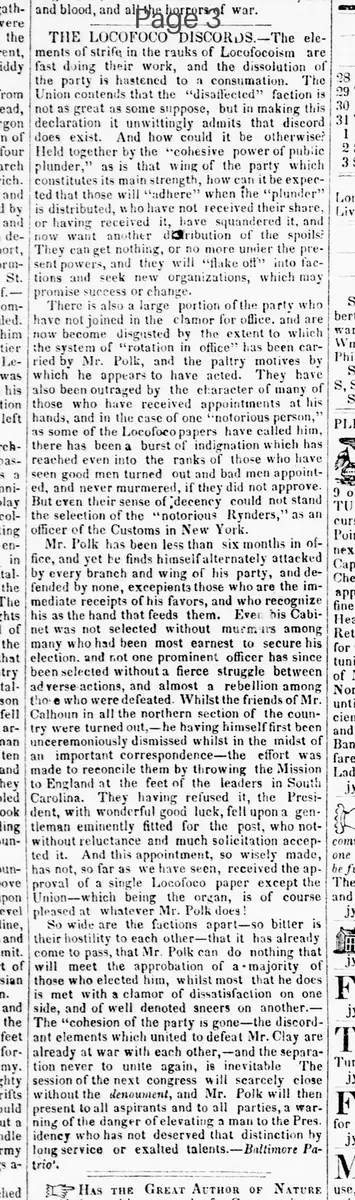
The elements of strife in the ranks of Locofocoism are fast doing their work, and the dissolution of the party is hastened to a consummation. The Union contends that the "disaffected" faction is not as great as some suppose, but in making this declaration it unwittingly admits that discord does exist. And how could it be otherwise? Held together by the "cohesive power of public plunder," as is that wing of the party which constitutes its main strength, how can it be expected that those will "adhere" when the "plunder" is distributed, who have not received their share, or having received it, have squandered it, and now want another distribution of the spoils? They can get nothing, or no more under the present powers, and they will "flake off" into factions and seek new organizations, which may promise success or change.
There is also a large portion of the party who have not joined in the clamor for office, and are now become disgusted by the extent to which the system of "rotation in office" has been carried by Mr. Polk, and the paltry motives by which he appears to have acted. They have also been outraged by the character of many of those who have received appointments at his hands, and in the case of one "notorious person," as some of the Locofoco papers have called him, there has been a burst of indignation which has reached even into the ranks of those who have seen good men turned out and bad men appointed, and never murmured, if they did not approve. But even their sense of decency could not stand the selection of the "notorious Rynders," as an officer of the Customs in New York.
Mr. Polk has been less than six months in office, and yet he finds himself alternately attacked by every branch and wing of his party, and defended by none, except those who are the immediate receipts of his favors, and who recognize him as the hand that feeds them. Even his Cabinet was not selected without murmurs among many who had been most earnest to secure his election, and not one prominent officer has since been selected without a fierce struggle between adverse factions, and almost a rebellion among those who were defeated. Whilst the friends of Mr. Calhoun in all the northern section of the country were turned out,—he having himself first been unceremoniously dismissed whilst in the midst of an important correspondence—the effort was made to reconcile them by throwing the Mission to England at the feet of the leaders in South Carolina. They having refused it, the President, with wonderful good luck, fell upon a gentleman eminently fitted for the post, who not without reluctance and much solicitation accepted it. And this appointment, so wisely made, has not, so far as we have seen, received the approval of a single Locofoco paper except the Union—which being the organ, is of course pleased at whatever Mr. Polk does!
So wide are the factions apart—so bitter is their hostility to each other—that it has already come to pass, that Mr. Polk can do nothing that will meet the approbation of a majority of those who elected him, whilst most that he does is met with a clamor of dissatisfaction on one side, and of well denoted sneers on another. The "cohesion of the party is gone—the discordant elements which united to defeat Mr. Clay are already at war with each other,—and the separation never to unite again, is inevitable. The session of the next congress will scarcely close without the denouement, and Mr. Polk will then present to all aspirants and to all parties, a warning of the danger of elevating a man to the Presidency who has not deserved that distinction by long service or exalted talents.—Baltimore Patriot.
The elements of strife in the ranks of Locofocoism are fast doing their work, and the dissolution of the party is hastened to a consummation. The Union contends that the "disaffected" faction is not as great as some suppose, but in making this declaration it unwittingly admits that discord does exist. And how could it be otherwise? Held together by the "cohesive power of public plunder," as is that wing of the party which constitutes its main strength, how can it be expected that those will "adhere" when the "plunder" is distributed, who have not received their share, or having received it, have squandered it, and now want another distribution of the spoils? They can get nothing, or no more under the present powers, and they will "flake off" into factions and seek new organizations, which may promise success or change.
There is also a large portion of the party who have not joined in the clamor for office, and are now become disgusted by the extent to which the system of "rotation in office" has been carried by Mr. Polk, and the paltry motives by which he appears to have acted. They have also been outraged by the character of many of those who have received appointments at his hands, and in the case of one "notorious person," as some of the Locofoco papers have called him, there has been a burst of indignation which has reached even into the ranks of those who have seen good men turned out and bad men appointed, and never murmured, if they did not approve. But even their sense of decency could not stand the selection of the "notorious Rynders," as an officer of the Customs in New York.
Mr. Polk has been less than six months in office, and yet he finds himself alternately attacked by every branch and wing of his party, and defended by none, except those who are the immediate receipts of his favors, and who recognize him as the hand that feeds them. Even his Cabinet was not selected without murmurs among many who had been most earnest to secure his election, and not one prominent officer has since been selected without a fierce struggle between adverse factions, and almost a rebellion among those who were defeated. Whilst the friends of Mr. Calhoun in all the northern section of the country were turned out,—he having himself first been unceremoniously dismissed whilst in the midst of an important correspondence—the effort was made to reconcile them by throwing the Mission to England at the feet of the leaders in South Carolina. They having refused it, the President, with wonderful good luck, fell upon a gentleman eminently fitted for the post, who not without reluctance and much solicitation accepted it. And this appointment, so wisely made, has not, so far as we have seen, received the approval of a single Locofoco paper except the Union—which being the organ, is of course pleased at whatever Mr. Polk does!
So wide are the factions apart—so bitter is their hostility to each other—that it has already come to pass, that Mr. Polk can do nothing that will meet the approbation of a majority of those who elected him, whilst most that he does is met with a clamor of dissatisfaction on one side, and of well denoted sneers on another. The "cohesion of the party is gone—the discordant elements which united to defeat Mr. Clay are already at war with each other,—and the separation never to unite again, is inevitable. The session of the next congress will scarcely close without the denouement, and Mr. Polk will then present to all aspirants and to all parties, a warning of the danger of elevating a man to the Presidency who has not deserved that distinction by long service or exalted talents.—Baltimore Patriot.
What sub-type of article is it?
Partisan Politics
What keywords are associated?
Locofoco Discord
Polk Administration
Party Factions
Spoils System
Office Rotation
Rynders Appointment
Calhoun Dismissal
What entities or persons were involved?
Mr. Polk
Locofocoism
Mr. Calhoun
Notorious Rynders
Union
Baltimore Patriot
Mr. Clay
Editorial Details
Primary Topic
Discord And Dissolution In The Locofoco Party Under Polk
Stance / Tone
Critical Of Polk's Administration And Party Factions
Key Figures
Mr. Polk
Locofocoism
Mr. Calhoun
Notorious Rynders
Union
Baltimore Patriot
Mr. Clay
Key Arguments
Party Held By Cohesive Power Of Public Plunder, Leading To Strife When Spoils Are Unevenly Distributed.
Disgust With Polk's Rotation In Office And Paltry Motives.
Outrage Over Appointments, Especially To Notorious Rynders.
Polk Attacked By All Party Wings, Defended Only By Beneficiaries.
Cabinet And Officer Selections Caused Factional Struggles.
Calhoun Supporters Dismissed, Failed Reconciliation Attempts.
Party Cohesion Gone, Separation Inevitable.
Warning Against Elevating Undeserving Presidents.