Thank you for visiting SNEWPapers!
Sign up free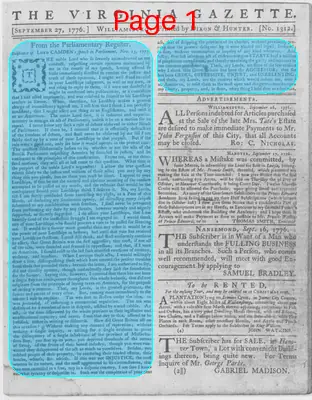
The Virginia Gazette
Richmond, Williamsburg, Richmond County, Virginia
What is this article about?
Lord Camden's parliamentary speech on Nov. 15, 1775, defends his criticism of British acts against America as consistent and just, highlighting oppression like the Boston port closure after the tea destruction, charter revocation, and starvation tactics as aggressions warranting resistance.
Clipping
OCR Quality
Full Text
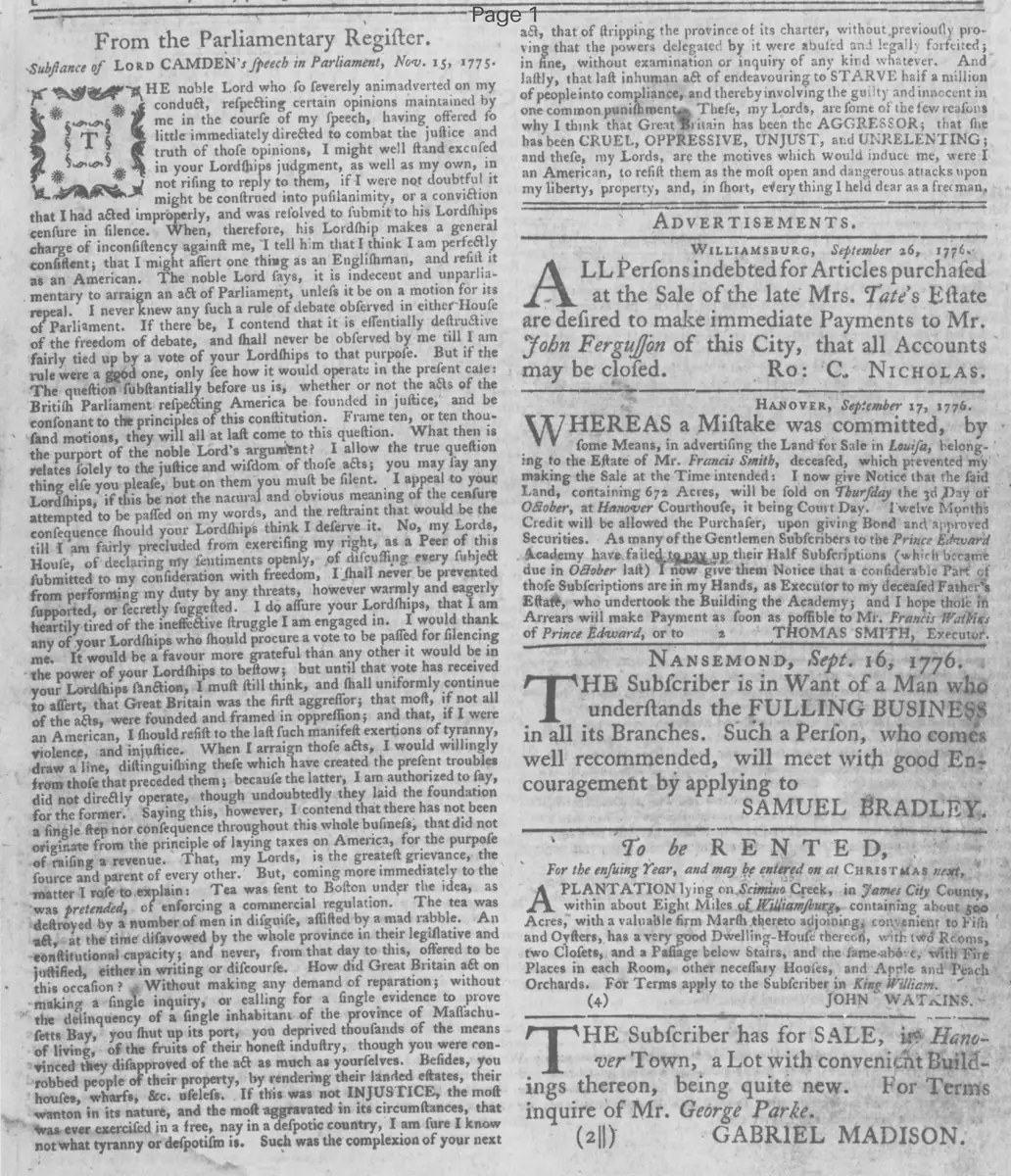
Substance of LORD CAMDEN's speech in Parliament, Nov. 15, 1775.
The noble Lord who so severely animadverted on my conduct, repeating certain opinions maintained by me in the course of my speech, having offered so little immediately directed to combat the justice and truth of those opinions, I might well stand excused in your Lordships' judgment, as well as my own, in not rising to reply to them, if I were not doubtful it might be construed into pusillanimity, or a conviction that I had acted improperly, and was resolved to submit to his Lordship's censure in silence. When, therefore, his Lordship makes a general charge of inconsistency against me, I tell him that I think I am perfectly consistent; that I might assert one thing as an Englishman, and resist it as an American. The noble Lord says, it is indecent and unparliamentary to arraign an act of Parliament, unless it be on a motion for its repeal. I never knew any such a rule of debate observed in either House of Parliament. If there be, I contend that it is essentially destructive of the freedom of debate, and shall never be observed by me till I am fairly tied up by a vote of your Lordships to that purpose. But if the rule were a good one, only see how it would operate in the present case: The question substantially before us is, whether or not the acts of the British Parliament respecting America be founded in justice, and be consonant to the principles of this constitution. Frame ten, or ten thousand questions and motions, they will all at last come to this question. What then is the purport of the noble Lord's argument? I allow the true question relates solely to the justice and wisdom of those acts; you may say anything else you please, but on them you must be silent. I appeal to your Lordships, if this be not the natural and obvious meaning of the censure attempted to be passed on my words, and the restraint that would be the consequence should your Lordships think I deserve it. No, my Lords, from performing my duty by any threats, however warmly and eagerly submitted to my consideration with freedom, I shall never be prevented from discussing every subject till I am fairly precluded from exercising my right, as a Peer of this House, of declaring my sentiments openly, of discussing every subject till I am fairly precluded from exercising my right, as a Peer of this House. It would be a favour more grateful than any other it would be in the power of your Lordships to bestow; but until that vote has received your Lordships' sanction, I must still think, and shall uniformly continue to assert, that Great Britain was the first aggressor; that most, if not all of the acts, were founded and framed in oppression; and that, if I were an American, I should resist to the last such manifest exertions of tyranny, violence, and injustice. When I arraign those acts, I would willingly draw a line, distinguishing these which have created the present troubles from those that preceded them; because the latter, I am authorized to say, did not directly operate, though undoubtedly they laid the foundation of raising a revenue. That, my Lords, is the greatest grievance, the source and parent of every other. But, coming more immediately to the matter I rose to explain: Tea was sent to Boston under the idea, as was pretended, of enforcing a commercial regulation. The tea was destroyed by a number of men in disguise, aided by a mad rabble. An act, at the time disavowed by the whole province in their legislative and constitutional capacity; and never, from that day to this, offered to be justified, either in writing or discourse. How did Great Britain act on this occasion? Without making any demand of reparation; without making a single inquiry, or calling for a single evidence to prove the delinquency of a single inhabitant of the province of Massachusetts Bay, you shut up its port, you deprived thousands of the means of living, of the fruits of their honest industry, though you were convinced they disapproved of the act as much as yourselves. Besides, you robbed people of their property, by rendering their landed estates, their houses, wharfs, &c. useless. If this was not INJUSTICE, the most wanton in its nature, and the most aggravated in its circumstances, that was ever exercised in a free, nay in a despotic country, I am sure I know not what tyranny or despotism is. Such was the complexion of your next act, that of stripping the province of its charter, without previously proving that the powers delegated by it were abused and legally forfeited; in fine, without examination or inquiry of any kind whatever. And lastly, that last inhuman act of endeavouring to STARVE half a million of people into compliance, and thereby involving the guilty and innocent in one common punishment. These, my Lords, are some of the few reasons why I think that Great Britain has been the AGGRESSOR; that he has been CRUEL, OPPRESSIVE, UNJUST, and UNRELENTING; and these, my Lords, are the motives which would induce me, were I an American, to resist them as the most open and dangerous attacks upon my liberty, property, and, in short, every thing I held dear as a freeman.
What sub-type of article is it?
What keywords are associated?
What entities or persons were involved?
Where did it happen?
Foreign News Details
Primary Location
America
Event Date
Nov. 15, 1775
Key Persons
Event Details
Lord Camden defends his consistency in opinions on British acts towards America, argues against rules restricting debate on acts of Parliament, asserts Great Britain was the aggressor through oppressive acts like closing Boston port after tea destruction, stripping Massachusetts charter, and attempting to starve the population, and states he would resist as an American.