Thank you for visiting SNEWPapers!
Sign up free
Atlanta Daily World
Atlanta, Fulton County, Georgia
What is this article about?
In Monrovia, Liberia, the U.S. Foreign Economic Administration closes on July 1 after aiding war-related development in mining, timber, clay, and agriculture. Liberians, unprepared to continue without equipment and training, appeal to the U.S. to sustain efforts in diversifying exports like coffee, piassava, and palm products.
Merged-components note: Continuation of the story on Liberians asking the U.S. to continue economic work from page 1 to page 6.
Clippings
1 of 2
OCR Quality
Full Text
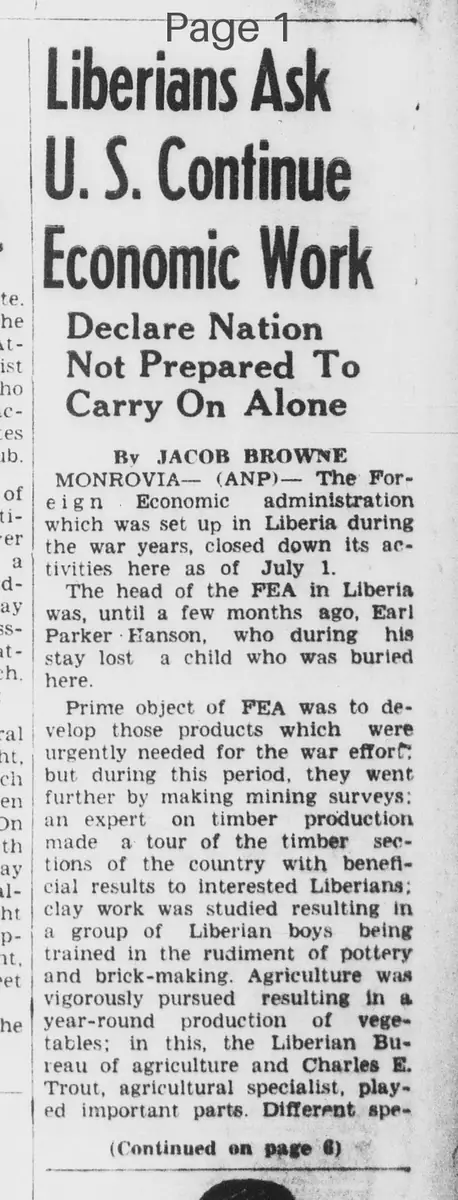
Declare Nation Not Prepared To Carry On Alone
By JACOB BROWNE
MONROVIA- (ANP)- The Foreign Economic administration which was set up in Liberia during the war years, closed down its activities here as of July 1.
The head of the FEA in Liberia was, until a few months ago, Earl Parker Hanson, who during his stay lost a child who was buried here.
Prime object of FEA was to develop those products which were urgently needed for the war effort: but during this period, they went further by making mining surveys: an expert on timber production made a tour of the timber sections of the country with beneficial results to interested Liberians: clay work was studied resulting in a group of Liberian boys being trained in the rudiment of pottery and brick-making. Agriculture was vigorously pursued resulting in a year-round production of vegetables; in this, the Liberian Bureau of agriculture and Charles E. Trout, agricultural specialist, played important parts. Different spe-
(Continued on page 6)
Librarians Ask
(Continued From Page One)
ches could be chopped twice yearly, there have been distributed in different sections of the interior with a view of getting sufficient needs for distribution.
PINDER REMAINS
But when the FEA was starting its economic program, it is faced with close down orders. True, Frank Pinder will remain as agricultural attache to the American legation, but this does not answer the question at all. Liberians looked to the FEA coming here as Godsend, for we were too much wrapped up in political maneuverings, and needed someone to tell us, "go back to the soil." The prosperous trade owned and controlled by Liberians had become something of the past on account of two principal reasons: (1) other men became political-minded and neglected their farms, trades and business, and (2) they were too narrow-minded and refused to take their children into their confidence so that as their successors the business could continue.
A good supply of vegetables could not answer Liberia's economic problem, what we need very badly is a resuscitation of the Liberian export trade, we want to be taught how to prepare our coffee, piassava, palm-oil, palmkernel, cocoa and rice. The mistake made by relying on one product in years gone by, and when that failed, we failed, should not repeat itself. Everybody now is interested in rubber growing, the same mistake made with coffee growing, so Liberian farmers looked with great hope on the FEA for developing the other products of Liberia.
APPEAL TO U. S.
The responsible head of the FEA now assured us that such is the plan but it has to be curtailed because Uncle Sam has ordered a close down. Liberians therefore are appealing to the good graces of Uncle Sam to continue the good work of the FEA.
Liberians are not prepared to carry on; they are without modern equipment, and when receiving them, must be taught how to use them.
What sub-type of article is it?
What keywords are associated?
What entities or persons were involved?
Where did it happen?
Foreign News Details
Primary Location
Monrovia, Liberia
Event Date
As Of July 1
Key Persons
Outcome
fea closed down its activities; liberians appeal to u.s. to continue economic development work as they are not prepared to carry on alone without modern equipment and training.
Event Details
The Foreign Economic Administration (FEA) in Liberia, established during the war to develop products needed for the war effort, closed on July 1. Activities included mining surveys, timber production tours, clay work training for pottery and brick-making, and vigorous agriculture pursuits leading to year-round vegetable production. Liberians relied on FEA for economic guidance amid political distractions and neglect of farms and businesses. They seek U.S. continuation to resuscitate export trade in coffee, piassava, palm-oil, palmkernel, cocoa, and rice, avoiding past mistakes of over-reliance on single products like rubber.