Thank you for visiting SNEWPapers!
Sign up free
Alexandria Gazette, Commercial And Political
Alexandria, Virginia
What is this article about?
Lecture by Father Paul on the profound influence of mothers on children's character and virtues, drawing from biblical texts, historical figures like Cicero, a cautionary tale of a condemned thief, Shakespeare's Lady Macbeth, and an anecdote about Anna's household management, advocating for comprehensive female education in Philadelphia.
Clipping
OCR Quality
Full Text
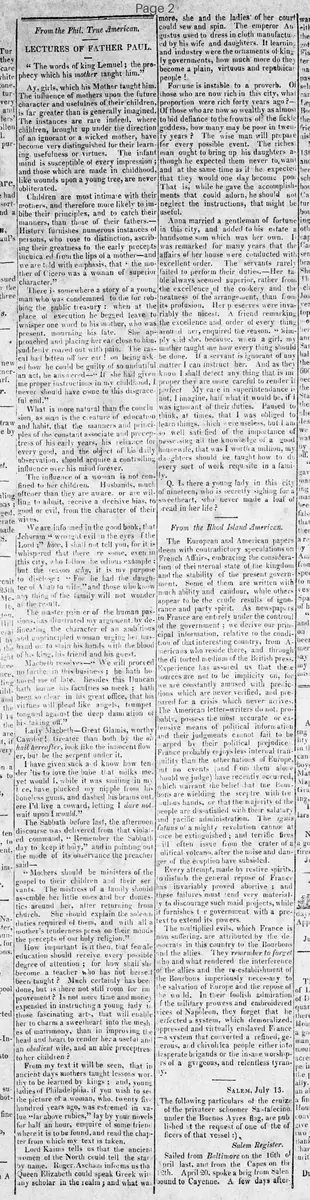
LECTURES OF FATHER PAUL.
"The words of king Lemuel; the prophecy which his mother taught him."
Ay, girls, which his Mother taught him.
The influence of mothers upon the future character and usefulness of their children, is far greater than is generally imagined. The instances are rare indeed, where children, brought up under the direction of an ignorant or a wicked mother, have become very distinguished for their learning usefulness or virtues. The infant mind is susceptible of every impression: and those which are made in childhood, like wounds upon a young tree, are never obliterated.
Children are most intimate with their mothers, and therefore more likely to imbibe their principles, and to catch their manners, than those of their fathers.-- History furnishes numerous instances of persons, who rose to distinction, ascribing their greatness to the early precepts inculcated from the lips of a mother; and we are told with emphasis, that the mother of Cicero was a woman of superior character.
There is somewhere a story of a young man who was condemned to die for robbing the public treasury: when at the place of execution he begged leave to whisper one word to his mother, who was present, mourning his fate. She approached and placing her ear close to him, suddenly roared out with pain. The rascal had bitten off her ear! on being asked how he could be guilty of so undutiful an act, he answered-"If she had given me proper instructions in my childhood, I never should have come to this disgraceful end."
What is more natural than the conclusion, as man is the creature of education and habit, that the manners and principles of the constant associate and preceptress of his early years, his reliance for every good, and the object of his daily observation, should acquire a controlling influence over his mind forever.
The influence of a woman is not confined to her children. Husbands, much oftener than they are aware, or are willing to admit, receive a decisive bias, to good or evil, from the character of their wives.
We are informed in the good book, that Jehoram "wrought evil in the eyes of the Lord;" how, I shall not tell you, for it is whispered that there are some, even in this city, who follow the odious example: but the reason why, it is my purpose to disclose: For he had the daughter of Ahab to wife." and those who know anything of the family will not wonder at the result.
the master painter of the human passions, has illustrated my argument, by delineating the character of an ambitious and unprincipled woman urging her husband on: to stain his hands with the blood of his king, his friend and his guest.
Macbeth resolves-"We will proceed no farthe in this business; he hath honored me of late. Besides this Duncan hath borne his faculties so meek: hath been so clear in his great office, that his virtues will plead like angels, trumpet tongued against the deep damnation of his taking off."
Lady Macbeth-Great Glamis, worthy Cawdor! Greater than both by the all hail hereafter, look like the innocent flower, but be the serpent under it.
I have given suck and know how tender 'tis to love the babe that milks me. yet would I, while it was smiling in my face, have plucked my nipple from his boneless gums, and dashed his brains out, ere I'd live a coward, letting "I dare not wait upon I would."
The Sabbath before last, the afternoon discourse was delivered from that violated command, "Remember the Sabbath day to keep it holy," and in pointing out the mode of its observance the preacher said-
"Mothers should be ministers of the gospel to their children and their servants. The mistress of a family should assemble her little ones and her domestics around her, after returning from church. She should explain the solemn duties required of them, and with all a mother's tenderness press on their minds the precepts of our holy religion."
How important is it then, that female education should receive every possible degree of attention; for how shall she become a teacher who has not herself been taught? Much certainly has been done, but is there not still room for improvement? Is not more time and money expended in instructing a young lady in those fascinating arts, that will enable her to charm a sweetheart into the meshes of matrimony, than in improving the head and heart to render her a useful and an obedient wife, and an able preceptress to her children?
From my text it will be seen, that in ancient days mothers taught lessons worthy to be learned by kings; and, young ladies of Philadelphia, if you wish to see the picture of a woman, who, twenty five hundred years ago, was esteemed in value "far above rubies," lay by your novels for half an hour, enquire of some friend where it is to be found, and read the chapter from which my text is taken.
Lord Kames tells us that the ancient women of the North could tell the stars by name. Roger Ascham informs us that Queen Elizabeth could speak Greek with any scholar in the realm; and what was more, she and the ladies of her court could sew and spin. The emperor Augustus used to dress in cloth manufactured by his wife and daughters. If learning and industry were the ornaments of kingly governments, how much more do they become a plain, virtuous and republican people!
Fortune is instable to a proverb. Of those who are now rich in this city, what proportion were rich forty years ago?- Of those who are now so wealthy as almost to bid defiance to the frowns of the fickle goddess, how many may be poor in twenty years? The wise man will prepare for every possible event. The richest man ought to bring up his daughters as though he expected them never to want and at the same time as if he expected that they would one day become poor That is, while he gave the accomplishments that could adorn, he should not neglect the instructions, that might be useful.
Anna married a gentleman of fortune in this city, and added to his estate a handsome sum which was her own. I was remarked for many years that the affairs of her house were conducted with excellent order. The servants rarely failed to perform their duties.--Her table always seemed superior, rather from the excellence of the cookery and the neatness of the arrangement, than from its profusion. Her preserves were invariably the nicest. A friend remarking the excellence and order of every thing around her, enquired the reason. "Simply said she, because, when a girl, my mother taught me how every thing should be done. If a servant is ignorant of any matter I can instruct her. And as they know I shall detect any thing that is improper they are more careful to render it perfect My care in superintendance is not, I imagine, half what it would be, if I was ignorant of their duties. Paused to think, at times, that I was obliged to learn things which were useless. but I am so well satisfied of the importance of possessing all the knowledge of a good housewife, that was I worth a million, my daughters should be taught how to do every sort of work requisite in a family."
What sub-type of article is it?
What themes does it cover?
What keywords are associated?
What entities or persons were involved?
Where did it happen?
Story Details
Key Persons
Location
Philadelphia
Story Details
Father Paul lectures on maternal influence, using biblical King Lemuel, historical examples like Cicero, a thief blaming his mother, Jehoram's wicked wife, Lady Macbeth's ambition, a preacher's call for mothers as gospel ministers, advocacy for female education, and Anna's successful household due to her mother's teachings.