Thank you for visiting SNEWPapers!
Sign up free
Editorial
August 31, 1803
The National Intelligencer And Washington Advertiser
Washington, District Of Columbia
What is this article about?
The editorial praises the US government's firm maintenance of peace amid a European coalition (France, Russia, Austria, Prussia, Sweden, Denmark) aimed at remodelling Europe, disrupting British trade and naval power, especially via Baltic closure. It criticizes US partisans urging war involvement, advocating neutrality instead.
Clipping
OCR Quality
95%
Excellent
Full Text
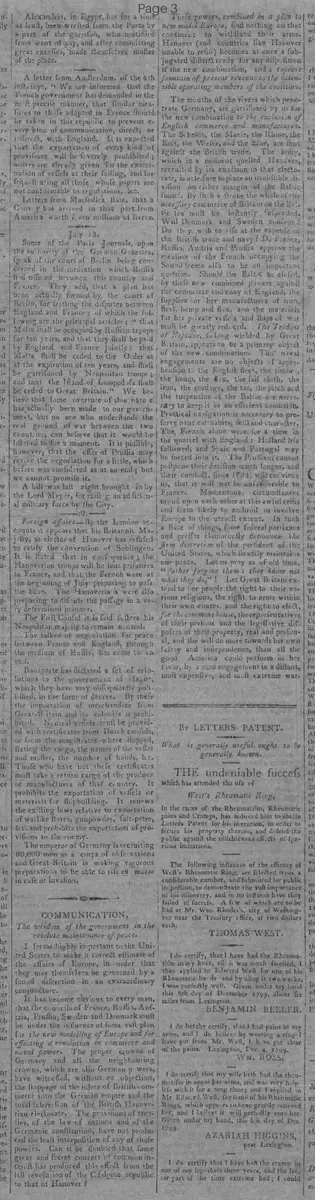
COMMUNICATION,
The wisdom of the government in the resolute maintenance of peace. It seems highly important to the United States to make a correct estimate of the affairs of Europe, in order that they may themselves be governed by a sound discretion in an extraordinary conjuncture.
It has become obvious to every man, that the councils of France, Russia, Austria, Prussia, Sweden and Denmark must be under the influence of some vast plan for the new modelling of Europe and for effecting a revolution in commerce and naval power. The proper crowns of Germany and all the neighbouring crowns, which are also German powers, have witnessed, without an objection, the stoppage of the inlets of British commerce into the German empire and the total subversion of the British Hanoverian electorate. The provisions of treaties, of the law of nations and of the Germanic constitution, have not produced the least interposition of any of those powers. Can it be doubted that some great and secret concert of common interest has produced this effect from the last revolution of the Cisalpine republic to that of Hanover?
These powers, combined in a plan to new model Europe, find nothing on that continent to withstand their arms. Hanover (and countries like Hanover unable to resist) becomes at once a subjugated district ready for any disposition of the new combination, and a copious fountain of present revenue to the ostensible operating members of the coalition. The mouths of the rivers which penetrate Germany, are garrisoned by or for the new combination to the exclusion of English commerce and manufactures. The Scheldt, the Maese, the Rhine, the Ems, the Weser, and the Elbe, are shut against the British trade. The army, which in a moment quelled Hanover, recruited by its exaction in that electorate, is able sure to place an irresistible division on either margin of the Baltic sound. By such a stroke the whole of the necessary commerce of Britain on the Baltic sea must be instantly suspended. Will Denmark and Sweden consent! Do they wish to rise at the expense of the British trade and navy? Do France, Russia, Austria and Prussia approve the measure of the French occupying the Sound seems also to be an important question. Should the Baltic be closed, by these new combined powers against the commerce and navy of England, the supplies of her manufactures of iron, steel, hemp and flax, and the materials for her private vessels and ships of war must be greatly reduced. The Trident of Neptune, long wielded by Great Britain, appears to be a primary object of the new combination Though naval engagements are no objects of apprehension to the English fleet, the timber, the hemp, the flax, the sail cloth, the iron, the cordage, the tar, the pitch and the turpentine of the Baltic are necessary to keep it in an efficient condition. Practical navigation is necessary to preserve nautical habits, skill and character. The French alone were for a time in the quarrel with England: Holland has followed, and Spain and Portugal may be forced into it. The Prussians cannot postpone their decision much longer, and their conduct, since 1794, will convince us, that it will not be unfavourable to France. Momentous, circumstances crowd upon each other at this awful crisis and seem likely to embroil or involve Europe to the utmost extent. In such a state of things, one federal partisans and press clamorously denounce the firm discretion of the president of the United States, which steadily maintains our peace. Let us pray as of old time, "father forgive them: they know not what they do," ! Let Great Britain extend to her people the right to their various religions, the right to arms within their own estates, and the right to elect, for the commons house, the representatives of their persons and the legislative disposers of their property, real and personal, and she will do more towards her own safety and independence, than all the good America could perform in her favor, by a mad engagement in a distant, most expensive, and most extreme war.
The wisdom of the government in the resolute maintenance of peace. It seems highly important to the United States to make a correct estimate of the affairs of Europe, in order that they may themselves be governed by a sound discretion in an extraordinary conjuncture.
It has become obvious to every man, that the councils of France, Russia, Austria, Prussia, Sweden and Denmark must be under the influence of some vast plan for the new modelling of Europe and for effecting a revolution in commerce and naval power. The proper crowns of Germany and all the neighbouring crowns, which are also German powers, have witnessed, without an objection, the stoppage of the inlets of British commerce into the German empire and the total subversion of the British Hanoverian electorate. The provisions of treaties, of the law of nations and of the Germanic constitution, have not produced the least interposition of any of those powers. Can it be doubted that some great and secret concert of common interest has produced this effect from the last revolution of the Cisalpine republic to that of Hanover?
These powers, combined in a plan to new model Europe, find nothing on that continent to withstand their arms. Hanover (and countries like Hanover unable to resist) becomes at once a subjugated district ready for any disposition of the new combination, and a copious fountain of present revenue to the ostensible operating members of the coalition. The mouths of the rivers which penetrate Germany, are garrisoned by or for the new combination to the exclusion of English commerce and manufactures. The Scheldt, the Maese, the Rhine, the Ems, the Weser, and the Elbe, are shut against the British trade. The army, which in a moment quelled Hanover, recruited by its exaction in that electorate, is able sure to place an irresistible division on either margin of the Baltic sound. By such a stroke the whole of the necessary commerce of Britain on the Baltic sea must be instantly suspended. Will Denmark and Sweden consent! Do they wish to rise at the expense of the British trade and navy? Do France, Russia, Austria and Prussia approve the measure of the French occupying the Sound seems also to be an important question. Should the Baltic be closed, by these new combined powers against the commerce and navy of England, the supplies of her manufactures of iron, steel, hemp and flax, and the materials for her private vessels and ships of war must be greatly reduced. The Trident of Neptune, long wielded by Great Britain, appears to be a primary object of the new combination Though naval engagements are no objects of apprehension to the English fleet, the timber, the hemp, the flax, the sail cloth, the iron, the cordage, the tar, the pitch and the turpentine of the Baltic are necessary to keep it in an efficient condition. Practical navigation is necessary to preserve nautical habits, skill and character. The French alone were for a time in the quarrel with England: Holland has followed, and Spain and Portugal may be forced into it. The Prussians cannot postpone their decision much longer, and their conduct, since 1794, will convince us, that it will not be unfavourable to France. Momentous, circumstances crowd upon each other at this awful crisis and seem likely to embroil or involve Europe to the utmost extent. In such a state of things, one federal partisans and press clamorously denounce the firm discretion of the president of the United States, which steadily maintains our peace. Let us pray as of old time, "father forgive them: they know not what they do," ! Let Great Britain extend to her people the right to their various religions, the right to arms within their own estates, and the right to elect, for the commons house, the representatives of their persons and the legislative disposers of their property, real and personal, and she will do more towards her own safety and independence, than all the good America could perform in her favor, by a mad engagement in a distant, most expensive, and most extreme war.
What sub-type of article is it?
Foreign Affairs
War Or Peace
Partisan Politics
What keywords are associated?
European Coalition
British Commerce
Baltic Trade
Us Neutrality
Peace Policy
Partisan Criticism
Naval Power
Hanover Subjugation
What entities or persons were involved?
France
Russia
Austria
Prussia
Sweden
Denmark
Great Britain
United States
President Of The United States
Editorial Details
Primary Topic
Wisdom Of Us Maintaining Peace Amid European Coalition Against Britain
Stance / Tone
Supportive Of Us Neutrality And Peace Policy, Critical Of Federal Partisans
Key Figures
France
Russia
Austria
Prussia
Sweden
Denmark
Great Britain
United States
President Of The United States
Key Arguments
European Powers Under Vast Plan To Remodel Europe And Revolution In Commerce And Naval Power
German Powers Allow Stoppage Of British Commerce Without Objection
Hanover Subjugated And Used For Revenue
Rivers In Germany Shut Against British Trade
Potential Closure Of Baltic Against British Commerce
Supplies From Baltic Essential For British Navy
Prussia Likely To Side With France
Us Should Maintain Peace Despite Partisan Denunciations
Britain Should Grant Rights To Her People For Safety
Us Involvement In War Would Be Mad And Expensive