Thank you for visiting SNEWPapers!
Sign up free
Editorial
May 8, 1950
The Augusta Courier
Augusta, Richmond County, Georgia
What is this article about?
Roy V. Harris compares 1850s Southern racial fears leading to Civil War secession with 1950s Northern agitation against segregation, arguing misunderstanding persists and federal force threatens Southern peace and self-determination.
Merged-components note: Merging the continuations of the 'STRICTLY PERSONAL' editorial by Roy V. Harris from page 1 to page 3 and then to page 4, as indicated by the continuation notices.
Clippings
1 of 3
OCR Quality
98%
Excellent
Full Text
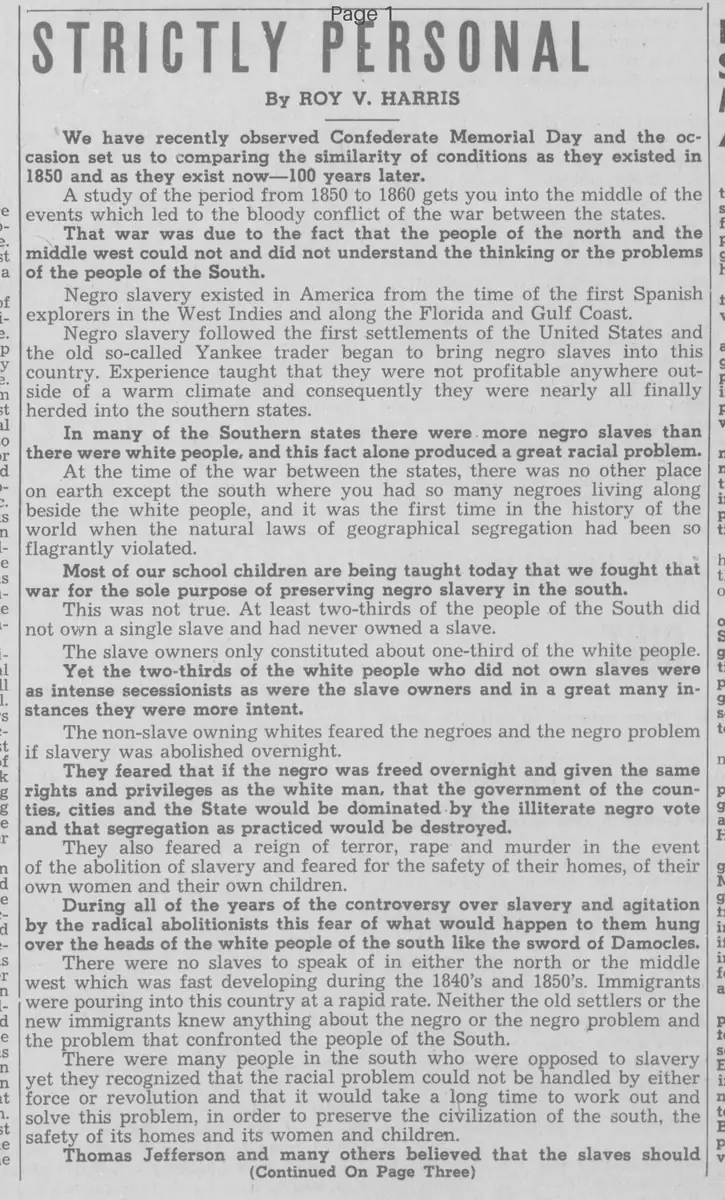
STRICTLY PERSONAL
By ROY V. HARRIS
We have recently observed Confederate Memorial Day and the occasion set us to comparing the similarity of conditions as they existed in 1850 and as they exist now 100 years later.
A study of the period from 1850 to 1860 gets you into the middle of the events which led to the bloody conflict of the war between the states.
That war was due to the fact that the people of the north and the middle west could not and did not understand the thinking or the problems of the people of the South.
Negro slavery existed in America from the time of the first Spanish explorers in the West Indies and along the Florida and Gulf Coast.
Negro slavery followed the first settlements of the United States and the old so-called Yankee trader began to bring negro slaves into this country. Experience taught that they were not profitable anywhere outside of a warm climate and consequently they were nearly all finally herded into the southern states.
In many of the Southern states there were more negro slaves than there were white people, and this fact alone produced a great racial problem.
At the time of the war between the states, there was no other place on earth except the south where you had so many negroes living along beside the white people, and it was the first time in the history of the world when the natural laws of geographical segregation had been so flagrantly violated.
Most of our school children are being taught today that we fought that war for the sole purpose of preserving negro slavery in the south.
This was not true. At least two-thirds of the people of the South did not own a single slave and had never owned a slave.
The slave owners only constituted about one-third of the white people.
Yet the two-thirds of the white people who did not own slaves were as intense secessionists as were the slave owners and in a great many instances they were more intent.
The non-slave owning whites feared the negroes and the negro problem if slavery was abolished overnight.
They feared that if the negro was freed overnight and given the same rights and privileges as the white man, that the government of the counties, cities and the State would be dominated by the illiterate negro vote and that segregation as practiced would be destroyed.
They also feared a reign of terror, rape and murder in the event of the abolition of slavery and feared for the safety of their homes, of their own women and their own children.
During all of the years of the controversy over slavery and agitation by the radical abolitionists this fear of what would happen to them hung over the heads of the white people of the south like the sword of Damocles.
There were no slaves to speak of in either the north or the middle west which was fast developing during the 1840's and 1850's. Immigrants were pouring into this country at a rapid rate. Neither the old settlers or the new immigrants knew anything about the negro or the negro problem and the problem that confronted the people of the South.
There were many people in the south who were opposed to slavery yet they recognized that the racial problem could not be handled by either force or revolution and that it would take a long time to work out and solve this problem, in order to preserve the civilization of the south, the safety of its homes and its women and children.
Thomas Jefferson and many others believed that the slaves should be bought up and should be settled some place outside of the United States where they could have a country of their own.
Out of the movement started by Jefferson a great many negroes were freed or purchased and were shipped to Liberia and there established a negro republic.
The people of the north and west and especially the new immigrants from Europe who had never had any experience with the negro were utterly incapable of understanding the position of the people of the South or anything of the nature of this fear which existed in the minds of the southern people.
Consequently, they believed that the people of the south were stubborn, determined to preserve the institution of slavery and that only force from without could ever do anything with southern people.
On the other hand the southern people knew what a problem they had on their hands. They believed that it would take a great many years to work out any solution whatever and that even slavery was better than turning loose a hoard of slaves to overrun the south.
They believed that conditions as they developed during the days of the reconstruction would inevitably result. It must be remembered that during the days of the reconstruction the negroes took charge of the government of the cities, counties and the state under the leadership of the carpet baggers and the scalawags. The carpet baggers and the scalawags held the big jobs and the legislatures were filled with negroes. In Georgia they issued fraudulent bonds and stole the money.
A reign of terror existed in the state and the white people of this state were forced to wade through blood shed to get rid of the negro, carpet bagger and scalawag governments.
In New England the yankees there held to the idea that the states were sovereign and that each state had a right to solve its own problem and a right to secede from the Union if it saw fit.
Southern people held to this same view and when they believed that Lincoln and his abolition party was going to turn the hoard of negroes loose with full rights of citizenship overnight, they believed that their only protection was to exercise their right to secede from the Union in order that they could handle this problem according to their own way and to protect themselves.
Today we find ourselves once again in the middle of another period of agitation in the north, in the middle west and in the far west against the white people of the south on account of the negro problem.
Once again they are seeking to use force. Once again they are trying to dictate to the people of the southern states how we should handle our own affairs. The President of the United States has committed the government to destroy the pattern of segregation in all walks of life and they hope to get Congress to ram these force measures down the throats of southern people.
The pattern of segregation has established a pattern where great numbers of negroes and whites can live together in a state of peace and harmony.
Without this pattern of segregation this condition could not exist.
Once again people outside the south do not have an understanding of our problems or our situation. They think they know it all and they are determined to destroy the southern people.
The radicals are agitating again and are attempting to divide this nation again.
Of course there will be no more secession but they have driven a wedge between the people of the south and the rest of the nation, and we are being driven further apart year after year.
This nation is spending billions of dollars for the recovery of our former allies and our former enemies in Europe. Yet our northern and western brothers contributed nothing to the recovery of the south although they applied the scorched earth policy to us. On the contrary they undertook to crush us and entertained the worst type of hatred for southern people.
And now today we are back in the same fix. Our northern and western brothers have the greatest sympathy for our former enemies and allies in Europe but they entertain no sympathy for us.
This is the time when southern people need understanding and when we need help in solving this most difficult problem, yet we are getting neither the understanding, sympathy or help.
And also this is a time when we need to have a united people and not a divided people.
Yet our leaders in Washington are quoted as saying I privately, "To Hell with the South" and they are following the same kind of a policy.
This is strange treatment for southern people to receive at a time when the administration in Washington is pouring out billions to help foreigners to solve their problems.
And at this time gives us something to really think about.
By ROY V. HARRIS
We have recently observed Confederate Memorial Day and the occasion set us to comparing the similarity of conditions as they existed in 1850 and as they exist now 100 years later.
A study of the period from 1850 to 1860 gets you into the middle of the events which led to the bloody conflict of the war between the states.
That war was due to the fact that the people of the north and the middle west could not and did not understand the thinking or the problems of the people of the South.
Negro slavery existed in America from the time of the first Spanish explorers in the West Indies and along the Florida and Gulf Coast.
Negro slavery followed the first settlements of the United States and the old so-called Yankee trader began to bring negro slaves into this country. Experience taught that they were not profitable anywhere outside of a warm climate and consequently they were nearly all finally herded into the southern states.
In many of the Southern states there were more negro slaves than there were white people, and this fact alone produced a great racial problem.
At the time of the war between the states, there was no other place on earth except the south where you had so many negroes living along beside the white people, and it was the first time in the history of the world when the natural laws of geographical segregation had been so flagrantly violated.
Most of our school children are being taught today that we fought that war for the sole purpose of preserving negro slavery in the south.
This was not true. At least two-thirds of the people of the South did not own a single slave and had never owned a slave.
The slave owners only constituted about one-third of the white people.
Yet the two-thirds of the white people who did not own slaves were as intense secessionists as were the slave owners and in a great many instances they were more intent.
The non-slave owning whites feared the negroes and the negro problem if slavery was abolished overnight.
They feared that if the negro was freed overnight and given the same rights and privileges as the white man, that the government of the counties, cities and the State would be dominated by the illiterate negro vote and that segregation as practiced would be destroyed.
They also feared a reign of terror, rape and murder in the event of the abolition of slavery and feared for the safety of their homes, of their own women and their own children.
During all of the years of the controversy over slavery and agitation by the radical abolitionists this fear of what would happen to them hung over the heads of the white people of the south like the sword of Damocles.
There were no slaves to speak of in either the north or the middle west which was fast developing during the 1840's and 1850's. Immigrants were pouring into this country at a rapid rate. Neither the old settlers or the new immigrants knew anything about the negro or the negro problem and the problem that confronted the people of the South.
There were many people in the south who were opposed to slavery yet they recognized that the racial problem could not be handled by either force or revolution and that it would take a long time to work out and solve this problem, in order to preserve the civilization of the south, the safety of its homes and its women and children.
Thomas Jefferson and many others believed that the slaves should be bought up and should be settled some place outside of the United States where they could have a country of their own.
Out of the movement started by Jefferson a great many negroes were freed or purchased and were shipped to Liberia and there established a negro republic.
The people of the north and west and especially the new immigrants from Europe who had never had any experience with the negro were utterly incapable of understanding the position of the people of the South or anything of the nature of this fear which existed in the minds of the southern people.
Consequently, they believed that the people of the south were stubborn, determined to preserve the institution of slavery and that only force from without could ever do anything with southern people.
On the other hand the southern people knew what a problem they had on their hands. They believed that it would take a great many years to work out any solution whatever and that even slavery was better than turning loose a hoard of slaves to overrun the south.
They believed that conditions as they developed during the days of the reconstruction would inevitably result. It must be remembered that during the days of the reconstruction the negroes took charge of the government of the cities, counties and the state under the leadership of the carpet baggers and the scalawags. The carpet baggers and the scalawags held the big jobs and the legislatures were filled with negroes. In Georgia they issued fraudulent bonds and stole the money.
A reign of terror existed in the state and the white people of this state were forced to wade through blood shed to get rid of the negro, carpet bagger and scalawag governments.
In New England the yankees there held to the idea that the states were sovereign and that each state had a right to solve its own problem and a right to secede from the Union if it saw fit.
Southern people held to this same view and when they believed that Lincoln and his abolition party was going to turn the hoard of negroes loose with full rights of citizenship overnight, they believed that their only protection was to exercise their right to secede from the Union in order that they could handle this problem according to their own way and to protect themselves.
Today we find ourselves once again in the middle of another period of agitation in the north, in the middle west and in the far west against the white people of the south on account of the negro problem.
Once again they are seeking to use force. Once again they are trying to dictate to the people of the southern states how we should handle our own affairs. The President of the United States has committed the government to destroy the pattern of segregation in all walks of life and they hope to get Congress to ram these force measures down the throats of southern people.
The pattern of segregation has established a pattern where great numbers of negroes and whites can live together in a state of peace and harmony.
Without this pattern of segregation this condition could not exist.
Once again people outside the south do not have an understanding of our problems or our situation. They think they know it all and they are determined to destroy the southern people.
The radicals are agitating again and are attempting to divide this nation again.
Of course there will be no more secession but they have driven a wedge between the people of the south and the rest of the nation, and we are being driven further apart year after year.
This nation is spending billions of dollars for the recovery of our former allies and our former enemies in Europe. Yet our northern and western brothers contributed nothing to the recovery of the south although they applied the scorched earth policy to us. On the contrary they undertook to crush us and entertained the worst type of hatred for southern people.
And now today we are back in the same fix. Our northern and western brothers have the greatest sympathy for our former enemies and allies in Europe but they entertain no sympathy for us.
This is the time when southern people need understanding and when we need help in solving this most difficult problem, yet we are getting neither the understanding, sympathy or help.
And also this is a time when we need to have a united people and not a divided people.
Yet our leaders in Washington are quoted as saying I privately, "To Hell with the South" and they are following the same kind of a policy.
This is strange treatment for southern people to receive at a time when the administration in Washington is pouring out billions to help foreigners to solve their problems.
And at this time gives us something to really think about.
What sub-type of article is it?
Slavery Abolition
Social Reform
Constitutional
What keywords are associated?
Confederate Memorial Day
Civil War Causes
Negro Slavery
Southern Secession
Racial Segregation
Reconstruction Terror
States Rights
Federal Intervention
What entities or persons were involved?
Roy V. Harris
Thomas Jefferson
Abraham Lincoln
Southern People
Northern People
Negroes
Carpetbaggers
Scalawags
Editorial Details
Primary Topic
Parallels Between 1850s Slavery Crisis And 1950s Segregation Debates
Stance / Tone
Defensive Of Southern Racial Policies And Secession
Key Figures
Roy V. Harris
Thomas Jefferson
Abraham Lincoln
Southern People
Northern People
Negroes
Carpetbaggers
Scalawags
Key Arguments
Northern Misunderstanding Of Southern Racial Problems Caused The Civil War
Most Southern Whites Did Not Own Slaves But Feared Sudden Abolition
Segregation Maintains Peace Between Races In The South
Reconstruction Era Demonstrated Dangers Of Negro Political Dominance
Current Federal Anti Segregation Efforts Repeat Historical Threats To Southern Self Determination
States' Rights Allow South To Handle Its Own Racial Issues
Jefferson's Plan To Relocate Freed Slaves To Liberia
Northern Immigrants Lacked Experience With Negro Problem