Thank you for visiting SNEWPapers!
Sign up free
Literary Cadet And Rhode Island Statesman
Providence, Providence County, Rhode Island
What is this article about?
Historical memorandum on General Burgoyne's 1777 campaign during the American Revolution, including his boast in Parliament, alliance with Native Americans, the scalping of Miss M'Rea, battles at Saratoga, and surrender to General Gates with 5,791 troops.
Clipping
OCR Quality
Full Text
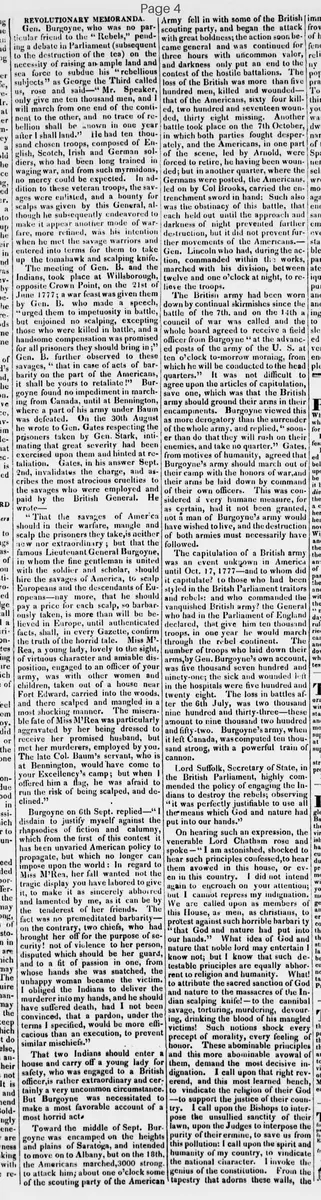
Gen. Burgoyne, who was no particular friend to the "Rebels," pending a debate in Parliament (subsequent to the destruction of the tea) on the necessity of raising an ample land and sea force to subdue his "rebellious subjects" as George the Third called us, rose and said—"Mr. Speaker, only give me ten thousand men, and I will march from one end of the continent to the other, and no trace of rebellion shall be known in one year after I shall land." He had ten thousand chosen troops, composed of English, Scotch, Irish and German soldiers, who had been long trained in waging war, and from such myrmidons, no mercy could be expected. In addition to these veteran troops, the savages were enlisted, and a bounty for scalps was given by this General, although he subsequently endeavored to make it appear another mode of war, more refined, was his intention when he met the savage warriors and entered into terms for them to take up the tomahawk and scalping knife.
The meeting of Gen. B. and the Indians, took place at Willsborough, opposite Crown Point, on the 21st of June 1777; a war feast was given them by Gen. B. who made a speech, "urged them to impetuosity in battle, but enjoined no scalping, excepting those who were killed in battle, and a handsome compensation was promised for all prisoners they should bring in;" Gen. B. further observed to these savages, "that in case of acts of barbarity on the part of the Americans, it shall be yours to retaliate!" Burgoyne found no impediment in marching from Canada, until at Bennington, where a part of his army under Baum was defeated. On the 30th August he wrote to Gen. Gates respecting the prisoners taken by Gen. Stark, intimating that great severity had been exercised upon them and hinted at retaliation. Gates, in his answer Sept. 2nd, invalidates the charge, and ascribes the most atrocious cruelties to the savages who were employed and paid by the British General. He wrote—
"That the savages of America should in their warfare, mangle and scalp the prisoners they take, is neither new nor extraordinary; but that the famous Lieutenant General Burgoyne, in whom the fine gentleman is united with the soldier and scholar, should hire the savages of America, to scalp Europeans and the descendants of Europeans—nay more, that he should pay a price for each scalp, so barbarously taken, is more than will be believed in Europe, until authenticated facts, shall, in every Gazette, confirm the truth of the horrid tale. Miss M'Rea, a young lady, lovely to the sight, of virtuous character and amiable disposition, engaged to an officer of your army, was with other women and children, taken out of a house near Fort Edward, carried into the woods, and there scalped and mangled in a most shocking manner. The miserable fate of Miss M'Rea was particularly aggravated by her being dressed to receive her promised husband, but met her murderers, employed by you. The late Col. Baum's servant, who is at Bennington, would have come to your Excellency's camp; but when I offered him a flag, he was afraid to run the risk of being scalped, and declined."
Burgoyne on 6th Sept. replied—"I disdain to justify myself against the rhapsodics of fiction and calumny, which from the first of this contest it has been unvaried American policy to propagate, but which no longer can impose upon the world: In regard to Miss M'Rea, her fall wanted not the tragic display you have labored to give it, to make it as sincerely abhorred and lamented by me, as it can be by the tenderest of her friends. The fact was no premeditated barbarity— on the contrary, two chiefs, who had brought her off for the purpose of security! not of violence to her person, disputed which should be her guard, and to a fit of passion in one, from whose hands she was snatched, the unhappy woman became the victim. I obliged the Indians to deliver the murderer into my hands, and he should have suffered death, had I not been convinced, that a pardon, under the terms I specified, would be more efficacious than an execution, to prevent similar mischiefs."
That two Indians should enter a house and carry off a young lady for safety, who was engaged to a British officer, is rather extraordinary and certainly a very uncommon circumstance. But Burgoyne was necessitated to make a most favorable account of a most horrid act.
Toward the middle of Sept. Burgoyne was encamped on the heights and plains of Saratoga, and intended to move on to Albany, but on the 18th. the Americans marched, 3000 strong to attack him; about one o'clock some of the scouting party of the American Army fell in with some of the British scouting party, and began the attack with great boldness; the action soon became general and was continued for three hours with uncommon valor, and darkness only put an end to the contest of the hostile battalions. The loss of the British was more than five hundred men, killed and wounded— that of the Americans, sixty four killed, two hundred and seventeen wounded, thirty eight missing. Another battle took place on the 7th October, in which both parties fought desperately, and the Americans, in one part of the scene, led by Arnold, were forced to retire, he having been wounded; but in another quarter, where the Germans were posted, the Americans, led on by Col Brooks, carried the entrenchment sword in hand: Such also was the obstinacy of this battle, that each held out until the approach and darkness of night prevented further destruction, but it did not prevent further movements of the Americans.— Gen. Lincoln who had, during the action, commanded within the works, marched with his division, between twelve and one o'clock at night, to relieve the troops.
The British army had been worn down by continual skirmishes since the battle of the 7th. and on the 14th a council of war was called and the whole board agreed to receive a field officer from Burgoyne "at the advanced posts of the army of the U. S. at ten o'clock to-morrow morning, from which he will be conducted to the head quarters."
It was not difficult to agree upon the articles of capitulation, save one, which was that the British army should ground their arms in their encampments. Burgoyne viewed this as more derogatory than the surrender of the whole army, and replied, "sooner than do that they will rush on their enemies, and take no quarter." Gates, from motives of humanity, agreed that Burgoyne's army should march out of their camp with the honors of war, and their arms be laid down by command of their own officers. This was considered a very humane measure, for as certain, had it not been granted, not a man of Burgoyne's army would have wished to live, and the destruction of both armies must necessarily have followed.
The capitulation of a British army was an event unknown in America until Oct. 17, 1777—and to whom did it capitulate? to those who had been styled in the British Parliament traitors and rebels: and who commanded the vanquished British army? the General who had in the Parliament of England declared, that give him ten thousand troops, in one year he would march through the rebel continent.
The number of troops who laid down their arms, by Gen. Burgoyne's own account, was five thousand seven hundred and ninety-one; the sick and wounded left in the hospitals were five hundred and twenty eight. The loss in battles after the 6th July, was two thousand nine hundred and thirty-three—these amount to nine thousand two hundred and fifty-two. Burgoyne's army, when it left Canada, was computed ten thousand strong, with a powerful train of cannon.
Lord Suffolk, Secretary of State, in the British Parliament, highly commended the policy of engaging the Indians to destroy the rebels; observing "it was perfectly justifiable to use all the means which God and nature had put into our hands."
What sub-type of article is it?
What keywords are associated?
What entities or persons were involved?
Where did it happen?
Domestic News Details
Primary Location
Saratoga
Event Date
1777
Key Persons
Outcome
british surrender of 5,791 troops on oct. 17, 1777; sick and wounded 528; total losses after july 6: 2,933; overall from canada: 9,252. american losses in sept. 18 battle: 64 killed, 217 wounded, 38 missing. miss m'rea scalped and mangled.
Event Details
Gen. Burgoyne boasted in Parliament of subduing rebels with 10,000 men. In 1777, he marched from Canada with veteran troops and allied with Indians at Willsborough on June 21, promising compensation for prisoners but allowing retaliation. Indians scalped Miss M'Rea near Fort Edward. British defeated at Bennington. Battles at Saratoga on Sept. 18 and Oct. 7 resulted in heavy British losses. Burgoyne's army capitulated on Oct. 17 after council of war, marching out with honors of war.