Thank you for visiting SNEWPapers!
Sign up free
Editorial
November 18, 1936
Imperial Valley Press
El Centro, Imperial County, California
What is this article about?
Bruce Catton advocates for intelligent conservation of natural resources, particularly timber, using a U.S. Forest Service example from Michigan's 129,000-acre virgin forest. Reducing annual cutting to 8.5 million board feet and implementing reforestation would sustain production indefinitely, avoiding economic collapse and ensuring long-term prosperity.
Clipping
OCR Quality
98%
Excellent
Full Text
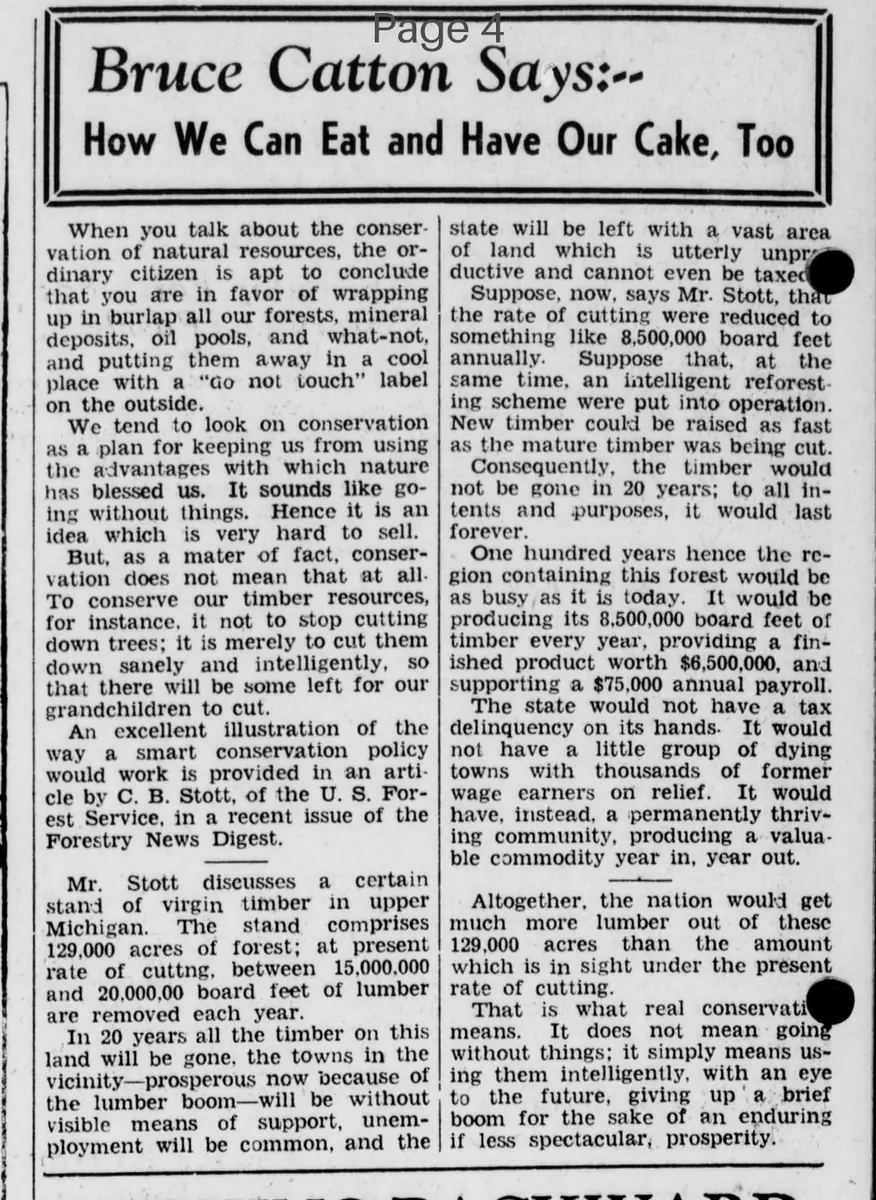
Bruce
Catton Says:--
How We Can Eat and Have Our Cake, Too
When you talk about the conservation of natural resources, the ordinary citizen is apt to conclude that you are in favor of wrapping up in burlap all our forests, mineral deposits, oil pools, and what-not, and putting them away in a cool place with a "do not touch" label on the outside.
We tend to look on conservation as a plan for keeping us from using the advantages with which nature has blessed us. It sounds like going without things. Hence it is an idea which is very hard to sell.
But, as a matter of fact, conservation does not mean that at all. To conserve our timber resources, for instance, is not to stop cutting down trees: it is merely to cut them down sanely and intelligently, so that there will be some left for our grandchildren to cut.
An excellent illustration of the way a smart conservation policy would work is provided in an article by C. B. Stott, of the U. S. Forest Service, in a recent issue of the Forestry News Digest.
Mr. Stott discusses a certain stand of virgin timber in upper Michigan. The stand comprises 129,000 acres of forest; at present rate of cutting, between 15,000,000 and 20,000,000 board feet of lumber are removed each year.
In 20 years all the timber on this land will be gone, the towns in the vicinity-prosperous now because of the lumber boom-will be without visible means of support, unemployment will be common, and the state will be left with a vast area of land which is utterly unproductive and cannot even be taxed.
Suppose, now, says Mr. Stott, that the rate of cutting were reduced to something like 8,500,000 board feet annually. Suppose that, at the same time, an intelligent reforesting scheme were put into operation. New timber could be raised as fast as the mature timber was being cut. Consequently, the timber would not be gone in 20 years; to all intents and purposes, it would last forever.
One hundred years hence the region containing this forest would be as busy as it is today. It would be producing its 8,500,000 board feet of timber every year, providing a finished product worth $6,500,000, and supporting a $75,000 annual payroll.
The state would not have a tax delinquency on its hands. It would not have a little group of dying towns with thousands of former wage earners on relief. It would have, instead, a permanently thriving community, producing a valuable commodity year in, year out.
Altogether, the nation would get much more lumber out of these 129,000 acres than the amount which is in sight under the present rate of cutting.
That is what real conservation means. It does not mean going without things; it simply means using them intelligently, with an eye to the future, giving up a brief boom for the sake of an enduring if less spectacular, prosperity.
Catton Says:--
How We Can Eat and Have Our Cake, Too
When you talk about the conservation of natural resources, the ordinary citizen is apt to conclude that you are in favor of wrapping up in burlap all our forests, mineral deposits, oil pools, and what-not, and putting them away in a cool place with a "do not touch" label on the outside.
We tend to look on conservation as a plan for keeping us from using the advantages with which nature has blessed us. It sounds like going without things. Hence it is an idea which is very hard to sell.
But, as a matter of fact, conservation does not mean that at all. To conserve our timber resources, for instance, is not to stop cutting down trees: it is merely to cut them down sanely and intelligently, so that there will be some left for our grandchildren to cut.
An excellent illustration of the way a smart conservation policy would work is provided in an article by C. B. Stott, of the U. S. Forest Service, in a recent issue of the Forestry News Digest.
Mr. Stott discusses a certain stand of virgin timber in upper Michigan. The stand comprises 129,000 acres of forest; at present rate of cutting, between 15,000,000 and 20,000,000 board feet of lumber are removed each year.
In 20 years all the timber on this land will be gone, the towns in the vicinity-prosperous now because of the lumber boom-will be without visible means of support, unemployment will be common, and the state will be left with a vast area of land which is utterly unproductive and cannot even be taxed.
Suppose, now, says Mr. Stott, that the rate of cutting were reduced to something like 8,500,000 board feet annually. Suppose that, at the same time, an intelligent reforesting scheme were put into operation. New timber could be raised as fast as the mature timber was being cut. Consequently, the timber would not be gone in 20 years; to all intents and purposes, it would last forever.
One hundred years hence the region containing this forest would be as busy as it is today. It would be producing its 8,500,000 board feet of timber every year, providing a finished product worth $6,500,000, and supporting a $75,000 annual payroll.
The state would not have a tax delinquency on its hands. It would not have a little group of dying towns with thousands of former wage earners on relief. It would have, instead, a permanently thriving community, producing a valuable commodity year in, year out.
Altogether, the nation would get much more lumber out of these 129,000 acres than the amount which is in sight under the present rate of cutting.
That is what real conservation means. It does not mean going without things; it simply means using them intelligently, with an eye to the future, giving up a brief boom for the sake of an enduring if less spectacular, prosperity.
What sub-type of article is it?
Social Reform
Economic Policy
What keywords are associated?
Conservation
Timber Resources
Reforesting
Sustainable Forestry
Michigan Forests
Lumber Industry
Economic Prosperity
What entities or persons were involved?
Bruce Catton
C. B. Stott
U. S. Forest Service
Editorial Details
Primary Topic
Sustainable Conservation Of Timber Resources
Stance / Tone
Advocacy For Intelligent Resource Use Over Short Term Exploitation
Key Figures
Bruce Catton
C. B. Stott
U. S. Forest Service
Key Arguments
Conservation Involves Using Resources Sanely To Ensure Future Availability, Not Abstaining From Use
Current Rapid Cutting In Michigan's 129,000 Acre Forest Will Deplete Timber In 20 Years, Causing Economic Ruin
Reducing Annual Cut To 8,500,000 Board Feet With Reforestation Sustains Perpetual Production And Prosperity
Long Term Approach Yields More Total Lumber And Supports Thriving Communities Without Tax Delinquency Or Unemployment