Thank you for visiting SNEWPapers!
Sign up free
The National Intelligencer And Washington Advertiser
Washington, District Of Columbia
What is this article about?
An anonymous editorial signed 'LYCURGUS' argues that recent state elections demonstrate a clear majority favoring Thomas Jefferson over John Adams for the 1800 U.S. presidential election. It emphasizes the republican principle of majority rule and warns against subverting it, which could lead to discord and national ruin.
Merged-components note: Merged across pages as this is a single continuous opinion piece on the presidential election favoring Jefferson, including the supporting electoral vote tables which provide data for the argument.
Clippings
1 of 2
OCR Quality
Full Text
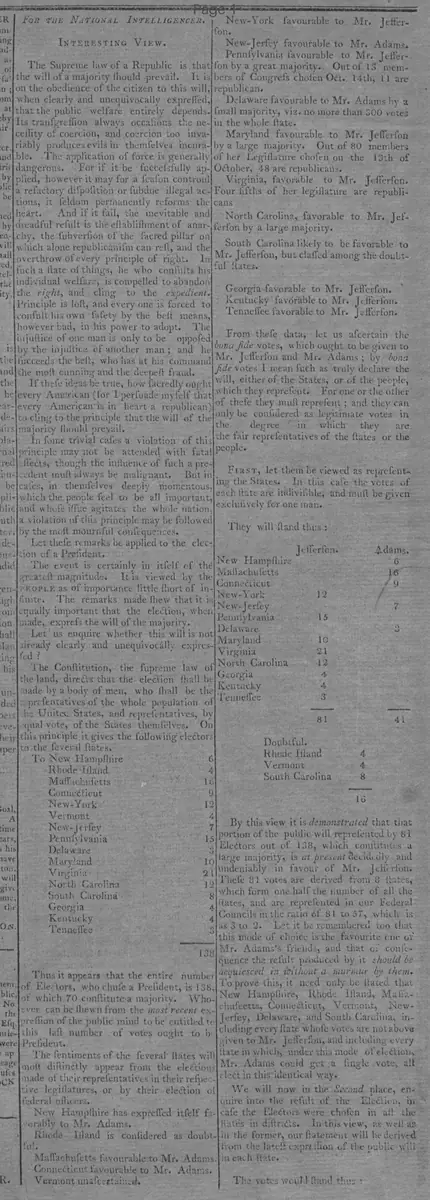
INTERESTING VIEW.
The Supreme law of a Republic is, that the will of a majority should prevail. It is on the obedience of the citizen to this will, when clearly and unequivocally expressed, that the public welfare entirely depends.
Its transgression always occasions the necessity of coercion, and coercion too invariably produces evils in themselves incurable. The application of force is generally dangerous. For if it be successfully applied, however it may for a season controul a refractory disposition or subdue illegal actions, it seldom permanently reforms the heart. And if it fail, the inevitable and dreadful result is the establishment of anarchy, the subversion of the sacred pillar on which alone republicanism can rest, and the overthrow of every principle of right. In such a state of things, he who consults his individual welfare, is compelled to abandon the right, and cling to the expedient. Principle is lost, and every one is forced to consult his own safety by the best means, however bad, in his power to adopt. The injustice of one man is only to be opposed by the injustice of another man; and he succeeds the best, who has at his command the most cunning and the deepest fraud.
If these ideas be true, how sacredly ought every American (for I persuade myself that every American is in heart a republican to cling to the principle that the will of the majority should prevail.
In some trivial cases a violation of this principle may not be attended with fatal effects, though the influence of such a precedent must always be malignant. But in cases, in themselves deeply momentous, which the people feel to be all important, and whose issue agitates the whole nation, a violation of this principle may be followed by the most mournful consequences.
Let these remarks be applied to the election of a President.
The event is certainly in itself of the greatest magnitude. It is viewed by the PEOPLE as of importance little short of infinite. The remarks made shew that it is equally important that the election, when made, expres the will of the majority.
Let us enquire whether this will is not already clearly and unequivocally expressed?
The Constitution, the supreme law of the land, directs that the election shall be made by a body of men, who shall be the representatives of the whole population of the United States, and representatives, by equal vote, of the States themselves. On this principle it gives the following electors to the several states.
To New Hampshire 6
Rhode Island 4
Massachusetts 16
Connecticut 9
New-York 12
Vermont 4
New-Jersey 7
Pennsylvania 15
Delaware 3
Maryland 10
Virginia 21
North Carolina 12
South Carolina 8
Georgia 4
Kentucky 4
Tennessee 3
138
Thus it appears that the entire number of Electors, who chuse a President, is 138, of which 70 constitute a majority. Whoever can be shewn from the most recent expression of the public mind to be entitled to this last number of votes ought to be President.
The sentiments of the several states will most distinctly appear from the elections made of their representatives in their respective legislatures, or by their election of federal officers.
New Hampshire has expressed itself favorably to Mr. Adams.
Rhode Island is considered as doubtful.
Massachusetts favourable to Mr. Adams
Connecticut favourable to Mr. Adams.
Vermont unascertained.
New-Jersey favourable to Mr. Adams.
Pennsylvania favourable to Mr. Jefferson by a great majority. Out of 13 members of Congress chosen Oct. 14th, 11 are republican.
Delaware favourable to Mr. Adams by a small majority, viz. no more than 800 votes in the whole state.
Maryland favourable to Mr. Jefferson by a large majority. Out of 80 members of her Legislature chosen on the 13th of October, 48 are republicans.
Virginia, favorable to Mr. Jefferson.
Four fifths of her legislature are republicans
North Carolina, favorable to Mr. Jefferson by a large majority.
South Carolina likely to be favorable to Mr. Jefferson, but classed among the doubtful states.
Georgia favorable to Mr. Jefferson.
Kentucky favorable to Mr. Jefferson.
Tennessee favorable to Mr. Jefferson.
From these data, let us ascertain the bona fide votes, which ought to be given to Mr. Jefferson and Mr. Adams; by bona fide votes I mean such as truly declare the will, either of the States, or of the people, which they represent. For one or the other of these they must represent; and they can only be considered as legitimate votes in the degree in which they are the fair representatives of the states or the people.
First, let them be viewed as representing the States. In this case the votes of each state are indivisible, and must be given exclusively for one man.
They will stand thus:
By this view it is demonstrated that that portion of the public will represented by 81 Electors out of 138, which constitutes a large majority, is at present decidedly and undeniably in favour of Mr. Jefferson.
These 81 votes are derived from 8 states, which form one half the number of all the states, and are represented in our Federal Councils in the ratio of 81 to 57, which is as 3 to 2. Let it be remembered too that this mode of choice is the favourite one of Mr. Adams's friends, and that consequently the result produced by it should be acquiesced in without a murmur by them.
To prove this, it need only be stated that New Hampshire, Rhode Island, Massachusetts, Connecticut, Vermont, New-Jersey, Delaware, and South Carolina, including every state whose votes are not above given to Mr. Jefferson, and including every state in which, under this mode of election, Mr. Adams could get a single vote, all elect in this identical way.
We will now in the Second place, enquire into the result of the Election, in case the Electors were chosen in all the States in districts. In this view, as well as in the former, our statement will be derived from the latest expression of the public will in each state.
The votes would stand thus :
| Jefferson. | Adams. | |
| New Hampshire | 6 | |
| Massachusetts | 16 | |
| Connecticut | 9 | |
| New-York | 12 | |
| New-Jersey | 7 | |
| Pennsylvania | 15 | |
| Delaware | 3 | |
| Maryland | 10 | |
| Virginia | 21 | |
| North Carolina | 12 | |
| Georgia | 4 | |
| Kentucky | 4 | |
| Tennessee | 3 | |
| 81 | 41 | |
| Doubtful. | ||
| Rhode Island | 4 | |
| Vermont | 4 | |
| South Carolina | 8 | |
| 16 |
| Jefferson | Adams. | |
| New Hampshire | 2 | 4 |
| Rhode Island | 2 | 2 |
| Massachusetts | 4 | 12 |
| Connecticut | 3 | 6 |
| New-York | 8 | 4 |
| Vermont | 2 | 2 |
| New-Jersey | 3 | 4 |
| Pennsylvania | 13 | 2 |
| Delaware | 1 | 2 |
| Maryland | 7 | 3 |
| Virginia | 16 | 5 |
| North Carolina | 8 | 4 |
| Georgia | 4 | 0 |
| Kentucky | 4 | 0 |
| Tennessee | 3 | 0 |
| South Carolina | 4 | 4 |
From this statement it appears that Mr. Jefferson would have, in case each state were divided into districts, 84 votes, which would ensure to him the Presidency by a majority of 30 votes.
As the results of the late state Elections may not be fresh in the memory of every reader, I will here state them, and they fully establish the accuracy of the above view; they will even show that in all doubtful cases I have been liberal in the votes I have given to Mr. Adams.
In New Hampshire the Federal candidate for governor had but a small majority over the democratic candidate; yet I allow Mr. Adams two thirds of the votes of that state. In Massachusetts at a late election to supply the places of Mr. Sewell and Mr. Foster, both federal members of Congress, the two democratic candidates obtained the largest portion of votes; besides, there are at present two democratic members in Congress. The reader will observe that the congressional district is somewhat larger than the electoral district. If the election for governor be resorted to as an evidence of public opinion, the citizens of that state appear nearly equally divided, for Mr. Strong gained his election over Mr. Gerry by but a small majority.
In Connecticut the Federal ticket for members of Congress had 6,150 votes; the Democratic 3,250 votes.
In New-York two thirds of the members of the house of representatives are democratic.
Vermont sends two members to Congress. At the late election she has chosen one democratic member. In the other district no choice has taken place, as neither candidate had an absolute majority. Mr. Morris having 879 and Mr. Niles 872. Yet I allow half the votes of Vermont to Mr. Adams.
In Pennsylvania, there are 11 democratic, and 2 federal members of Congress chosen the 11th of October.
In Delaware, the Federal member of Congress prevailed over the democratic by the small majority of 300 votes out of between 5 and 6 thousand. Yet the above Statement allows Mr. Adams two votes out of three.
In Maryland, the house of Delegates, chosen Oct. 14, contains 48 democratic, and 32 federal members.
In Virginia, the legislature is composed, four fifths of democratic to one fifth of federal members.
In North Carolina, the late election for members of Congress yielded 6 democratic and 4 federal members.
Georgia, Kentucky, and Tennessee are allowed to be unanimously in favour of Mr. Jefferson.
Rhode Island. A majority of the Legislature are stated from the best authority to be republican.
New Jersey. From the votes given at the late election for members of Assembly, as far as they have been ascertained the federal ticket had 9,695 votes, the democratic 6,235.
South Carolina. The last legislature was democratic. We have not learned the complexion of the present. In the above statement, the votes are equally divided.
If the above statements are correct, and I have sought with the most diligent enquiry to make them so, does it not conclusively appear that a great majority of the People of the United States are in favour of the election of Mr. Jefferson? Is it not equally conclusive that the same majority are hostile to the election of Mr. Adams? These conclusions are irresistible. Nor can their truth be impaired by any event. Should Mr. Adams become President by the major vote of the Electors, of which however there does not appear to be the least probability, will that vote make him the real representative of the people? In what manner will that majority be constituted? It will be formed by depriving Pennsylvania entirely of her legitimate portion of authority, and by withholding from the respectable republican minorities of the Eastern States all participation in the election, while the minorities in the other states, that are friendly to Mr. Adams, will exercise their rights unimpaired. Thus should Mr. Adams be elected, his success will arise altogether from the superior cunning and stratagem of his supporters.
View Mr. Adams continued in the Presidency by these means. What will be the consequences?
In the next Congress, the representatives elected will enter upon the discharge of their duties, under the direction of that spirit which placed them there. It has been demonstrated that the latest expression of the public mind is decidedly republican. Who does not perceive that in every state in the union the republican interest is still gaining strength? It cannot, therefore, be doubted that in the ensuing House of Representatives, a vast majority of the members will be republican. The Senate, hitherto anti-republican, will be shaken in its attachment to Mr. Adams. It is known that several of the federal members are already inimical to him, and that they consider his late measures as pernicious to the country. In addition to the impaired support, which would by this crisis be given to his administration, there will be seven members, at present federal, replaced by the same number republican; two from the state of New York, and one from each of the following states, viz. Pennsylvania, Maryland, South Carolina, Kentucky, and Georgia; the legislatures of all which states, by whom the election of Senators is made, being decidedly republican.
The effect of these two causes will be decisive on the character of the Senate. Independently of the influence of the firm and intrepid republican spirit of the house of representatives, which will, without question, pursue its course undismayed by Presidential frowns, unseduced by Presidential favour.
Hitherto Americans have believed and professed that the energy of the Federal Government depended upon the harmony of its several departments. A division in our councils has been deprecated as the severest national misfortune. Internal distraction and external imbecility have been portrayed as its inevitable attendants.
Is this maxim verified by all our experience? If it is, shall we, by one precipitate act of temerity, in its violation, undermine the foundations of our political happiness?
The view which I have taken, is on my mind awfully impressive. Ranking myself with no party, I am neither the dupe of their professions, nor the victim of their intrigues. Still I boast not, that I am neutral. When republicanism is at stake, there can be no neutrality among those who know and value their rights. Beyond an attachment to this principle, and a desire to see its true spirit transfused into all our political institutions, I AM neutral. Who enjoys this office, or that office, can never shake my repose.
These are my honest convictions. I believe them to be the honest convictions of my countrymen. They love their Country with a zeal no less ardent than mine. To them, then, do I address my voice. Is the will of America decidedly, unequivocally in favor of the election of Mr. Jefferson? If this be the case, can that will be resisted? If it be smothered or repressed to-day, will it not soon burst forth with irresistible energy? Will it not appear in the election of the next Congress, and in the choice of the State Legislatures? What can the President do, if at variance with the Legislature of the Union, created and sustained directly by the People? Can harmony be expected? Will the men to whom he delegates the public power, be respected? Will the laws which he enforces, receive the cheerful and prompt obedience, which all laws constitutionally framed, should receive?
Even grant that we have no internal enemies, are we secure from external ones! Has France restored to us the mighty mass of wealth of which she has robbed us? Is the proud spirit of England submissive to the voice of justice? Is not the indignation of the one, and the jealousy of the other, ready to seize the favourable moment that may ruin us? And may not the unprecedented posture of European affairs soon present France and England allied in an exterminating war against all republics?
I pretend not to prophecy, but I say such things may be. And if they should be, where is our safety? It is in our Union. It is in one spirit animating the people and the government. Then, indeed, we might brave the mad fury of the Universe in arms. Undivided, no force could subdue us.
Electors of the President! Ye who are too honest to be the slaves of party, I appeal to you as the defenders of your Country's peace and honor. What though, heretofore, you have supported Mr. Adams and approved his measures, do you not see that he has lost the confidence of his constituents? And are you not convinced, without this confidence, his very virtues may prove ruinous to his country; and that the purest measures which he can propose will be viewed with jealousy, perhaps opposed with effect.
Does not this solemn state of things convince you that the crisis of change is arrived? Ought not Mr. Adams, like a good citizen, imitating the example of his illustrious Roman predecessors, to reject those honors, which can only be retained at the expense of your welfare?
Pause, fellow citizens, I intreat you, before your votes shall decide the fate of republicanism. Once given, there can be no retraction. One mistaken vote may hurry us into discord, plunge us into war, and despoil us of our freedom.
LYCURGUS.
What sub-type of article is it?
What keywords are associated?
What entities or persons were involved?
Editorial Details
Primary Topic
Support For Jefferson's Election Based On Majority Will In 1800
Stance / Tone
Strongly Pro Jefferson And Pro Republican Majority Rule, Warning Against Subverting The People's Will
Key Figures
Key Arguments