Thank you for visiting SNEWPapers!
Sign up free
Editorial
April 18, 1817
Alexandria Gazette, Commercial And Political
Alexandria, Virginia
What is this article about?
An editorial critiquing the misuse of words, particularly 'Tory,' contrasting its historical meanings in England and Scotland, quoting Lord Belhaven's speech against the Union to illustrate party divisions and calling for unity amid political animosities.
Clipping
OCR Quality
98%
Excellent
Full Text
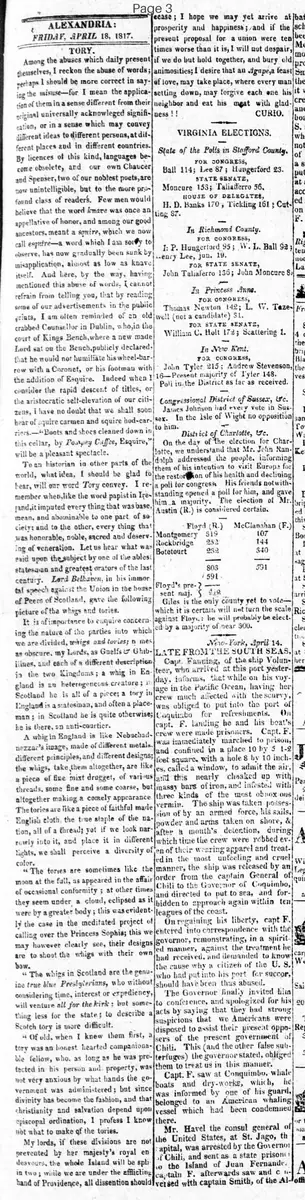
ALEXANDRIA:
FRIDAY, APRIL 18, 1817.
TORY.
Among the abuses which daily present themselves, I reckon the abuse of words; perhaps I should be more correct in saying the misuse—for I mean the application of them in a sense different from their original universally acknowledged signification, or in a sense which may convey different ideas to different persons, at different places and in different countries. By licences of this kind, languages become obsolete, and our own Chaucer and Spenser, two of our noblest poets, are now unintelligible, but to the more profound class of readers. Few men would believe that the word knave was once an appellative of honor, and among our good ancestors, meant a squire, which we now call esquire—a word which I am sorry to observe, has now gradually been sunk by misapplication, almost as low as knave itself. And here, by the way, having mentioned this abuse of words, I cannot refrain from telling you, that by reading some of our advertisements in the public prints, I am often reminded of an old crabbed Counsellor in Dublin, who, in the court of Kings Bench, where a new made Lord sat on the Bench, publicly declared that he would not humiliate his wheel-barrow with a Coronet, or his footman with the addition of Esquire. Indeed when I consider the rapid descent of titles, or the aristocratic self-elevation of our citizens, I have no doubt that we shall soon hear of squire carmen and squire hod-carriers.—"Boots and shoes cleaned down in this cellar, by Poupey Cuffee, Esquire," will be a pleasant spectacle.
To an historian in other parts of the world, what idea, I should be glad to know, will our word Tory convey. I remember when, like the word papist in Ireland, it imputed every thing that was base, mean, and abominable to one part of society; and to the other, every thing that was honorable, noble, sacred and deserving of veneration. Let us hear what was said upon the subject by one of the ablest statesman and greatest orators of the last century. Lord Belhaven, in his immortal speech against the Union in the house of Peers of Scotland, gave the following picture of the whigs and tories.
It is of importance to enquire concerning the nature of the parties into which we are divided, whigs and tories; names as obscure, my Lords, as Guelfs and Ghibilines, and each of a different description in the two Kingdoms; a whig in England is an heterogeneous creature; in Scotland he is all of a piece; a tory in England is a statesman, and often a placeman; in Scotland he is quite otherwise: he is there, an anti-courtier.
A whig in England is like Nebuchadnezzar's image, made of different metals, different principles, and different designs; the whigs, take them altogether, are like a piece of fine mixt drugget, of various threads, some fine and some coarse, but altogether making a comely appearance. The tories are like a piece of faithful made English cloth, the true staple of the nation, all of a thread; yet if we look narrowly into it, and place it in different lights, we shall perceive a diversity of color.
"The tories are sometimes like the moon at the full, as appeared in the affair of occasional conformity; at other times they seem under a cloud, eclipsed as it were by a greater body; this was evident in the case in the meditated project of calling over the Princess Sophia; this we may however clearly see, their designs are to shoot the whigs with their own bow.
"The whigs in Scotland are the genuine true blue Presbyterians, who without considering time, interest or expediency, will venture all for the kirk; but something less for the state; to describe a Scotch tory is more difficult.
"Of old, when I knew them first, a tory was an honest hearted companionable fellow, who, as long as he was protected in his person and property, was not very anxious by what hands the government was administered; but since divinity has become the fashion, and that christianity and salvation depend upon episcopal ordination, I profess I know not what to make of the tories.
My Lords, if these divisions are not prevented by her majesty's royal endeavours, the whole Island will be split in two; while we are under the afflicting hand of Providence, all dissention should cease; I hope we may yet arrive at prosperity and happiness;—and if the present proposal for a union were ten times worse than it is, I will not despair, if we do but hold together, and bury old animosities; I desire that an Jigape, a feast of love, may take place, where every man setting down, may forgive each one his neighbor and eat his meat with gladness!!
CURIO.
FRIDAY, APRIL 18, 1817.
TORY.
Among the abuses which daily present themselves, I reckon the abuse of words; perhaps I should be more correct in saying the misuse—for I mean the application of them in a sense different from their original universally acknowledged signification, or in a sense which may convey different ideas to different persons, at different places and in different countries. By licences of this kind, languages become obsolete, and our own Chaucer and Spenser, two of our noblest poets, are now unintelligible, but to the more profound class of readers. Few men would believe that the word knave was once an appellative of honor, and among our good ancestors, meant a squire, which we now call esquire—a word which I am sorry to observe, has now gradually been sunk by misapplication, almost as low as knave itself. And here, by the way, having mentioned this abuse of words, I cannot refrain from telling you, that by reading some of our advertisements in the public prints, I am often reminded of an old crabbed Counsellor in Dublin, who, in the court of Kings Bench, where a new made Lord sat on the Bench, publicly declared that he would not humiliate his wheel-barrow with a Coronet, or his footman with the addition of Esquire. Indeed when I consider the rapid descent of titles, or the aristocratic self-elevation of our citizens, I have no doubt that we shall soon hear of squire carmen and squire hod-carriers.—"Boots and shoes cleaned down in this cellar, by Poupey Cuffee, Esquire," will be a pleasant spectacle.
To an historian in other parts of the world, what idea, I should be glad to know, will our word Tory convey. I remember when, like the word papist in Ireland, it imputed every thing that was base, mean, and abominable to one part of society; and to the other, every thing that was honorable, noble, sacred and deserving of veneration. Let us hear what was said upon the subject by one of the ablest statesman and greatest orators of the last century. Lord Belhaven, in his immortal speech against the Union in the house of Peers of Scotland, gave the following picture of the whigs and tories.
It is of importance to enquire concerning the nature of the parties into which we are divided, whigs and tories; names as obscure, my Lords, as Guelfs and Ghibilines, and each of a different description in the two Kingdoms; a whig in England is an heterogeneous creature; in Scotland he is all of a piece; a tory in England is a statesman, and often a placeman; in Scotland he is quite otherwise: he is there, an anti-courtier.
A whig in England is like Nebuchadnezzar's image, made of different metals, different principles, and different designs; the whigs, take them altogether, are like a piece of fine mixt drugget, of various threads, some fine and some coarse, but altogether making a comely appearance. The tories are like a piece of faithful made English cloth, the true staple of the nation, all of a thread; yet if we look narrowly into it, and place it in different lights, we shall perceive a diversity of color.
"The tories are sometimes like the moon at the full, as appeared in the affair of occasional conformity; at other times they seem under a cloud, eclipsed as it were by a greater body; this was evident in the case in the meditated project of calling over the Princess Sophia; this we may however clearly see, their designs are to shoot the whigs with their own bow.
"The whigs in Scotland are the genuine true blue Presbyterians, who without considering time, interest or expediency, will venture all for the kirk; but something less for the state; to describe a Scotch tory is more difficult.
"Of old, when I knew them first, a tory was an honest hearted companionable fellow, who, as long as he was protected in his person and property, was not very anxious by what hands the government was administered; but since divinity has become the fashion, and that christianity and salvation depend upon episcopal ordination, I profess I know not what to make of the tories.
My Lords, if these divisions are not prevented by her majesty's royal endeavours, the whole Island will be split in two; while we are under the afflicting hand of Providence, all dissention should cease; I hope we may yet arrive at prosperity and happiness;—and if the present proposal for a union were ten times worse than it is, I will not despair, if we do but hold together, and bury old animosities; I desire that an Jigape, a feast of love, may take place, where every man setting down, may forgive each one his neighbor and eat his meat with gladness!!
CURIO.
What sub-type of article is it?
Partisan Politics
What keywords are associated?
Tory
Whig
Abuse Of Words
Political Parties
Lord Belhaven
Union Scotland
Party Divisions
What entities or persons were involved?
Lord Belhaven
Whigs
Tories
Chaucer
Spenser
Editorial Details
Primary Topic
Misuse Of The Word Tory And Historical Party Divisions
Stance / Tone
Reflective Critique Calling For Unity
Key Figures
Lord Belhaven
Whigs
Tories
Chaucer
Spenser
Key Arguments
Words Change Meaning Over Time, Leading To Obsolescence Of Language
Example Of 'Knave' Originally Meaning Squire, Now Derogatory
Misuse Of Titles Like 'Esquire' Degrading Social Distinctions
'Tory' Conveys Different Ideas Historically In England And Scotland
Quote From Lord Belhaven On Whigs And Tories As Obscure And Varying By Kingdom
Whigs In England Heterogeneous, Tories More Uniform
Scottish Whigs As True Presbyterians, Tories As Anti Courtier
Political Divisions Threaten Unity; Call To Bury Animosities