Thank you for visiting SNEWPapers!
Sign up free
The Daily Alaska Empire
Juneau, Juneau County, Alaska
What is this article about?
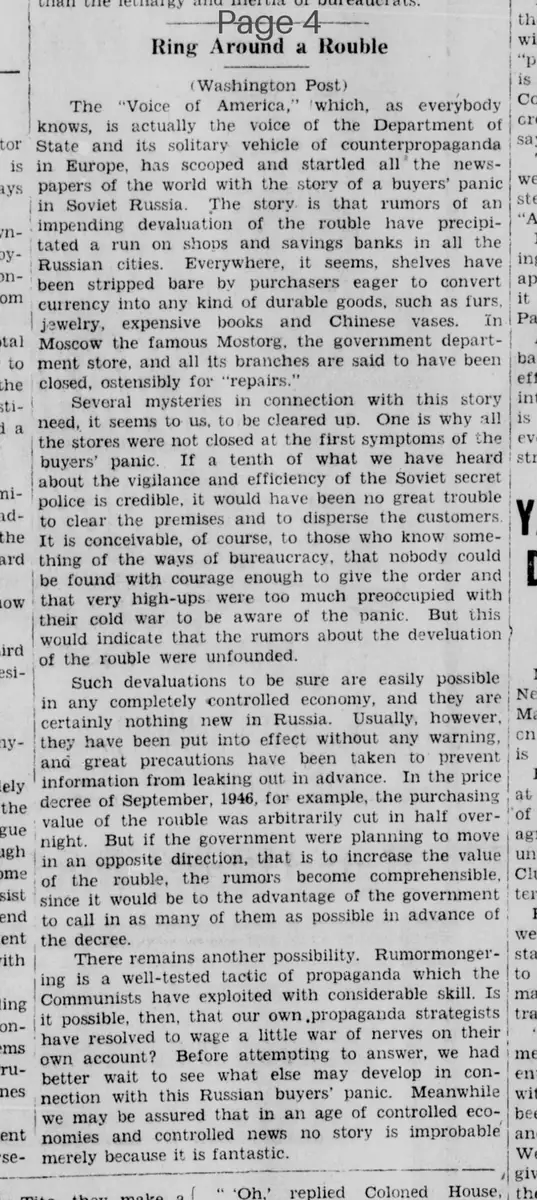
Voice of America reports buyers' panic in Soviet Russia from rumors of impending rouble devaluation, causing runs on shops and banks to buy durable goods; Moscow's Mostorg closed for 'repairs.' Article questions if rumors are real or U.S. propaganda tactic.
Clipping
OCR Quality
Full Text
(Washington Post)
The "Voice of America," which, as everybody
knows, is actually the voice of the Department of
State and its solitary vehicle of counterpropaganda
in Europe, has scooped and startled all the news-
papers of the world with the story of a buyers' panic
in Soviet Russia. The story is that rumors of an
impending devaluation of the rouble have precipi-
tated a run on shops and savings banks in all the
Russian cities. Everywhere, it seems, shelves have
been stripped bare by purchasers eager to convert
currency into any kind of durable goods, such as furs.
jewelry, expensive books and Chinese vases. In
Moscow the famous Mostorg, the government depart-
ment store, and all its branches are said to have been
closed, ostensibly for "repairs."
Several mysteries in connection with this story
need, it seems to us, to be cleared up. One is why all
the stores were not closed at the first symptoms of the
buyers' panic. If a tenth of what we have heard
about the vigilance and efficiency of the Soviet secret
police is credible, it would have been no great trouble
to clear the premises and to disperse the customers.
It is conceivable, of course, to those who know some-
thing of the ways of bureaucracy, that nobody could
be found with courage enough to give the order and
that very high-ups were too much preoccupied with
their cold war to be aware of the panic. But this
would indicate that the rumors about the devaluation
of the rouble were unfounded.
Such devaluations to be sure are easily possible
in any completely controlled economy, and they are
certainly nothing new in Russia. Usually, however,
they have been put into effect without any warning,
and great precautions have been taken to prevent
information from leaking out in advance. In the price
decree of September, 1946, for example, the purchasing
value of the rouble was arbitrarily cut in half over-
night. But if the government were planning to move
in an opposite direction, that is to increase the value
of the rouble, the rumors become comprehensible,
since it would be to the advantage of the government
to call in as many of them as possible in advance of
the decree.
There remains another possibility. Rumormonger-
ing is a well-tested tactic of propaganda which the
Communists have exploited with considerable skill. Is
it possible, then, that our own propaganda strategists
have resolved to wage a little war of nerves on their
own account? Before attempting to answer, we had
better wait to see what else may develop in con-
nection with this Russian buyers' panic. Meanwhile
we may be assured that in an age of controlled eco-
nomies and controlled news no story is improbable
merely because it is fantastic.
What sub-type of article is it?
What keywords are associated?
Where did it happen?
Foreign News Details
Primary Location
Soviet Russia
Outcome
shelves stripped bare; mostorg and branches closed for 'repairs'; potential devaluation or revaluation of rouble.
Event Details
Rumors of impending devaluation of the rouble precipitated a buyers' panic in all Russian cities, with runs on shops and savings banks. Purchasers converted currency into durable goods like furs, jewelry, expensive books, and Chinese vases. In Moscow, the government department store Mostorg and its branches closed ostensibly for repairs.