Thank you for visiting SNEWPapers!
Sign up free
Palladium Of Virginia And The Pacific Monitor
Lewisburg, Greenbrier County, West Virginia
What is this article about?
An anonymous constituent addresses Virginia legislators, quoting Patrick Henry's criticism of sheriffs as extortionate, and urges action against their practice of claiming double commissions on executions, which defrauds the public and boosts revenue when curbed.
Clipping
OCR Quality
Full Text
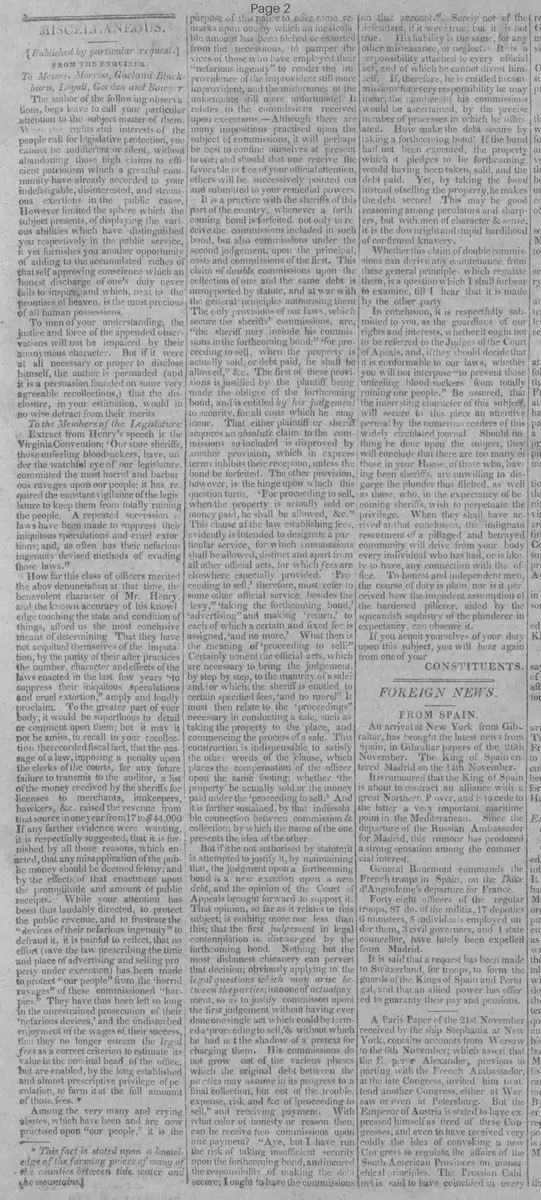
[Published by particular request.]
FROM THE ENQUIRER.
To Messrs. Morriss, Garland, Blackburn, Loyall, Gordon and Bowyer
The author of the following observations, begs leave to call your particular attention to the subject matter of them.
When the rights and interests of the people call for legislative protection, you cannot be indifferent or silent, without abandoning those high claims to efficient patriotism which a grateful community have already accorded to your indefatigable, disinterested, and strenuous exertions in the public cause.
However limited the sphere which the subject presents, of displaying the various abilities which have distinguished you respectively in the public service, it yet furnishes you another opportunity of adding to the accumulated riches of that self approving conscience which an honest discharge of one's duty never fails to inspire, and which, next to the promises of heaven, is the most precious of all human possessions.
To men of your understanding, the justice and force of the appended observations will not be impaired by their anonymous character. But if it were at all necessary or proper to disclose himself, the author is persuaded (and it is a persuasion founded on some very agreeable recollections,) that the disclosure, in your estimation, would in no wise detract from their merits
To the Members of the Legislature:
Extract from Henry's speech in the Virginia Convention: 'Our state sheriffs, those unfeeling bloodsuckers, have, under the watchful eye of our legislature, committed the most horrid and barbarous ravages upon our people: it has required the constant vigilance of the legislature to keep them from totally ruining the people. A repeated succession of laws have been made to suppress their iniquitous speculations and cruel extortions: and, as often has their nefarious ingenuity devised methods of evading those laws.'
How far this class of officers merited the above denunciation at that time, the benevolent character of Mr. Henry, and the known accuracy of his knowledge touching the state and condition of things, afford us the most conclusive means of determining That they have not acquitted themselves of the imputation, by the purity of their after practices the number, character and effects of the laws enacted in the last few years 'to suppress their iniquitous speculations and cruel extortion,' amply and loudly proclaim. To the greater part of your body, it would be superfluous to detail or comment upon them; but it may not be amiss, to recall to your recollection the recorded fiscal fact, that the passage of a law, imposing a penalty upon the clerks of the courts, for any future failure to transmit to the auditor, a list of the money received by the sheriffs for licenses to merchants, innkeepers, hawkers, &c. raised the revenue from that source in one year from $17 to $44,000
If any farther evidence were wanting, it is respectfully suggested, that it is furnished by all those reasons, which enacted, that any misapplication of the public money should be deemed felony; and by the effects of that enactment upon the promptitude and amount of public receipts. While your attention has been thus laudably directed, to protect the public revenue, and to frustrate the 'devices of their nefarious ingenuity' to defraud it, it is painful to reflect, that no effort (save the law prescribing the time and place of advertising and selling property under execution) has been made to protect 'our people' from the horrid 'ravages' of these commissioned 'harpies.' They have thus been left so long in the unrestrained prosecution of their nefarious devices, and the undisturbed enjoyment of the wages of their success, that they no longer esteem the legal Fees as a correct criterion to estimate its value to the nominal head of the office; but are enabled, by the long established and almost prescriptive privilege of peculation, to farm it at the full amount of those fees. *
Among the very many and crying abuses, which have been and are now practised upon 'our people,' it is the purpose of this paper to offer some remarks upon one by which an incalculable amount has been filched or extorted from the necessitous, to pamper the vices of those who have employed their 'nefarious ingenuity' to render the im providence of the improvident still more improvident, and the misfortunes of the unfortunate still more unfortunate! It relates to the commissions received upon executions. Although there are many impositions practised upon the subject of commissions, it will perhaps be best to confine ourselves at present to one and should that one receive the favorable notice of your official attention, others will be successively pointed out and submitted to your remedial powers.
It is a practice with the sheriffs of this part of the country, whenever a forthcoming bond is forfeited, not only to receive the commissions included in such bond, but also commissions under the second judgement, upon the principal, costs and commissions of the first. This claim of double commissions upon the collection of one and the same debt is unsupported by statute, and at war with the general principles authorising them The only provisions of our laws, which secure the sheriffs' commissions, are, 'the sheriff may include his commissions in the forthcoming bond:' for proceeding to sell, when the property is actually sold, or debt paid, he shall be allowed,' &c. The first of these provisions is justified by the plaintiff being made the obligee of the forthcoming bond, and is entitled by his judgement to security, for all costs which he may incur. 'That either plaintiff or sheriff acquires an absolute claim to the commissions so included is disproved by another provision, which in express terms inhibits their reception, unless the bond be forfeited. The other provision, however, is the hinge upon which this question turns. For proceeding to sell, when the property is actually sold or money paid, he shall be allowed, &c.'
This clause of the law establishing fees, evidently is intended to designate a particular service, for which commissions shall be allowed, distinct and apart from all other official acts, for which fees are elsewhere especially provided. Proceeding to sell,' therefore, must refer to some other official service besides the levy, taking the forthcoming bond, advertising' and making 'return,' to each of which a certain and fixed fee is assigned, 'and no more.' What then is the meaning of proceeding to sell?'
Certainly none of the official acts, which are necessary to bring the judgement, by step by step, to the maturity of a sale? and for which the sheriff is entitled to certain specified fees, 'and no more!' It must then relate to the proceedings' necessary in conducting a sale; such as taking the property to the place, and commencing the process of a sale. This construction is indispensable to satisfy the other words of the clause, which places the compensation of the officer upon the same footing; whether the property be actually sold or the money paid under the 'proceeding to sell.' And it is further sustained, by that indissoluble connection between commission & collection; by which the name of the one presents the idea of the other
But if it be not authorised by statute; it is attempted to justify it, by maintaining that, the judgment upon a forthcoming bond is a new execution upon a new debt, and the opinion of the Court of Appeals brought forward to support it. That opinion, so far as it relates to this subject; is nothing more nor less than this; that the first judgement in legal contemplation is, discharged by the forthcoming bond. Nothing but the most dishonest chicanery can pervert that decision; obviously applying to the legal questions which may arise between the parties; into one of actual payment, so as to justify commission upon the first judgement without having ever done one single act which could be termed a 'proceeding to sell,' & without which he had not the shadow of a pretext for charging them. His commissions do not grow out of the various phases which the original debt between the parties may assume in its progress to a final collection, but out of the trouble, expense, risk and &c of proceeding to sell,' and receiving payment. With what color of honesty or reason then, can he receive two commissions upon one payment? 'Aye, but I have run the risk of taking insufficient security upon the forthcoming bond, and incurred the responsibility of making the debt secure; I ought to have the commissions on that account.' Surely not of the defendant, if it were true; but it is not true. His liability is the same, for any other misfeasance, or neglect. It is a responsibility attached to every official act, and of which he cannot divest himself, If, therefore, he is entitled to commissions for every responsibility he may incur, the number of his commissions would be ascertained, by the precise number of processes in which he officiated. How make the debt secure by taking a forthcoming bond! If the bond had not been executed, the property which it pledges to be forthcoming would having been taken, sold, and the debt paid. Yet, by taking the bond instead of selling the property, he makes the debt secure! This may be good reasoning among peculators and sharp ers, but with men of character & sense, it is the downright and stupid hardihood of confirmed knavery.
Whether this claim of double commissions can derive any countenance from these general principle which regulate them, is a question which I shall forbear to examine, till I hear that it is made by the other party.
In conclusion, it is respectfully submitted to you, as the guardians of our rights and interests, whether it ought not to be referred to the Judges of the Court of Appeals, and, if they should decide that it is conformable to our laws, whether you will not interpose 'to prevent those unfeeling blood suckers from totally ruining our people.' Be assured, that the interesting character of this subject, will secure to this piece an attentive perusal by the numerous readers of this widely circulated journal Should nothing be done upon the subject, they will conclude that there are too many of those in your House, of those who, having been sheriffs, are unwilling to disgorge the plunder thus filched, as well as those, who, in the expectancy of becoming sheriffs, wish to perpetuate the privilege. When they shall have arrived at that conclusion, the indignant resentment of a pillaged and betrayed community will drive from your body every individual who has had, or is likely to have, any connection with the office. To honest and independent men, the course of duty is plain, nor is it perceived how the impudent assumption of the hardened pilferer, aided by the squeamish sophistry of the plunderer in expectancy, can obscure it.
If you acquit yourselves of your duty upon this subject, you will hear again from one of your
CONSTITUENTS.
* This fact is stated upon a knowledge of the farming prices of many of the counties between tide water and the mountains
What sub-type of article is it?
What themes does it cover?
What keywords are associated?
What entities or persons were involved?
Letter to Editor Details
Author
Constituents
Recipient
Messrs. Morriss, Garland, Blackburn, Loyall, Gordon And Bowyer; To The Members Of The Legislature
Main Argument
sheriffs unlawfully claim double commissions on executions when forthcoming bonds are forfeited, defrauding the public; the legislature must investigate and enact laws to prevent this extortion, as urged by historical precedent from patrick henry's speech.
Notable Details