Thank you for visiting SNEWPapers!
Sign up free
Norfolk Gazette And Publick Ledger
Norfolk, Virginia
What is this article about?
On April 10, 1813, American forces under Gen. Wilkinson peacefully occupied Mobile, raising the U.S. flag at Fort Charlotte. The Spanish garrison, low on supplies, departed for Pensacola but returned for provisions. Judge Toulmin was selected to represent the town. Concerns arise over potential Spanish-Indian hostilities against U.S. settlements.
Clipping
OCR Quality
Full Text
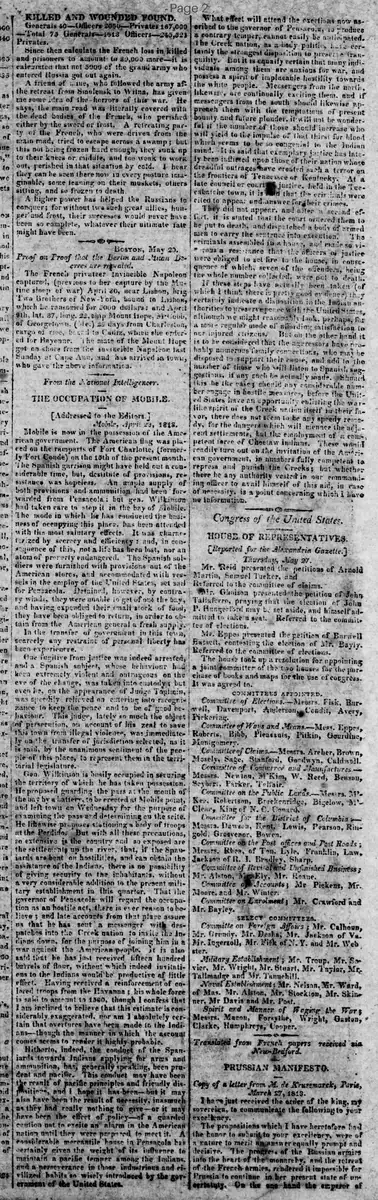
THE OCCUPATION OF MOBILE.
[Addressed to the Editors.]
Mobile, April 23, 1813.
Mobile is now in the possession of the American government. The American flag was placed on the ramparts of Fort Charlotte, (formerly Fort Conde) on the 10th of the present month. The Spanish garrison might have held out a considerable time, but, destitute of provisions, resistance was hopeless. An ample supply of both provisions and ammunition had been forwarded from Pensacola: but gen. Wilkinson had taken care to stop it in the bay of Mobile. The mode in which he has conducted the business of occupying this place, has been attended with the most salutary effects. It was characterized by secrecy and efficiency: and, in consequence of this, not a life has been lost, nor an atom of property endangered. The Spanish soldiers were furnished with provisions out of the American stores, and accommodated with vessels in the employ of the United States, set sail for Pensacola. Detained, however, by contrary winds, they were unable to get out of the bay, and having expended their small stock of food, they have been obliged to return, in order to obtain from the American general a fresh supply.
In the transfer of government in this town, scarcely any restraint of personal liberty has been experienced. One fugitive from justice was indeed arrested, and a Spanish subject, whose behaviour had been extremely violent and outrageous on the eve of the change, was taken into custody: but even he, on the appearance of Judge Toulmin, was speedily relieved on entering into recognizance to keep the peace and to be of good behaviour. This judge, lately so much the object of persecution, on account of his zeal to save this town from illegal violence, was immediately on the transfer of jurisdiction selected, as it is said, by the unanimous sentiment of the people of this place, to represent them in the territorial legislature.
Gen. Wilkinson is busily occupied in securing the territory of which he has taken possession. He proposes guarding the pass at the mouth of the bay by a battery, to be erected at Mobile Point, and left town on Wednesday for the purpose of examining the pass and determining on the site. He likewise proposes stationing a body of troops at the Perdido. But with all these precautions, so extensive is the country and so exposed are the settlements on the river, that, if the Spaniards are bent on hostilities, and can obtain the assistance of the Indians, there is no possibility of giving security to the inhabitants, without a very considerable addition to the present military establishment in this quarter. That the governor of Pensacola will regard the occupation as an hostile act, there is every reason to believe; and late accounts from that place assure us that he has sent a messenger with despatches into the Creek nation to invite the Indians down, for the purpose of joining him in a war against the American people. It is also said that he has just received fifteen hundred barrels of flour, without which indeed invitations to the Indians would be productive of little effect. Having received a reinforcement of colored troops from the Havana; his whole force is said to amount to 1,500, though I confess that I am inclined to believe that this estimate is considerably exaggerated. Nor am I absolutely certain that overtures have been made to the Indians--though the manner in which the account comes seems to render it highly probable.
Hitherto, indeed, the conduct of the Spaniards towards Indians applying for arms and ammunition, has generally speaking, been prudent and pacific. This conduct may have been the result of pacific principles and friendly dispositions, and I hope it has been--but it may also have been the result of necessity, inasmuch as they had really nothing to give--or it may have been the effect of policy--of a guarded caution not to excite an alarm in the American nation until they were prepared to meet it. A considerable mercantile house in Pensacola has certainly given the weight of its influence to maintain a pacific temper among the Indians, and a perseverance in those industrious and civilized habits so wisely introduced by the government of the United States.
What effect will attend the exertions now ascribed to the governor of Pensacola, to produce a contrary temper, cannot easily be anticipated. The Creek nation, as a body politic, less certainly the strongest disposition to preserve tranquility. But it is equally certain that many individuals among them are anxious for war, and possess a spirit of implacable hostility towards the white people. Messengers from the north, likewise, are continually exciting them, and if messengers from the south should likewise approach them with the temptations of present bounty and future plunder, it will not be wonderful if the number of those should increase who will yield to the impulse of that thirst for blood which seems to be so congenial to the Indian mind. It is said that exemplary justice has lately been inflicted upon those of their nation whose dreadful outrages have created such a terror on the frontiers of Tennessee or Kentucky. At a late council or court of justice, held in the Tuckabatchee town, it is said that the criminals were cited to appear and answer for their crimes. They did not appear, and after a second effort, it is stated that the court ordered them to be put to death, and dispatched a body of armed men to carry the sentence into execution. The criminals assembled in a house, and made so violent a resistance that the officers of justice were obliged to set fire to the house, in consequence of which, seven of the offenders, being the whole number collected, were put to death.
If these steps have actually been taken (of which I think there is pretty good evidence) they certainly indicate a disposition in the Indian authorities to preserve peace with the United States, although one might reasonably look, perhaps, for a more regular mode of affording satisfaction to our injured citizens. But on the other hand it is to be considered that the aggressors have probably numerous family connections, who may be disposed to support their cause, and add to the number of those who will listen to Spanish suggestions, if any such be actually made. Should this be the case; should any considerable number engage in hostile measures, before the United States have an opportunity enlisting the warlike spirit of the Creek nation itself in their favor, there does not seem to be any speedy remedy, for the dangers which will menace the adjacent settlements, but the employment of a competent force of Choctaw Indians. These would readily turn out on the invitation of the American government, in numbers fully competent to repress and punish the Creeks; but whether there be any authority vested in our commanding officer to avail himself of this aid, in case of necessity, is a point concerning which I have no information.
What sub-type of article is it?
What keywords are associated?
What entities or persons were involved?
Where did it happen?
Domestic News Details
Primary Location
Mobile
Event Date
April 10, 1813
Key Persons
Outcome
no lives lost in occupation; spanish garrison departed peacefully but returned for provisions; one fugitive arrested; violent spanish subject released on recognizance; seven creek criminals executed by their own authorities.
Event Details
American forces under Gen. Wilkinson occupied Mobile on April 10, 1813, raising the flag at Fort Charlotte without resistance due to Spanish supply shortages intercepted by Wilkinson. Transfer was peaceful with minimal restraints; Judge Toulmin selected for legislature. Wilkinson plans fortifications at Mobile Point and Perdido. Concerns over Spanish governor inviting Creek Indians to war, though past Spanish conduct pacific; recent Creek justice against outlaws indicates peace efforts, but risks of hostilities persist, suggesting need for Choctaw aid.