Thank you for visiting SNEWPapers!
Sign up free
Gazette Of The United States, & Philadelphia Daily Advertiser
Philadelphia, Philadelphia County, Pennsylvania
What is this article about?
On April 11, the U.S. House of Representatives debated a bill for fortifying coastal defenses. Members discussed appropriations, the state of existing fortifications, and specific needs like North Carolina's coast. The motion to discharge the committee was negatived, and the bill passed with a $250,000 appropriation, granting the President discretion on locations.
Merged-components note: Parts of the same congressional debate, vote, and yeas/nays tables on fortifications bill.
Clipping
OCR Quality
Full Text
HOUSE OF REPRESENTATIVES.
WEDNESDAY, April 11.
(Concluded from yesterday's Gazette.)
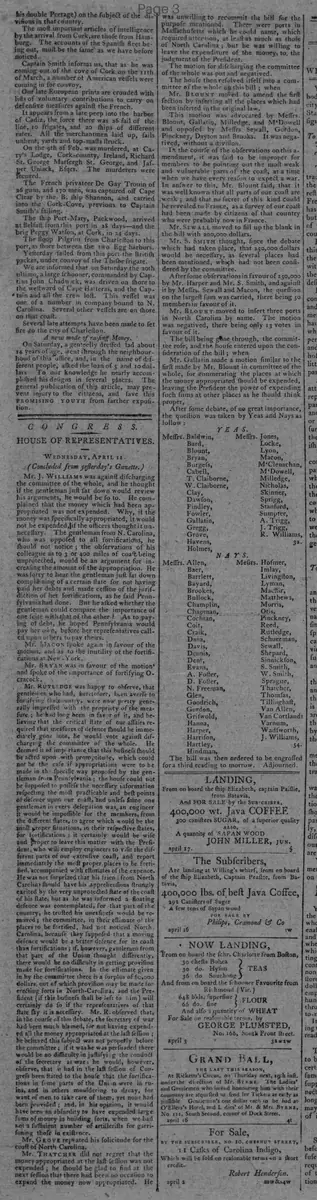
Mr. J. Williams was against discharging the committee of the whole, and he thought if the gentleman just sat down would review his arguments, he would be so too. He complained that the money which had been appropriated was not expended. Why, if the money was specifically appropriated, it would not be expended, if the officers thought it unnecessary. The gentleman from N. Carolina, who was opposed to all fortifications, he should not notice; the observations of his colleague as to 3 or 400 miles of coast being unprotected, would be an argument for increasing the amount of the appropriation. He was sorry to hear the gentleman just sat down complaining of a certain state or not having paid her debts and made cession of the jurisdiction of her fortifications, as he said Pennsylvania had done. But he asked whether the gentleman could compare the importance of one city with that of the other? As to paying off debt, he hoped Pennsylvania would pay her own, before her representatives called upon others to pay theirs.
Mr. Macon spoke again in favour of the motion, and as to the inutility of the fortifications at New-York.
Mr. Bryan was in favour of the motion and spoke of the importance of fortifying Ocracoke.
Mr. Rutledge was happy to observe, that gentlemen who had, heretofore, been averse to fortifying this country, were now pretty generally impressed with the propriety of the measure; he had long been in favor of it, and believing that the critical state of our affairs required that measures of defence should be immediately gone into, he would vote against discharging the committee of the whole. He deemed it of importance that this business should be acted upon with promptitude, which could not be the case if appropriations were to be made in the specific way proposed by the gentleman from Pennsylvania; the house could not be supposed to possess the necessary information respecting the most practicable and best points of defence upon our coast, and unless some one gentleman in every delegation was an engineer it would be impossible for the members, from the different states, to agree which would be the most proper situations, in their respective states, for fortifications: it certainly would be wise and proper to leave this matter with the President, who will employ engineers to visit the different parts of our extensive coast, and report immediately the most proper places to be fortified, accompanied with estimates of the expense. He was not surprised that his friend from North Carolina should have his apprehensions strongly excited by the very unprotected state of the coast of his state, but as he was informed a floating defence was contemplated, for that part of the country, he trusted his uneasiness would be removed; the committee, in their estimate of the places to be fortified, had not noticed North Carolina, because they supposed that a moving defence would be a better defence for its coast than fortifications; if, however, gentlemen from that part of the Union thought differently, there would be no difficulty in getting provision made for fortifications. In the estimate given in by the committee there is a surplus of 80,000 dollars, out of which provision may be made for erecting forts in North-Carolina, and the President (if this business shall be left to him) will certainly do so if the representatives of that state say it is necessary. Mr. R. observed that, in the course of this debate, the secretary of war had been much blamed, for not having expended all the money appropriated at the last session; he believed this subject was not properly before the committee: if it was he was persuaded there would be no difficulty in justifying the conduct of the secretary at war: he would, however, observe, that it had in the last session of Congress been stated to the house that the fortifications in some parts of the Union were in ruins, and in others mouldering to decay, for want of men to take care of them, yet none had been provided; and, in his opinion, it would have been an absurdity to have expended large sums of money in building forts, when we had not a sufficient number of artillerists for garrisoning those in existence,
Mr. Grove repeated his solicitude for the coast of North Carolina.
Mr. Thatcher did not regret that the money appropriated at the last session was not expended; he should be glad to find at the next session that there had been no occasion to expend the money now appropriated. He
was unwilling to recommit the bill for the purpose mentioned. There were ports in Massachusetts which he could name, which required attention, at least as much as those of North Carolina; but he was willing to leave the expenditure of the money to the judgment of the President.
The motion for discharging the committee of the whole was put and negatived.
The house then resolved itself into a committee of the whole on this bill; when Mr. Blount moved to amend the first section by inserting all the places which had been inserted in the original law.
This motion was advocated by Messrs. Blount, Gallatin, Milledge, and M'Dowell and opposed by Messrs Sewall, Gordon, Pinckney, Dayton and Brooks. It was negatived, without a division.
In the course of the observations on this amendment, it was said to be improper for members to be pointing out the most weak and vulnerable parts of the coast, at a time when we have every reason to expect a war.
In answer to this, Mr. Blount said, that it was well known that all parts of our coast are weak; and that no secret of this kind could be revealed to France, as a survey of our coast had been made by citizens of that country who were probably now in France.
Mr. Sewall moved to fill up the blank in the bill with 200,000 dollars.
Mr. S. Smith thought, since the debate which had taken place, that 250,000 dollars would be necessary. as several places had been mentioned, which had not been considered by the committee.
After some observations in favour of 250,000 by Mr. Harper and Mr. S. Smith, and against it by Messrs. Sewall and Macon, the question on the largest sum was carried, there being 50 members in favour of it.
Mr. Blount moved to insert three ports in North Carolina by name. The motion was negatived, there being only 13 votes in favour of it.
The bill being gone through, the committee rose, and the house entered upon the consideration of the bill: when Mr. Gallatin made a motion similar to the first made by Mr. Blount in committee of the whole, for enumerating the places at which the money appropriated should be expended, leaving the President the power of expending such sums at other places as he should think proper,
After some debate, of no great importance, the question was taken by Yeas and Nays as follow:
YEAS
The bill was then ordered to be engrossed for a third reading to morrow. Adjourned.
| Meifrs. Baldwin, Bard, Blount, Bryan, Burges, Cabeil, T. Claiborne, W. Claiborne, Clay, Dawfon, Findley, Fowler, Gallatin, Gregg, Grove, Havens, Holmes. | Meifrs. Jones, Locke, Lyon, Macon, M'Clenachan, M'Dowell, Milledge, Nicholas, Skinner, Sprigg, Stanford, Sumpter, A. Trigg, J. Trigg, R. Williams, |
| Melfrs. Allen, | Mefirs. Hofmer, |
| Baer, | Imlay, |
| Bartlett, | Livingfton, |
| Bayard, | Lyman, |
| Brookes, | MacAir, |
| Bullock, | Matthews, |
| Champlin, | Morris, |
| Chapman, | Otis, |
| Cochran, | Pinckney, |
| Coit, | Reed, |
| Craik, | Rutledge, |
| Dana, | Schureman, |
| Davis, | Sewall, |
| Dennis, | Shepard, |
| Dent, | Sinnickfon, |
| Evans, | S. Smith, |
| A. Fofter, | W. Smith, |
| D. Fofter, | Sprague, |
| N. Freeman, | Tharcher, |
| Glen, | Thomfas, |
| Goodrich, | Tillinghaft, |
| Gordon, | Van Allen, |
| Grifwold, | Van Cortlandt |
| Hanna, | Varnum, |
| Harper, | Wadsworth, |
| Harrifon, | J. Williams, |
| Hartley, | 54 |
| Hindman, |
What sub-type of article is it?
What keywords are associated?
What entities or persons were involved?
Domestic News Details
Event Date
Wednesday, April 11
Key Persons
Outcome
motion to discharge committee negatived; amendment to specify locations negatived; bill passed with $250,000 appropriation, yeas 54 (incomplete list), leaving discretion to president; ordered engrossed for third reading.
Event Details
Debate in House of Representatives on bill for coastal fortifications. Speakers argued for and against specific appropriations vs. presidential discretion, unexpended prior funds, needs of North Carolina and other states' coasts, and amount of appropriation. Motions to specify locations and lower amount failed; $250,000 approved without naming sites.