Thank you for visiting SNEWPapers!
Sign up free
Story
December 5, 1807
Alexandria Daily Advertiser
Alexandria, Virginia
What is this article about?
Transcript from the Richmond Examiner of proceedings in Colonel Aaron Burr's trial on October 7, 1807, detailing witness examinations by Messrs. Wickham, Cabell, and others on General Wilkinson's testimony, a ciphered letter, and variances with Mr. Swartwout's account before the grand jury and court.
Clipping
OCR Quality
95%
Excellent
Full Text
FROM THE RICHMOND EXAMINER
TRIAL
OF
COLONEL A. BURR
MOTION FOR COMMITMENT
EXAMINATION OF EVIDENCE
WEDNESDAY, October 7
(Mr. Cabell's evidence concluded.)
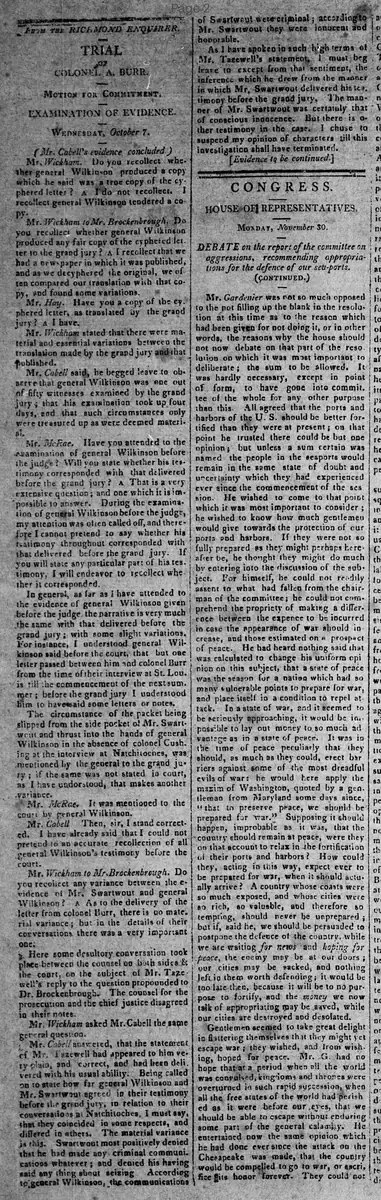
Mr. Wickham. Do you recollect whether general Wilkinson produced a copy which he said was a true copy of the ciphered letter? A. I do not recollect. I recollect general Wilkinson tendered a copy—
Mr. Wickham to Mr. Brockenbrough. Do you recollect whether general Wilkinson produced any fair copy of the ciphered letter to the grand jury? A. I recollect that we had a newspaper in which it was published; and as we deciphered the original, we often compared our translation with that copy, and found some variations.
Mr. Hay. Have you a copy of the ciphered letter, as translated by the grand jury? A. I have.
Mr. Wickham stated that there were material and essential variations between the translation made by the grand jury and that published.
Mr. Cabell said, he begged leave to observe that general Wilkinson was one out of fifty witnesses examined by the grand jury; that his examination took up four days, and that such circumstances only were treasured up as were deemed material.
Mr. McRae. Have you attended to the examination of general Wilkinson before the judge? Will you state whether his testimony corresponded with that delivered before the grand jury? A. That is a very extensive question; and one which it is impossible to answer. During the examination of general Wilkinson before the judge my attention was often called off, and therefore I cannot pretend to say whether his testimony throughout corresponded with that delivered before the grand jury. If you will state any particular part of his testimony, I will endeavor to recollect whether it corresponded.
In general, as far as I have attended to the evidence of general Wilkinson given before the judge, the narrative is very much the same with that delivered before the grand jury; with some slight variations.
For instance, I understood general Wilkinson said before the court, that but one letter passed between him and colonel Burr from the time of their interview at St. Louis till the commencement of the next summer; before the grand jury I understood him to have said some letters or notes.
The circumstance of the packet being slipped from the side pocket of Mr. Swartwout and thrust into the hands of general Wilkinson in the absence of colonel Cushing at the interview at Natchitoches, was mentioned by the general to the grand jury; if the same was not stated in court, as I have understood, that makes another variance.
Mr. McRae. It was mentioned to the court by general Wilkinson.
Mr. Cabell. Then, sir, I stand corrected. I have already said that I could not pretend to an accurate recollection of all general Wilkinson's testimony before the court.
Mr. Wickham to Mr. Brockenbrough. Do you recollect any variance between the evidence of Mr. Swartwout and general Wilkinson? A. As to the delivery of the letter from colonel Burr, there is no material variance; but in the details of their conversations there was a very important one:
Here some desultory conversation took place between the counsel on both sides and the court, on the subject of Mr. Tazewell's reply to the question propounded to Dr. Brockenbrough. The counsel for the prosecution and the chief justice disagreed in their notes.
Mr. Wickham asked Mr. Cabell the same general question.
Mr. Cabell answered, that the statement of Mr. Tazewell had appeared to him very plain, and correct, and had been delivered with his usual ability. Being called on to state how far general Wilkinson and Mr. Swartwout agreed in their testimony before the grand jury, in relation to their conversations at Natchitoches, I must say that they coincided in some respects, and differed in others. The material variance is this: Swartwout most positively denied that he had made any criminal communications whatever; and denied his having said any thing about seizing. According to general Wilkinson, the communications of Swartwout were criminal; according to Mr. Swartwout they were innocent and honorable.
As I have spoken in such high terms of Mr. Tazewell's statement I must beg leave to except from that sentiment, the inference which he drew from the manner in which Mr. Swartwout delivered his testimony before the grand jury. The manner of Mr. Swartwout was certainly that of conscious innocence. But there is other testimony in the case. I choose to suspend my opinion of characters till this investigation shall have terminated.
[Evidence to be continued.]
TRIAL
OF
COLONEL A. BURR
MOTION FOR COMMITMENT
EXAMINATION OF EVIDENCE
WEDNESDAY, October 7
(Mr. Cabell's evidence concluded.)
Mr. Wickham. Do you recollect whether general Wilkinson produced a copy which he said was a true copy of the ciphered letter? A. I do not recollect. I recollect general Wilkinson tendered a copy—
Mr. Wickham to Mr. Brockenbrough. Do you recollect whether general Wilkinson produced any fair copy of the ciphered letter to the grand jury? A. I recollect that we had a newspaper in which it was published; and as we deciphered the original, we often compared our translation with that copy, and found some variations.
Mr. Hay. Have you a copy of the ciphered letter, as translated by the grand jury? A. I have.
Mr. Wickham stated that there were material and essential variations between the translation made by the grand jury and that published.
Mr. Cabell said, he begged leave to observe that general Wilkinson was one out of fifty witnesses examined by the grand jury; that his examination took up four days, and that such circumstances only were treasured up as were deemed material.
Mr. McRae. Have you attended to the examination of general Wilkinson before the judge? Will you state whether his testimony corresponded with that delivered before the grand jury? A. That is a very extensive question; and one which it is impossible to answer. During the examination of general Wilkinson before the judge my attention was often called off, and therefore I cannot pretend to say whether his testimony throughout corresponded with that delivered before the grand jury. If you will state any particular part of his testimony, I will endeavor to recollect whether it corresponded.
In general, as far as I have attended to the evidence of general Wilkinson given before the judge, the narrative is very much the same with that delivered before the grand jury; with some slight variations.
For instance, I understood general Wilkinson said before the court, that but one letter passed between him and colonel Burr from the time of their interview at St. Louis till the commencement of the next summer; before the grand jury I understood him to have said some letters or notes.
The circumstance of the packet being slipped from the side pocket of Mr. Swartwout and thrust into the hands of general Wilkinson in the absence of colonel Cushing at the interview at Natchitoches, was mentioned by the general to the grand jury; if the same was not stated in court, as I have understood, that makes another variance.
Mr. McRae. It was mentioned to the court by general Wilkinson.
Mr. Cabell. Then, sir, I stand corrected. I have already said that I could not pretend to an accurate recollection of all general Wilkinson's testimony before the court.
Mr. Wickham to Mr. Brockenbrough. Do you recollect any variance between the evidence of Mr. Swartwout and general Wilkinson? A. As to the delivery of the letter from colonel Burr, there is no material variance; but in the details of their conversations there was a very important one:
Here some desultory conversation took place between the counsel on both sides and the court, on the subject of Mr. Tazewell's reply to the question propounded to Dr. Brockenbrough. The counsel for the prosecution and the chief justice disagreed in their notes.
Mr. Wickham asked Mr. Cabell the same general question.
Mr. Cabell answered, that the statement of Mr. Tazewell had appeared to him very plain, and correct, and had been delivered with his usual ability. Being called on to state how far general Wilkinson and Mr. Swartwout agreed in their testimony before the grand jury, in relation to their conversations at Natchitoches, I must say that they coincided in some respects, and differed in others. The material variance is this: Swartwout most positively denied that he had made any criminal communications whatever; and denied his having said any thing about seizing. According to general Wilkinson, the communications of Swartwout were criminal; according to Mr. Swartwout they were innocent and honorable.
As I have spoken in such high terms of Mr. Tazewell's statement I must beg leave to except from that sentiment, the inference which he drew from the manner in which Mr. Swartwout delivered his testimony before the grand jury. The manner of Mr. Swartwout was certainly that of conscious innocence. But there is other testimony in the case. I choose to suspend my opinion of characters till this investigation shall have terminated.
[Evidence to be continued.]
What sub-type of article is it?
Crime Story
Historical Event
What themes does it cover?
Justice
Crime Punishment
What keywords are associated?
Burr Trial
General Wilkinson
Ciphered Letter
Grand Jury
Swartwout Testimony
Natchitoches Interview
What entities or persons were involved?
Colonel A. Burr
General Wilkinson
Mr. Wickham
Mr. Cabell
Mr. Brockenbrough
Mr. Mcrae
Mr. Swartwout
Mr. Tazewell
Where did it happen?
Richmond
Story Details
Key Persons
Colonel A. Burr
General Wilkinson
Mr. Wickham
Mr. Cabell
Mr. Brockenbrough
Mr. Mcrae
Mr. Swartwout
Mr. Tazewell
Location
Richmond
Event Date
Wednesday, October 7
Story Details
Examination of evidence in Colonel A. Burr's trial, including testimony on a ciphered letter, variances between grand jury and court statements by General Wilkinson, and differences in accounts between Wilkinson and Swartwout regarding conversations at Natchitoches.