Thank you for visiting SNEWPapers!
Sign up free
Gazette Of The United States
New York, New York County, New York
What is this article about?
In Philadelphia on January 11, the Pennsylvania constitutional convention committee agreed on Senate districts based on taxable inhabitants, with Senators serving four years in rotating classes. Proposals for representation proportional to taxes or compound ratio were rejected.
Clipping
OCR Quality
Full Text
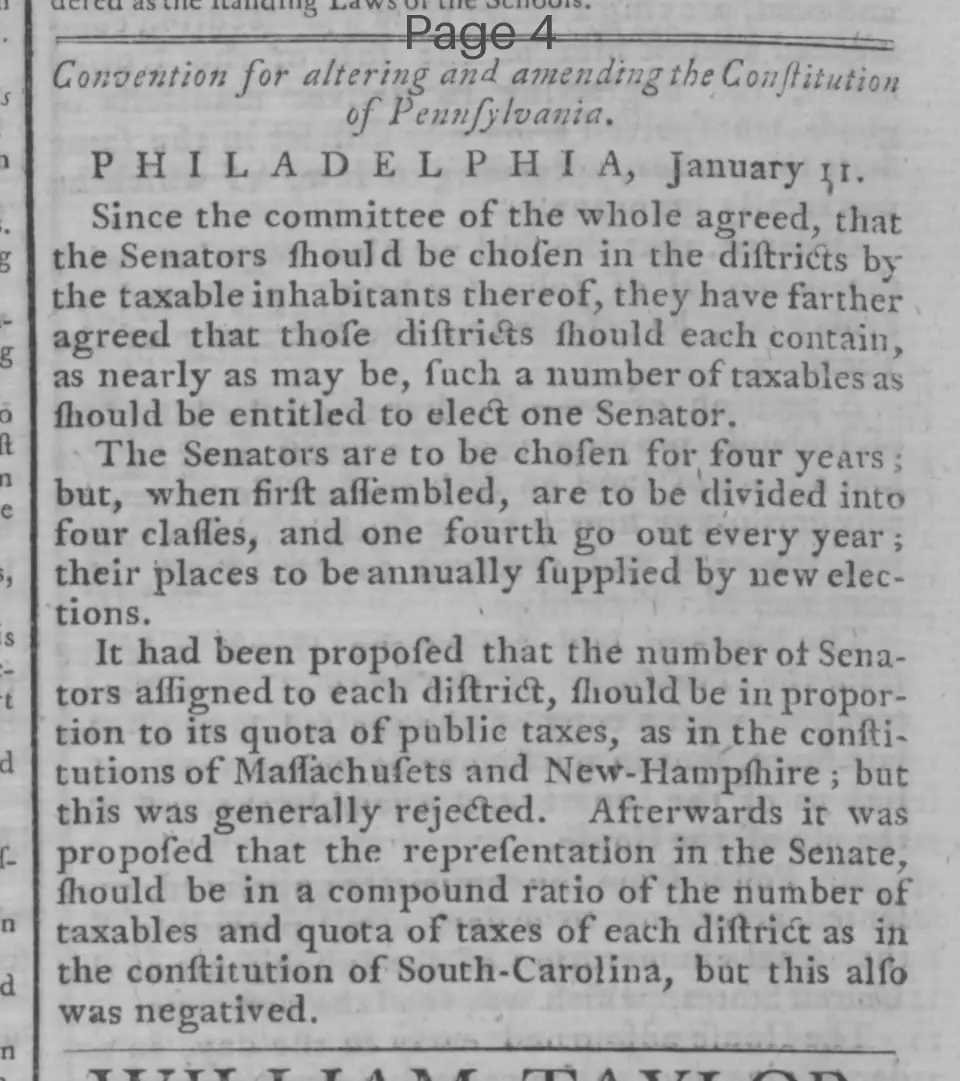
of Pennsylvania.
PHILADELPHIA, January 11.
Since the committee of the whole agreed, that
the Senators should be chosen in the districts by
the taxable inhabitants thereof, they have farther
agreed that those districts should each contain,
as nearly as may be, such a number of taxables as
should be entitled to elect one Senator.
The Senators are to be chosen for four years;
but, when first assembled, are to be divided into
four classes, and one fourth go out every year;
their places to be annually supplied by new elec-
tions.
It had been proposed that the number of Sena-
tors assigned to each district, should be in propor-
tion to its quota of public taxes, as in the conti-
tutions of Massachusetts and New-Hampshire; but
this was generally rejected. Afterwards it was
proposed that the representation in the Senate,
should be in a compound ratio of the number of
taxables and quota of taxes of each district as in
the constitution of South-Carolina, but this also
was negatived.
What sub-type of article is it?
What keywords are associated?
Where did it happen?
Domestic News Details
Primary Location
Philadelphia
Event Date
January 11
Event Details
The committee of the whole agreed that Senators should be chosen in districts by taxable inhabitants, with each district containing as nearly as possible the number of taxables entitled to elect one Senator. Senators serve four years, divided into four classes with one fourth replaced annually. Proposals for Senate representation proportional to public taxes (as in Massachusetts and New-Hampshire) or in a compound ratio of taxables and taxes (as in South-Carolina) were rejected.