Thank you for visiting SNEWPapers!
Sign up free
Alexandria Advertiser And Commercial Intelligencer
Alexandria, Virginia
What is this article about?
Memorial from American vessel owners in Buenos Aires detailing detentions and injustices by Spanish authorities against US ships involved in trade, freighting for slave importers, and seeking US government redress; includes a Spanish decree limiting foreign vessel exports.
Merged-components note: These components form a single continued foreign news article about American vessels detained by Spanish authorities in South America, split across columns.
Clipping
OCR Quality
Full Text
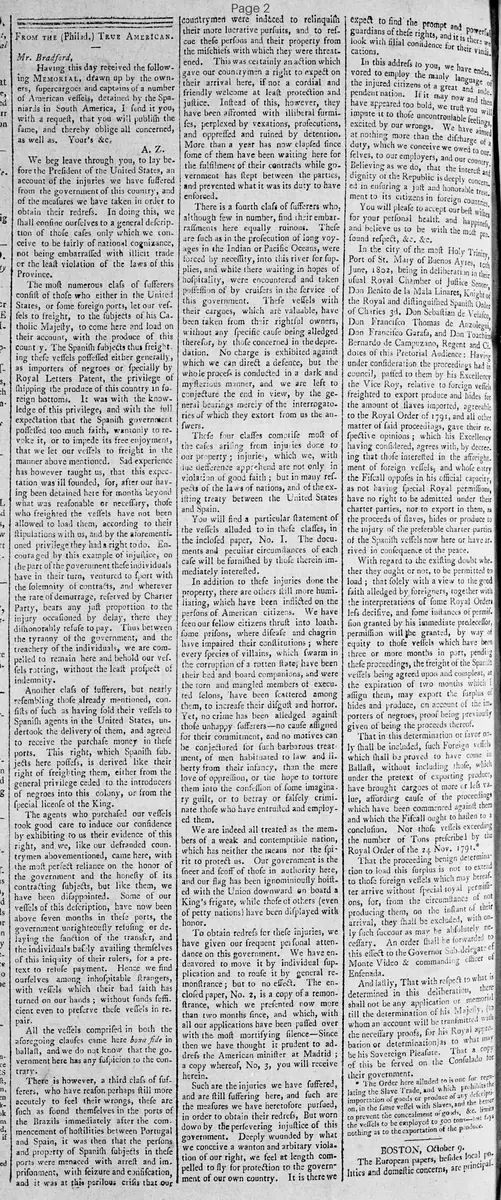
Mr. Bradford,
Having this day received the following
Memorial, drawn up by the owners,
supercargoes and captains of a number
of American vessels, detained by the Spaniards in South America, I send it to you,
with a request, that you will publish the
same, and thereby oblige all concerned,
as well as. Yours &c.
A. Z.
We beg leave through you, to lay before
the President of the United States, an
account of the injuries we have suffered
from the government of this country, and
of the measures we have taken in order to
obtain their redress. In doing this, we
shall confine ourselves to a general description
of those cases only which we conceive to be fairly
of national cognizance,
not being embarrassed with illicit trade
or the least violation of the laws of this
Province.
The most numerous class of sufferers
consist of those who either in the United
States, or some foreign ports, let our vessels
to freight, to the subjects of his Catholic
Majesty, to come here and load on
their account, with the produce of this
country. The Spanish subjects thus freighting
these vessels possessed either generally,
as importers of negroes or specially by
Royal Letters Patent, the privilege of
shipping the produce of this country in foreign
bottoms. It was with the knowledge
of this privilege, and with the full
expectation that the Spanish government
possessed too much faith, wantonly to revoke
it, or to impede its free enjoyment,
that we let our vessels to freight in the
manner above mentioned. Sad experience
has however taught us, that this expectation
was ill founded, for, after our having
been detained here for months beyond
what was reasonable or necessary, those
who freighted the vessels have not been
allowed to load them, according to their
stipulations with us, and by the aforementioned
privilege they had a right to do. Encouraged
by this example of injustice, on
the part of the government these individuals
have in their turn, ventured to sport with
the solemnity of contracts, and wherever
the rate of demurrage, reserved by Charter
Party, bears any just proportion to the
injury occasioned by delay, there they
dishonorably refuse to pay. Thus between
the tyranny of the government, and the
treachery of the individuals, we are compelled
to remain here and behold our vessels
rotting, without the least prospect of
indemnity.
Another class of sufferers, but nearly
resembling those already mentioned, consists
of such as having sold their vessels to
Spanish agents in the United States, undertook
the delivery of them, and agreed
to receive the purchase money in these
ports. This right, which Spanish subjects
here possess, is derived like their
right of freighting them, either from the
general privilege ceded to the introducers
of negroes into this colony, or from the
special license of the King.
The agents who purchased our vessels
took good care to induce our confidence
by exhibiting to us their evidence of this
right, and we, like our defrauded countrymen
abovementioned, came here, with
the most perfect reliance on the honor of
the government and the honesty of its
contracting subjects, but like them, we
have been disappointed. Some of our
vessels of this description, have now been
above even months in these ports, the
government unrighteously refusing or delaying
the sanction of the transfer, and
the individuals basely availing themselves
of this iniquity of their rulers, for a pretext
to refuse payment. Hence we find
ourselves among inhospitable strangers,
with vessels which their bad faith has
turned on our hands; without funds sufficient
even to preserve these vessels in repair.
All the vessels comprised in both the
aforegoing clauses came here bona fide in
ballast, and we do not know that the government
here has any suspicion to the contrary.
There is however, a third class of sufferers,
who have reason perhaps still more
acutely to feel their wrongs, these are
such as found themselves in the ports of
the Brazils immediately after the commencement
of hostilities between Portugal
and Spain, it was then that the persons
and property of Spanish subjects in these
ports were menaced with arrest and imprisonment,
with seizure and confiscation,
and it was at this perilous crisis that our
countrymen were induced to relinquish
their more lucrative pursuits, and to rescue
these persons and their property from
the mischiefs with which they were threatened.
This was certainly an action which
gave our countrymen a right to expect on
their arrival here, if not a cordial and
friendly welcome at least protection and
justice. Instead of this, however, they
have been affronted with illiberal surmises,
perplexed by vexatious, prosecutions
and oppressed and ruined by detention.
More than a year has now elapsed since
some of them have been waiting here for
the fulfilment of their contracts while government
has slept between the parties,
and prevented what it was its duty to have
enforced.
There is a fourth class of sufferers who,
although few in number, find their embarrassments
here equally ruinous. These
are such as in the prosecution of long voyages
in the Indian or Pacific Oceans, were
forced by necessity, into this river for supplies,
and while there waiting in hopes of
hospitality, were encountered and taken
possession of by cruisers in the service of
this government. These vessels with
their cargoes, which are valuable, have
been taken from their rightful owners,
without any specific cause being alleged
therefor, by those concerned in the depredation.
No charge is exhibited against
which we can direct a defence. but the
whole process is conducted in a dark and
mysterious manner, and we are left to
conjecture the end in view, by the general
bearings merely of the interrogatories of
which they extort from us the answers.
These four classes comprise most of
the cases arising from injuries done to
our property; injuries, which we, with
due deference apprehend are not only in
violation of good faith; but in many respects
of the laws of nations, and of the existing
treaty between the United States
and Spain.
You will find a particular statement of
the vessels alluded to in these classes, in
the enclosed paper, No. I. The documents
and peculiar circumstances of each
case will be furnished by those therein immediately
interested.
In addition to these injuries done the
property, there are others still more humiliating,
which have been inflicted on the
persons of American citizens. We have
seen our fellow citizens thrust into loathsome
prisons, where disease and chagrin
have impaired their constitutions; where
every species of villains, which swarm in
the corruption of a rotten state have been
their bed and board companions, and were
the torn and mangled members of executed
felons, have been scattered among
them, to increase their disgust and horror.
Yet, no crime has been alleged against
those unhappy sufferers-no cause assigned
for their commitment, and no motives can
be conjectured for such barbarous treatment,
of men habituated to law and liberty
from their infancy. than the mere
love of oppression, or the hope to torture
them into the confession of some imaginary
guilt, or to betray or falsely criminate
those who have entrusted and employed
them.
We are indeed all treated as the members
of a weak and contemptible nation,
which has neither the means nor the spirit
to protect us. Our government is the
scoff of those in authority here,
and our flag has been ignominiously hoisted
with the Union downward on board a
King's frigate, while those of others (even
of petty nations) have been displayed with
honor.
To obtain redress for these injuries, we
have given our frequent personal attendance
on this government. We have endeavored
to move it by individual application
and to rouse it by general remonstrance;
but to no effect. The enclosed paper, No. 2,
is a copy of a remonstrance, which we presented
now more than two months since,
and which, with all our applications have been
passed over with the most mortifying silence-
Since then we have thought it prudent to address
the American minister at Madrid;
a copy whereof, No, 3, you will receive
herein.
Such are the injuries we have suffered,
and are still suffering here, and such are
the measures we have heretofore pursued,
in order to obtain their redress, But worn
down by the persevering injustice of this
government. Deeply wounded by what
we conceive a wanton and arbitrary violation
of our right, we feel at length compelled
to fly for protection to the government of
our own country. It is there we
expect to find the prompt and powerful
guardians of these rights, and it is there we
look with filial confidence for their vindication.
In this address to you, we have endeavored
to employ the manly language of
the injured citizens of a great and independent
nation. If it may now and then
have appeared too bold, we trust you will
impute it to those uncontroulable feelings
excited by our wrongs. We have aimed
at nothing more than the discharge of a
duty, which we conceive we owed to ourselves,
to our employers, and our country.
Believing as we do, that the interest and
dignity of the Republic is deeply concerned
in ensuring a just and honorable treatment
to its citizens in foreign countries.
You will please to accept our best wishes
for your personal health. and happiness,
and believe us to be with the most profound
respect, &c. &c.
In the city of the most Holy Trinity,
Port of St. Mary of Buenos Ayres, 10th
June, 1802, being in deliberation in their
usual Royal Chamber of Justice Senore,
Don Benito de la Mala Linares, Knight of
the Royal and distinguished Spanish Order
of Charles 3d. Don Sebastian de Velasco,
Don Francisco Thomas de Anzolegui,
Don Francisco Garasa, and Don Joachim
Bernardo de Campuzano, Regent and Ciudadotes
of this Pretorial Audience: Having
under consideration the proceedings had in
council, passed to them by his Excellency
the Vice Roy, relative to foreign vessel
freighted to export produce and hides for
the amount of slaves imported, agreeable
to the Royal Order of 1791, and all other
matter of said proceedings, gave their respective
opinions; which his Excellency
having considered, agrees with, by decreeing
that those interested in the affreightment
of foreign vessels. and whose entry
the Fiscal opposes in his official capacity
as not having special Royal permissions.
have no right to be admitted under their
charter parties, nor to export in them, as
the proceeds of slaves, hides or produce to
the injury of the preferable charter parties
of the Spanish vessels now here or have arrived
in consequence of the peace
With regard to the existing doubt whether
they ought or not, to be permitted to
load; that solely with a view to the good
faith alleged by foreigners, together with
the interpretations of some Royal Orders
less decisive, and some instances of permission
granted by his immediate predecessor,
permission will be granted, by way of
equity to those vessels which have been
three or more months in port, pending
these proceedings, the freight of the Spanish
vessels being agreed upon and complete, at
the expiration of two months which I
assign them, may export the surplus of
hides and produce, on account of the importers
of negroes, proof being previously
given of being the proceeds thereof.
That in this determination or favor only
shall be included, such Foreign vessels
which shall be proved to have come in
Ballast, without including those, which
under the pretext of exporting produce
have brought cargoes of more or less value,
affording cause of the proceedings
which have been commenced against them
and which the Fiscal ought to hasten to a
conclusion. Nor those vessels exceeding
the number of Tons prescribed by the
Royal Order of the 24 Nov. 1791.*
That the proceeding benign determination
to load this surplus is not to extend
to those foreign vessels which may hereafter
arrive without special royal permissions,
for, from the circumstance of not
producing them, on the instant of their
arrival, they shall be excluded, with only
such succour as may be absolutely necessary.
An order shall be forwarded to
this effect to the Governor Subdelegate of
Monte Video &
commanding officer of
Ensenada.
And lastly, That with respect to what is
determined in this deliberation, there
shall not be any application or memorial
till the determination of his Majesty, (to
whom an account will be transmitted with
the necessary proofs, for his Royal approbation
or determination) as to what may
be his Sovereign Pleasure. That a copy
of this be served on the Consulado for
their government.
* The Order here alluded to is one for regulating
the Slave Trade, and which prohibits the
importation of goods or produce of any description
to prevent the concealment of goods. &c. limits
on, in the same vessel with Slaves, and the better
the vessels to be employed to 500 tons-but says
nothing as to the exportation of the produce.
What sub-type of article is it?
What keywords are associated?
What entities or persons were involved?
Where did it happen?
Foreign News Details
Primary Location
Buenos Ayres
Event Date
10th June 1802
Key Persons
Outcome
detention of american vessels for months; refusal to allow loading or transfer without special permissions; imprisonment of citizens without cause; limited equity permission for some vessels to export surplus after two months if in ballast and under tonnage limits; future arrivals excluded without royal permissions.
Event Details
American owners, supercargoes, and captains in Buenos Aires memorialize the US President about four classes of detained vessels: those freighted by Spanish subjects for exporting produce linked to slave imports; those sold to Spanish agents; those aiding Spanish subjects during Brazil hostilities; and those seized for supplies. They report violations of privileges, treaties, and laws of nations, plus humiliations like flag insults and imprisonments. A Spanish judicial decree limits foreign vessel exports to protect Spanish shipping, granting temporary equity to some detained ships.